


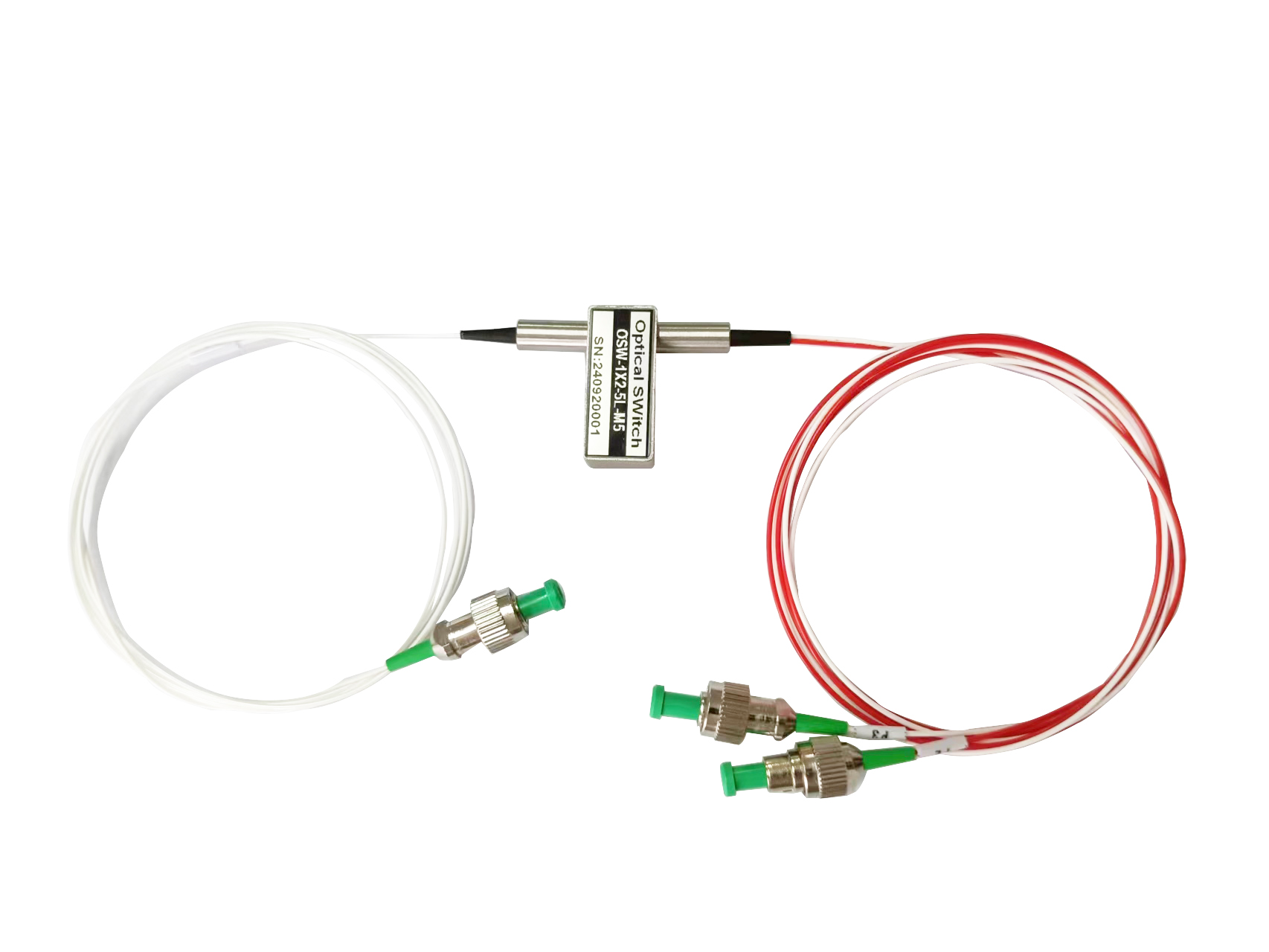
1×2 Mechanical Optical Switch: Automatic Primary/Backup Optical Path Switching Solution
In modern optical communication networks, data centers, and industrial fiber systems, link stability and reliability are critical. When the primary optical path fails, switching to a backup path in the shortest possible time to ensure uninterrupted service becomes a key design challenge. In this context, the automatic primary/backup switching solution based on a 1×2 mechanical optical switch offers a cost-effective and highly reliable protection mechanism.
1. What Is a 1×2 Mechanical Optical Switch?
1×2 mechanical optical switch is a device that uses physical movement to redirect optical signals between one input port and two output ports, enabling selective path switching.
Key features include:
- Low insertion loss (typically ≤1 dB)
- High isolation (≥50 dB)
- Excellent repeatability and stability
- Latching function (maintains state without power)
- Insensitive to wavelength and polarization (suitable for various applications)
Compared with MEMS or solid-state switches, mechanical switches have a simpler structure and stronger resistance to interference, making them ideal for high-reliability applications.
2. Working Principle of Automatic Primary/Backup Switching
In a redundancy protection system, the 1×2 mechanical optical switch enables a primary + backup architecture.
Operating logic:
- Normal Operation (Primary Path Active)
Optical signals are transmitted through the primary path, with the switch connected to Port 1 → Port 2. - Fault Detection
A monitoring unit (e.g., photodiode detector) continuously measures optical power. When the signal drops below a preset threshold (such as in the case of a link failure or severe attenuation), a fault is detected. - Automatic Switching
The control module sends a switching command, and the optical switch redirects the signal to the backup path (Port 1 → Port 3). - Recovery and Revert (Optional)
Once the primary path is restored, the system can switch back automatically or manually, depending on configuration.
3. System Architecture
A typical automatic switching system includes:
- 1×2 mechanical optical switch
- Optical power monitoring unit (photodiode, PD)
- Control circuit or MCU module
- Power management module
- Communication interface (e.g., RS232 / TTL)
The system relies on real-time monitoring and control logic to ensure fast and accurate switching between primary and backup paths.
4. Advantages of the Solution
- 1. High Reliability
- Mechanical switching ensures stable operation with minimal failure risk.
- 2. Fast Switching
- Typical switching time is in the millisecond range (10–20 ms), suitable for most communication systems.
- 3. Cost-Effective
- Compared to full optical protection systems (such as OLP), this solution is simpler and more economical.
- 4. Flexible Customization
- Supports various connector types (FC/SC/LC), fiber types (SM/MM/PM), and control interfaces.
5. Typical Applications
1. Optical Communication Networks
Used in backbone and access networks for link protection.
2. Data Centers
Provides redundancy between servers or inter-rack optical links.
3. Fiber Optic Sensing Systems
Ensures uninterrupted data transmission in critical monitoring scenarios, such as oil pipelines, bridges, and tunnels.
4. Laser and Scientific Systems
Offers backup transmission paths for high-power laser applications, preventing system interruption or equipment damage.
6. Design Considerations
When implementing this solution, consider:
- Switching threshold settings to avoid false triggering
- Switching delay optimization to maintain service continuity
- Environmental factors such as temperature and vibration
- Lifetime and reliability testing (mechanical switches typically support millions of cycles)
7. Conclusion
The 1×2 mechanical optical switch–based automatic primary/backup switching solution stands out for its simplicity, reliability, and cost efficiency. With proper system design and control logic, it enables rapid switching in the event of optical path failure, ensuring continuous operation.
For applications that demand high reliability with controlled budgets, this solution is an excellent choice.
Comments are closed