


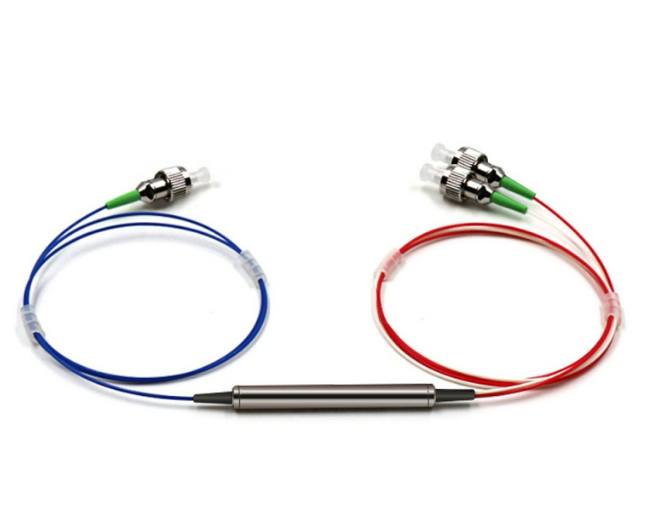
10W High Power PM Optical Circulator
Introduction
In the world of optical communication and laser systems, optical circulators play a pivotal role in directing light in specific paths without the need for mechanical switching. A high-power Polarization-Maintaining (PM) Optical Circulator designed for wavelengths ranging from 1310 nm to 1650 nm is an essential component in high-performance systems that require minimal loss and polarization control. These circulators are designed to operate with optical signals carrying power levels up to 10W, making them suitable for demanding applications in telecom, fiber-optic sensing, and laser systems.
What is an Optical Circulator?
An optical circulator is a non-reciprocal device that routes light signals in a specific, one-way direction through optical fibers. It operates based on the principles of Faraday rotation, a phenomenon where the polarization of light rotates when passing through a material under a magnetic field. A circulator essentially allows signals to flow from port 1 to port 2, and from port 2 to port 3, but it prevents the reverse flow of light, thereby providing effective isolation between different components of an optical system.
Polarization-maintaining (PM) optical circulator is specifically designed to preserve the polarization state of the optical signal. This is crucial in applications where the signal’s polarization must remain consistent for accurate measurements, efficient transmission, or effective signal processing.
Key Features of 10W High Power PM Optical Circulators (1310~1650 nm)
-
Broad Wavelength Range (1310~1650 nm)
-
The circulator operates across the widely used 1310 nm to 1650 nm wavelength range, which covers important communication bands like the C-band and L-band. This range is essential for fiber-optic communications, providing high capacity and low attenuation, making it ideal for long-distance transmission and high-data-rate applications.
-
-
High Power Handling (Up to 10W)
-
One of the standout features of this device is its ability to handle high power levels of up to 10W. This is particularly important in high-power applications such as fiber lasers, optical amplifiers, and optical sensing systems that require high signal strength and stability. The design ensures minimal signal distortion and reduces the risk of optical damage to the components.
-
-
Polarization-Maintaining (PM) Capability
-
The polarization-maintaining feature is essential for maintaining the integrity of the polarization state of light, which is vital in applications where polarization-sensitive components are used, such as fiber-optic sensors, polarization-division multiplexing (PDM) systems, and coherent communication systems. This functionality ensures that polarization-dependent losses (PDL) are minimized.
-
-
Low Insertion Loss
-
The optical circulator exhibits low insertion loss, meaning that the amount of light that is lost when passing through the device is minimal. This feature is critical for maximizing the power efficiency of the system and ensuring signal integrity over long distances.
-
-
Compact and Robust Design
-
The circulator’s design is compact yet robust, offering high durability and stability in harsh operating conditions. It is suitable for both laboratory environments and field applications, making it versatile for a wide range of industries and research areas.
-
-
High Isolation
-
High isolation between the input and output ports is essential to prevent signal interference and cross-talk between channels. This ensures the reliable operation of optical systems, especially in dense WDM (wavelength-division multiplexing) networks, where multiple channels are used simultaneously.
-
-
Temperature Stability
-
High power PM optical circulators are designed to be stable across a wide range of operating temperatures, ensuring consistent performance even in environments with fluctuating temperatures, such as outdoor field installations or industrial settings.
-
Applications of High Power PM Optical Circulators
-
Telecommunications and Fiber Optic Networks
-
High power PM optical circulators are commonly used in telecommunications to enable the efficient routing of signals in WDM systems, optical amplifiers, and fiber-optic networks. They help in isolating different channels, preventing unwanted back-reflections, and improving system reliability.
-
-
Fiber Optic Sensing
-
These circulators are widely used in fiber-optic sensors for applications such as temperature sensing, strain monitoring, and pressure sensing. They allow the precise routing of light in the sensor system while maintaining polarization control, ensuring accurate measurement and signal integrity.
-
-
Fiber Lasers and Amplifiers
-
In fiber lasers and amplifiers, maintaining the polarization of the light is crucial for ensuring optimal performance. The PM optical circulator helps in controlling the light’s path, ensuring that the polarization is preserved and that the system operates efficiently even at high power levels.
-
-
Coherent Communications
-
Coherent optical communication systems rely heavily on the polarization of light. High-power PM optical circulators are used to maintain the polarization states of signals, enabling high-performance communication over long distances, with minimal distortion or data loss.
-
-
Laser Systems and Research
-
High-power circulators are essential in laser systems, including research lasers and precision optical instruments, where controlled routing and polarization-maintaining performance are crucial for experiment accuracy and system efficiency.
-
Conclusion
High Power PM Optical Circulator (1310~1650 nm, 10W) is a vital component for modern optical systems that demand high-performance, efficient signal routing, and polarization control. Its ability to handle high power levels while maintaining signal integrity makes it indispensable in fields like telecommunications, fiber-optic sensing, laser systems, and coherent communications. As optical technologies continue to advance, these circulators will play a critical role in enabling the next generation of high-speed, high-capacity optical networks and sensors.
Comments are closed