


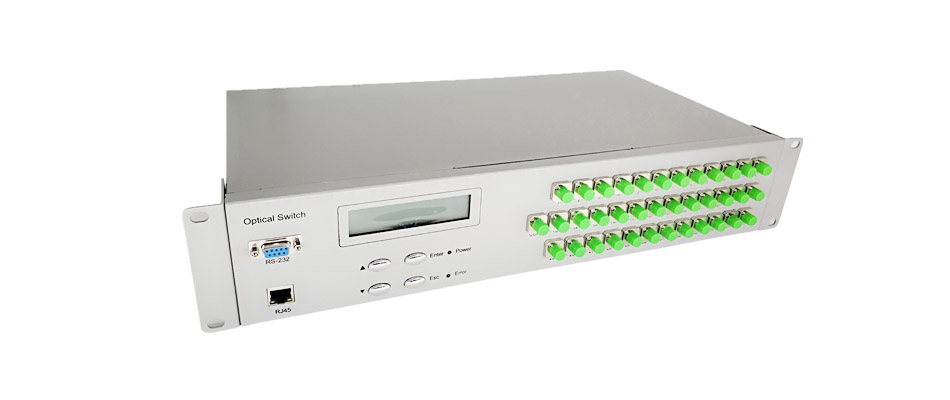
1×36 Single-Mode Rack-Mount Optical Switch: The Core Hub for High-Density Optical Path Management
In modern optical communication networks, data centers, and test & measurement fields, the increasing scale of networks and complexity of services have created a growing demand for flexible, reliable, and centralized management of fiber optic links. The 1×36 Single-Mode Rack-Mount Optical Switch is a critical device that has emerged in this context, serving as an intelligent “traffic hub” for optical path scheduling and management.
I. Overview
The 1×36 Single-Mode Rack-Mount Optical Switch is an optical matrix switching device based on advanced opto-mechatronic technology. Its core function is to dynamically route an optical signal from one common input port to any one of 36 independent output ports via electrical control, with the entire process being transparent to the optical signal (i.e., it does not alter the signal content).
- 1×36: Denotes its port configuration—one common input port and 36 independent output ports.
- Single-Mode: Indicates that the device is designed for single-mode fiber, typically operating at standard communication wavelengths such as 1310nm, 1490nm, and 1550nm. It features low loss and high bandwidth, making it suitable for long-distance, high-capacity communication.
- Rack-Mount: Refers to its design as a standard 19-inch rack-mountable unit, commonly 1U or 2U in height. This facilitates centralized deployment in standard server racks within equipment rooms or data centers, enabling high-density integration and unified management.
Internally, the device typically employs Micro-Electro-Mechanical Systems (MEMS) technology or precision stepper motor-driven mirrors to achieve high-speed, accurate optical path switching on the order of nanoseconds or milliseconds.
II. Key Features
- High Port Density and Integration: Provides up to 36 channels of switching capability within a compact 1U or 2U space, significantly saving equipment room space, simplifying cabling, and making it an ideal choice for building compact optical network nodes.
- Low Insertion Loss and High Stability: Utilizes high-quality optical components and precision alignment technology to ensure low and uniform insertion loss across all channels. It offers excellent temperature and mechanical stability, guaranteeing reliable performance over long-term operation.
- High-Speed Switching and High Isolation: Switching time is typically on the order of milliseconds, meeting the speed requirements for most protection switching and test automation scenarios. It provides very high port-to-port isolation (usually >50dB), effectively preventing channel crosstalk and ensuring signal integrity.
- Remote Intelligent Control: Supports multiple control interfaces such as RS-232, RS-485, Ethernet (Telnet/SNMP), and GPIB. Users can easily execute port switching, status queries, and other operations via local serial ports or remote network commands, facilitating integration into automated management systems.
- Excellent Reliability: All-optical design with no optical-electrical-optical conversion, avoiding electronic bottlenecks. Its passive component characteristics contribute to a long lifespan and high Mean Time Between Failures (MTBF). Some models support redundant power supplies, further ensuring 24/7 uninterrupted operation.
- Protocol Transparency: As a physical layer device, it is completely transparent to signal protocols, data rates, and modulation formats. It can be widely deployed in various network environments such as SDH/SONET, Ethernet, OTN, and Fibre Channel.
III. Primary Application Areas
- Optical Network Protection and Restoration: Serves as a key execution unit for Optical Line Protection (OLP) or optical channel protection switching in backbone and metropolitan area networks. In the event of a failure in the primary fiber link, it can rapidly switch services to a backup route, significantly enhancing network survivability.
- Test & Measurement Automation:
- Multi-Device Testing: Connects a single, expensive test instrument (e.g., OTDR, optical power meter, optical spectrum analyzer) to multiple fibers under test via the optical switch, enabling automated polling tests. This greatly improves testing efficiency and reduces capital equipment expenditure.
- Production Line Testing: Used in automated test systems for optical components and modules, enabling rapid, high-volume performance verification.
- Data Centers and Cloud Networks:
- Fiber Resource Scheduling: Enables flexible configuration and reconfiguration of optical connections between server clusters, storage devices, and core switches within large data centers, supporting dynamic service deployment.
- Network Functions Virtualization Infrastructure (NFVi): Provides flexible connectivity for physical network resource pools, supporting NFV architectures.
- Laboratory and Research Systems: Used to construct complex optical experimental platforms, such as sensor networks, quantum communication experiments, or multi-user shared experimental setups, enabling programmable control of optical paths.
- Military and Security Communications: Used to build highly reliable, reconfigurable dedicated communication networks that meet requirements for rapid deployment and survivability in special environments.
- Cable Television (CATV) Networks: Enables backup and switching of optical node signals, ensuring uninterrupted transmission of broadcast television signals.
IV. Conclusion
In summary, with its characteristics of high density, high reliability, and intelligence, the 1×36 Single-Mode Rack-Mount Optical Switch has become an indispensable piece of intelligent hardware in modern optical network infrastructure. It not only addresses the challenges of complex and inefficient management in large-scale fiber optic networks but also provides robust physical-layer support for network automation, intelligent testing, and flexible resource scheduling. As initiatives like 5G, All-Optical Networks, and the “East Data West Computing” project advance, the value of such high-performance optical switches will become even more prominent, continuously empowering the development of the optical communication industry.
Comments are closed