


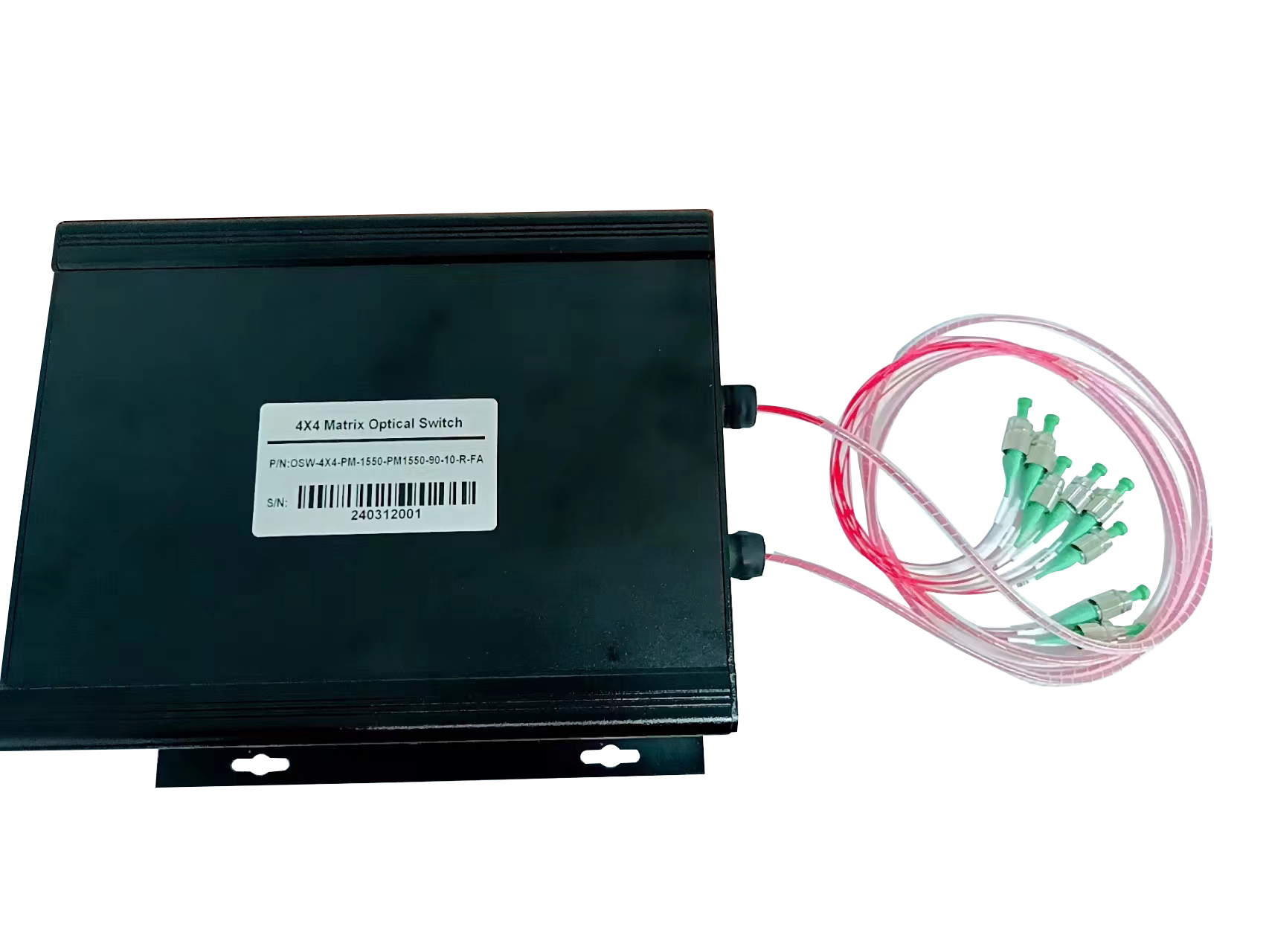
Polarization-Maintaining Optical Switch Wavelength Selection Guide
1. Introduction
Polarization-maintaining optical switch (PM optical switch) is a key optical device that enables optical path switching while maintaining the polarization state of the input light. It is widely used in polarization-sensitive systems such as fiber optic sensing, quantum communication, coherent optical communication, and lidar. Wavelength selection is a core aspect of ensuring the performance and system compatibility of PM optical switches; incorrect selection will directly lead to increased insertion loss, worsened polarization crosstalk, and even system failure.
2. Core Concept: Why Wavelength is Crucial
The characteristics of light propagation in waveguides or optical fibers strongly depend on the wavelength (λ). For PM optical switches, the wavelength influence is mainly reflected in the following aspects:
* Material dispersion and waveguide dispersion: The refractive index of the materials (such as SiO₂, LiNbO₃, polymers, etc.) that constitute the optical switch varies with wavelength, leading to changes in optical path difference and phase matching conditions.
* Polarization characteristics: The beat length (L_B) of polarization-maintaining fibers or waveguides is related to the wavelength. L_B(λ) = λ / Δn(λ), where Δn is the effective refractive index difference of orthogonal polarization modes. Deviation of the operating wavelength from the design value will change the birefringence and affect the polarization maintenance effect.
* Device design specifications: The key performance parameters of optical switches, such as insertion loss (IL), polarization-dependent loss (PDL), polarization crosstalk (XT), and extinction ratio (ER), are usually specified at a specific wavelength (or wavelength band).
3. Key Steps and Considerations for Wavelength Selection
Step 1: Determine the System Operating Wavelength
First, you must determine the operating wavelength of your entire optical system. Common wavelength bands include:
- O-band: 1260 nm – 1360 nm (original band, used in some sensing applications)
- E-band: 1360 nm – 1460 nm (extended band)
- S-band: 1460 nm – 1530 nm
- C-band: 1530 nm – 1565 nm (most commonly used for DWDM, high-speed communication)
- L-band: 1565 nm – 1625 nm (used for DWDM extension)
- Special wavelengths: 780 nm, 850 nm, 980 nm, 1064 nm, 1310 nm, 1550 nm, etc. (commonly used for pump lasers, sensing, and specific laser systems).
Conclusion 1: The center wavelength of the selected optical switch must cover or match the system’s operating wavelength.
Step Two: Evaluate Wavelength-Related Performance Changes
In the datasheet, performance parameter tables or graphs will show how parameters change with wavelength.
. Insertion Loss vs. Wavelength: Usually lowest at the center wavelength and slowly increases towards both sides. It is necessary to confirm whether the IL is acceptable at the system wavelength.
. Polarization Crosstalk vs. Wavelength: This is one of the most sensitive indicators for PM devices. Crosstalk may deteriorate sharply at specific wavelengths. It must be ensured that the XT at the system wavelength is better than the system requirements (for example, quantum communication systems may require XT < -35 dB).
. Polarization Dependent Loss vs. Wavelength: PDL should also be within a low and stable range.
Conclusion 2: It is important not only to look at the performance at the center wavelength but also to evaluate the flatness and stability of the performance across the entire operating wavelength band.
Step Three: Consider the Coupling Effect of Temperature and Wavelength
Temperature changes cause thermo-optic effects and thermal expansion of the material, leading to changes in the effective optical length and birefringence of the device, which is equivalent to a shift in the operating wavelength. The datasheet will provide the wavelength temperature drift coefficient (e.g., pm/°C). For wide operating temperature ranges (such as -40°C to 85°C), the wavelength drift across the entire temperature range needs to be calculated, ensuring that the drifted range remains within the device’s operating wavelength range.
Conclusion 3: In harsh temperature environments, a “wavelength-temperature” combined verification is necessary.
4. Wavelength Characteristics of Different Types of PM Optical Switches
• Mechanical PM Optical Switches: Based on the physical movement of polarization-maintaining fibers. Their wavelength characteristics are mainly affected by the type of polarization-maintaining fiber used (e.g., Panda type, Bow-tie type) and the filtering elements. They usually have a wide bandwidth, but alignment is difficult.
• MEMS PM Optical Switches: Based on micromirror reflection. Wavelength characteristics are determined by the mirror coating bandwidth and polarization-maintaining fiber alignment. The coating design determines the wavelength range with high reflectivity.
• Waveguide PM Optical Switches (e.g., LiNbO₃, PLC): Based on interference or electro-optic effects. They have the highest wavelength sensitivity, and the operating bandwidth is usually narrow (tens of nanometers), requiring strict matching to the design wavelength.
• Magneto-optic/Thermo-optic PM Optical Switches: Wavelength characteristics are determined by the Faraday rotator material or the waveguide thermo-optic coefficient.
Selection Recommendation: If the system operating wavelength is fixed, waveguide type is a high-performance choice; if a wide bandwidth or tunability is required, mechanical or MEMS types are more suitable.
5. Summary and Final Recommendations
• Matching First: The primary principle is that the device’s nominal center wavelength matches the system’s core wavelength.
• Range Coverage: The device’s operating wavelength range must completely cover all possible wavelengths of the system.
• Performance Verification: Focus on polarization crosstalk and insertion loss at both ends of the actual operating wavelength band, not just at the center point.
• Environmental Considerations: In applications with large temperature variations, wavelength drift must be included in the calculations.
• Practical Testing is Key: Before final system integration, it is strongly recommended to use a tunable laser and a polarization analyzer to test the performance indicators of the optical switch at the actual operating wavelength. This is the most reliable verification method.
Comments are closed