


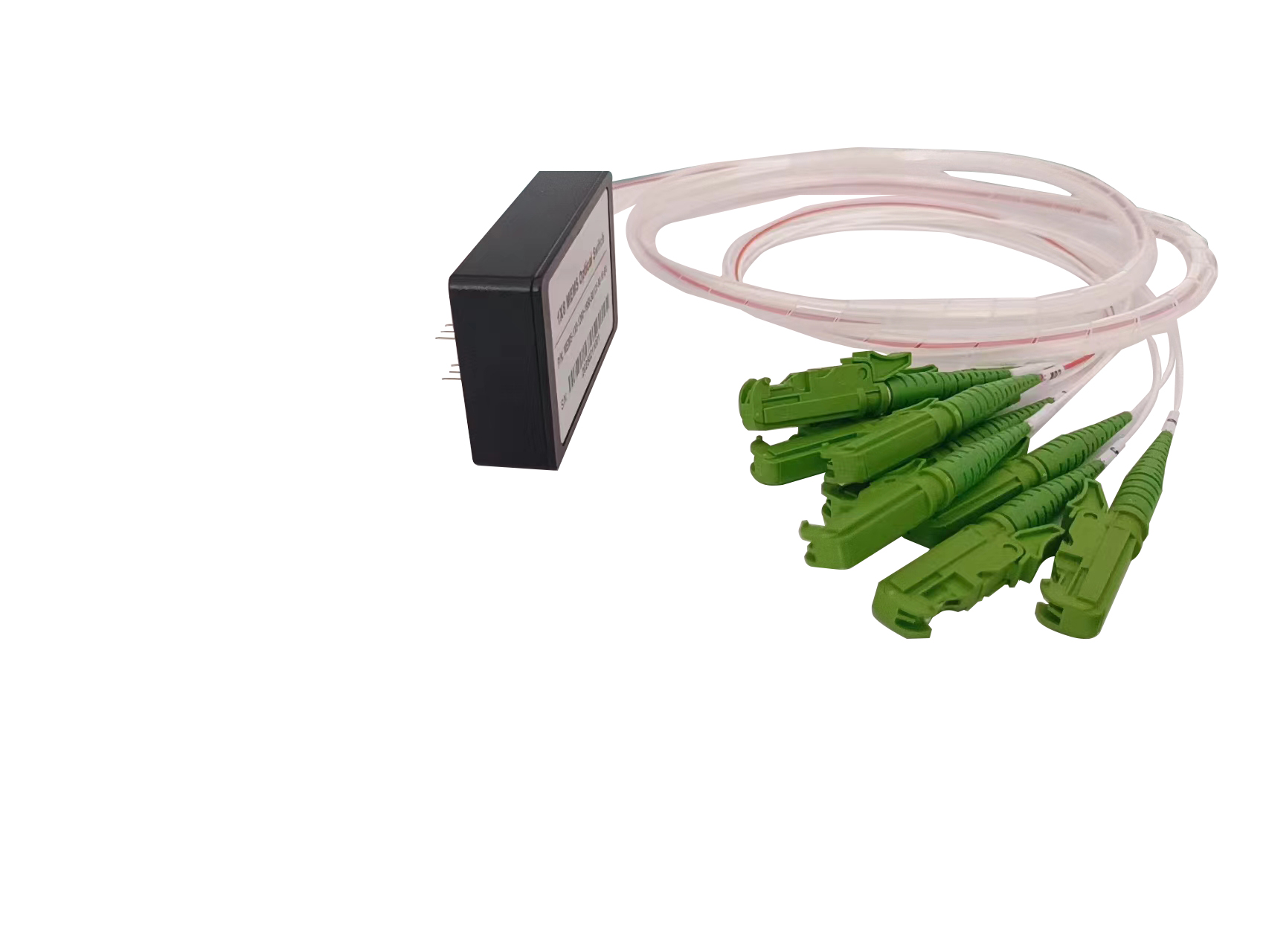
1X32 MEMS Optical Switch Selection Guide
MEMS (Micro-Electromechanical Systems) optical switches are essential components in modern optical communication systems, widely used in data centers, optical fiber communication, fiber optic sensors, and more. A 1X32 MEMS optical switch can route an optical signal from one input port to one of 32 output ports, making it an efficient optical routing device. When selecting the right 1X32 MEMS optical switch, it is crucial to consider both the switch’s technical parameters and the compatibility with fiber types to ensure optimal system performance.
This guide will help you understand the key technical parameters of the 1X32 MEMS optical switch, the matching of fiber types, and how to choose the most suitable optical switch based on your actual requirements.
1. Overview of 1X32 MEMS Optical Switch
1X32 MEMS optical switch is an optical switch based on MEMS technology, capable of routing optical signals from one input port to one of 32 output ports. It is used in various fields, including fiber optic communication, data centers, optical sensors, and testing & monitoring. The features of MEMS optical switches include:
-
High Performance: Low insertion loss, low crosstalk, and fast response time.
-
Compact Size: MEMS technology allows for a small and compact design, making integration and deployment easier.
-
High Reliability: MEMS optical switches have long lifespans and high stability, suitable for various demanding environments.
-
Multi-Wavelength Support: Capable of working across multiple wavelengths, meeting the multi-wavelength transmission requirements of modern optical communication.
2. Key Technical Parameters
When selecting the right 1X32 MEMS optical switch, several key parameters should be considered:
2.1 Wavelength Range
1X32 MEMS optical switches typically support the C-band (1530-1565 nm) and L-band (1570-1610 nm). The wavelength selection depends on your application needs:
-
C-Band: Commonly used for most fiber optic communication systems.
-
L-Band: Suitable for certain specific applications, especially in long-distance fiber transmission.
2.2 Insertion Loss (IL)
Insertion loss refers to the loss of optical power as the signal passes through the switch. MEMS optical switches typically have low insertion loss, usually less than 1 dB. Low insertion loss is crucial for efficient signal transmission and system performance.
2.3 Crosstalk
Crosstalk refers to the leakage of light into other ports when the signal is routed from one port to another. High-quality MEMS optical switches should have low crosstalk, typically below -50 dB, to ensure signal integrity.
2.4 Response Time
Response time is the time required for the optical switch to switch from one port to another. For most applications, the response time should be in the millisecond range. The faster the response time, the better the dynamic performance of the system, making it ideal for high-frequency switching applications.
2.5 Port Configuration
A 1X32 MEMS optical switch has one input port and 32 output ports. Depending on the specific requirements, other configurations such as 1X8, 1X16, or 1X32 are available.
2.6 Reliability
The reliability of the optical switch directly impacts the stability and lifespan of the system. When selecting a MEMS optical switch, you should ensure that it has a long lifespan and low failure rate, making it suitable for long-term, high-frequency use.
3. Fiber Type Selection
Fiber type plays a critical role in the performance and stability of the optical switch. Different fiber types have different optical properties, so it is essential to choose compatible fibers when selecting an optical switch. The following are the common types of optical fibers:
3.1 Single-Mode Fiber (SMF)
-
Applications: Used for long-distance, high-speed fiber optic communication, widely used in optical communications, metropolitan area networks (MANs), and long-haul transmission.
-
Fiber Characteristics: Small core diameter (8-10 µm), supports only a single mode of light transmission, resulting in low loss and dispersion.
-
Compatibility with 1X32 MEMS Optical Switch: Single-mode fiber is the most common choice for MEMS optical switches, especially in optical communication and high-efficiency network systems. The switch ports typically use LC/SC/FC connectors to ensure seamless integration with single-mode fibers.
3.2 Multi-Mode Fiber (MMF)
-
Applications: Suitable for short-distance applications, such as data centers, local area networks (LANs), and fiber optic sensors.
-
Fiber Characteristics: Larger core diameter (50 µm or 62.5 µm), supports multiple modes of light transmission, ideal for high-capacity short-distance transmission.
-
Compatibility with 1X32 MEMS Optical Switch: Multi-mode fibers are suitable for data centers and LAN applications. In this case, the optical switch ports can use MTP/MPO connectors, which are compatible with multi-mode fibers for short-distance high-capacity transmission.
3.3 Fiber Jumper
-
Applications: Used to connect devices in optical transmission links, supports both single-mode and multi-mode fibers.
-
Compatibility with 1X32 MEMS Optical Switch: Fiber jumpers are commonly used for interconnecting devices. Choose jumpers that match both the optical switch ports and fiber types.
3.4 High-Power Fiber
-
Applications: Designed for high-power laser systems, industrial applications, and high-power optical transmission.
-
Fiber Characteristics: Specially designed to handle high-power optical signals, often used in industrial laser applications.
-
Compatibility with 1X32 MEMS Optical Switch: High-power fibers require optical switches that can withstand high-power transmission. Make sure the optical switch has the necessary power handling capacity to prevent damage.
4. Applications
1X32 MEMS optical switches are widely used in the following fields:
-
Optical Communication Networks: Including metropolitan area networks (MAN), long-haul transmission networks, and fiber to the x (FTTX). MEMS optical switches enable efficient signal routing to support large-scale data transmission needs.
-
Data Centers: In data centers, MEMS optical switches route optical signals for efficient data transmission and multi-wavelength transmission.
-
Fiber Optic Sensors: In fiber optic sensor applications, MEMS optical switches can be used to select different sensor nodes for precise optical signal collection.
-
Testing and Monitoring: MEMS optical switches can be used in optical fiber network testing and monitoring to quickly detect and analyze fiber link performance.
5. Selection Recommendations
-
General Optical Communication Applications: For most optical communication applications, it is recommended to choose a 1X32 MEMS optical switch with a C-band wavelength, insertion loss less than 1 dB, and crosstalk lower than -50 dB.
-
Data Center Applications: For data centers or short-distance applications, choose a 1X32 MEMS optical switch with low insertion loss, fast response time, and multi-wavelength support for efficient data transmission.
-
High-Power Applications: If the application involves high-power transmission, select a MEMS optical switch with high power handling capacity and ensure compatibility with fibers designed for high-power transmission.
6. Conclusion
The 1X32 MEMS optical switch is an efficient optical routing device that meets the needs of various optical communication and data transmission applications. When selecting the right switch, it is crucial to consider technical parameters such as wavelength range, insertion loss, crosstalk, response time, and port configuration, along with fiber type compatibility. Ensuring compatibility between the optical switch and fiber type will optimize the system’s performance and stability.
By considering the above parameters, you can choose the most suitable 1X32 MEMS optical switch for your application, ensuring efficient operation and long-term reliability.For further parameter customization, please contact our sales representative.
Comments are closed