


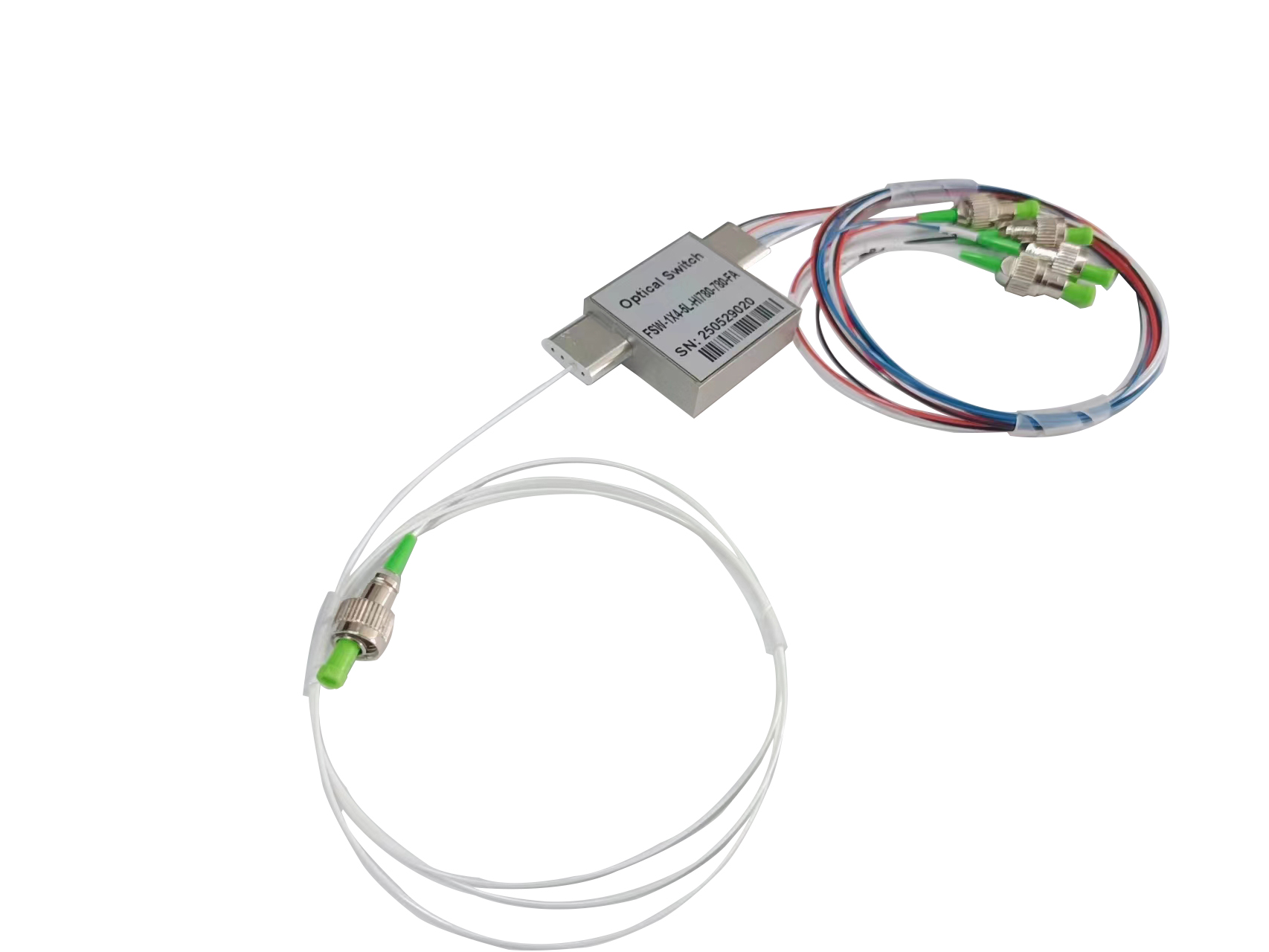
Passive Tilt Sensor Based on Optical Switch: A Power-Free Solution for Precise Tilt Monitoring
1. Introduction
In applications such as industrial safety monitoring, structural health monitoring, and harsh environments (e.g., high voltage, strong electromagnetic interference, or explosive atmospheres), accurate tilt measurement is critically important.
Traditional electronic tilt sensors are widely used, but they typically require a power supply and are susceptible to electromagnetic interference (EMI), temperature drift, and environmental limitations.
A passive tilt sensor based on an optical switch provides a new approach by converting mechanical tilt into optical signal variation—without requiring any local power supply. This makes it highly reliable and especially suitable for demanding environments.
2. Working Principle
The system operates based on optical switching and optical path deviation:
- A stable optical signal is transmitted from a remote light source through an optical fiber.
- The sensor integrates a mechanical or MEMS optical switch structure, including collimators, mirrors, or fiber alignment components.
- When tilt occurs, a gravity-driven micro-mechanical structure shifts, causing the optical beam to deviate from its original path.
- This deviation results in either optical power variation or channel ON/OFF switching at the output.
- The tilt condition is determined by monitoring the output optical signal.
In essence, the system converts tilt (mechanical change) into optical signal change.
3. System Configuration
A complete passive tilt sensing system typically includes:
- Remote light source
- Optical fiber transmission link
- Optical switch-based tilt sensor
- Optical receiver or power detector
- Data acquisition and alarm system
The sensing unit itself is fully passive and requires no electrical power.
4. Key Advantages
4.1 Passive Operation
- No electrical power required at the sensing point
- No local wiring needed
- Suitable for high-voltage, hazardous, or remote environments
4.2 Strong EMI Immunity
- Immune to electromagnetic interference
- Ideal for substations, rail systems, and industrial environments
4.3 High Reliability
- Simple mechanical structure
- No electronic component aging
- Long operational lifetime
4.4 High Sensitivity and Fast Response
- Small tilt angles produce noticeable optical changes
- Response time can reach milliseconds
4.5 Long-Distance Monitoring
- Optical fiber enables transmission over kilometers
- Supports centralized monitoring systems
5. Typical Structural Types
5.1 Mechanical Optical Switch Type
- Uses gravity mass or pendulum structures
- Tilt alters fiber alignment
- Robust and cost-effective
5.2 MEMS Optical Switch Type
- Uses micro-electromechanical systems
- Higher precision and faster response
- Suitable for high-accuracy applications
5.3 Continuous Optical Power Variation Type
- Tilt changes coupling efficiency
- Enables continuous angle measurement rather than simple switching
6. Application Scenarios
Power Systems
- Transmission tower tilt monitoring
- Substation equipment stability monitoring
Civil Engineering & Structural Health
- Bridge tilt monitoring
- Building settlement detection
- Tunnel deformation monitoring
Oil & Gas / Chemical Industry
- Storage tank tilt detection
- Pipeline support monitoring
Rail Transportation
- Track stability monitoring
- Ground subsidence warning
Aerospace & Harsh Environments
- Strong EMI conditions
- Extreme temperatures
7. Comparison with Traditional Tilt Sensors
| Feature | Optical Switch Passive Tilt Sensor | Electronic Tilt Sensor |
|---|---|---|
| Power Supply | Not required | Required |
| EMI Immunity | Excellent | Moderate |
| Safety | High (no sparks) | Potential risk |
| Transmission Distance | Very long (fiber-based) | Limited |
| Accuracy | High | Medium to high |
| Environmental Adaptability | Excellent | Moderate |
8. Future Development Trends
Future advancements will focus on:
- Higher precision (micro-radian level)
- Integration with fiber optic sensing networks
- Intelligent monitoring with AI-based analysis
- Multi-parameter sensing (tilt, vibration, temperature)
As optical technologies continue to evolve, costs will decrease, enabling wider adoption across industries.
9. Conclusion
The passive tilt sensor based on optical switches offers a power-free, highly reliable, and EMI-immune solution for tilt monitoring.
With its advantages in safety, durability, and long-distance capability, it is expected to play an increasingly important role in smart infrastructure, energy systems, and industrial monitoring applications.
Comments are closed