


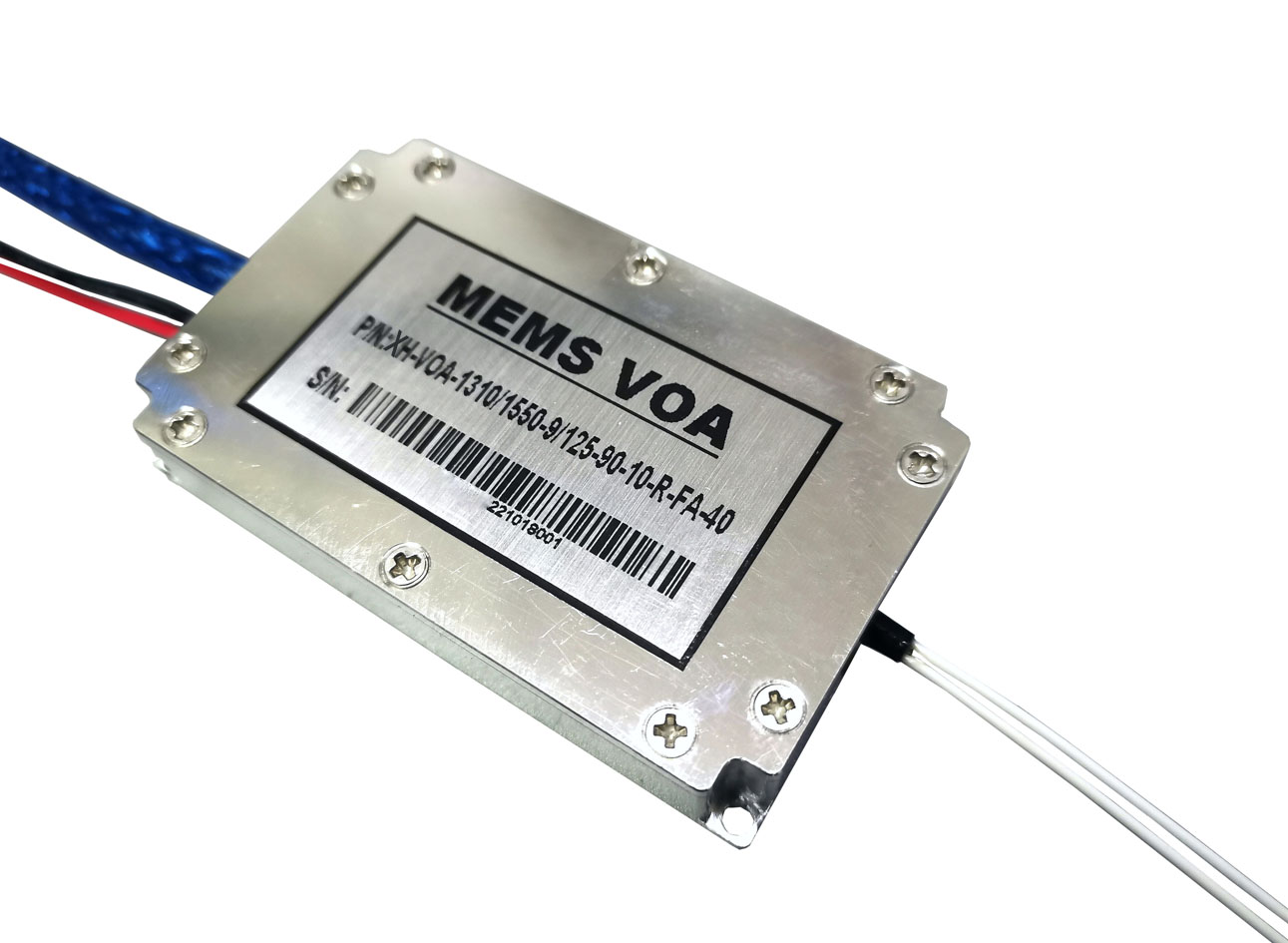
MEMS VOA Module: The Precision “Optical Valve” in Optical Communication Networks
In rapidly evolving optical communication networks, the ability to precisely control optical signals is critical to system stability and transmission quality. Among the key components, the MEMS VOA (Micro-Electro-Mechanical System Variable Optical Attenuator) acts like a highly sensitive “optical valve,” playing an indispensable role in complex optical networks.
1. What is a MEMS VOA?
MEMS VOA is a device based on micro-electro-mechanical system technology that enables precise adjustment of optical power. Its primary function is to provide continuous or discrete attenuation of optical signals.
Simply put, it works like a “dimmer switch” for light, allowing real-time control of signal strength according to system requirements.
2. Working Principle
The core of a MEMS VOA lies in the integration of micro-mechanical structures with optical systems. Typical operating mechanisms include:
- Micromirror deflection type: Adjusts attenuation by changing the coupling efficiency through micromirror angle variation
- Shutter/obstruction type: Partially blocks the optical path to reduce output power
- Displacement-based type: Alters the position of optical fibers or components to affect coupling efficiency
These microstructures are typically driven by electrical signals, enabling high-precision and low-power control.
3. Key Advantages
- 1. High Precision Control
- MEMS structures enable nanometer-scale displacement control, ensuring fine and accurate attenuation adjustment.
- 2. Low Insertion Loss
- Compared to traditional mechanical or thermo-optic VOAs, MEMS VOAs offer lower insertion loss in the unattenuated state.
- 3. Fast Response
- MEMS actuation provides rapid response, typically in the millisecond range or faster.
- 4. High Reliability
- Manufactured using mature semiconductor processes, MEMS VOAs offer excellent stability and long operational lifetime.
- 5. Compact Size & Easy Integration
- Their small form factor makes them ideal for integration into optical modules, amplifiers, and complex network systems.
4. Typical Applications
- 1. Optical Power Equalization
- In WDM (Wavelength Division Multiplexing) systems, MEMS VOAs are used to dynamically balance power levels across different channels.
- 2. EDFA Gain Control
- In Erbium-Doped Fiber Amplifiers (EDFA), VOAs help stabilize output power and prevent signal distortion or saturation.
- 3. Optical Protection & Switching Systems
- In protection systems such as OLP, VOAs assist in ensuring smooth power transitions during switching.
- 4. Test and Measurement Equipment
- Used in laboratories and production environments for precise optical signal control and calibration.
- 5. Data Centers & High-Speed Communication
- Applied in high-speed optical modules and data center networks for link optimization and dynamic adjustment.
5. Comparison with Other VOA Technologies
| Technology | Advantages | Disadvantages |
|---|---|---|
| MEMS VOA | High precision, low loss, fast response | More complex structure, higher cost |
| Thermo-optic VOA | Low cost, simple design | High power consumption, slow response |
| Mechanical VOA | High stability | Large size, slow response |
MEMS VOAs strike a strong balance between performance and efficiency, making them a preferred choice in advanced optical communication systems.
6. Development Trends
With the rapid growth of 5G, data centers, and high-speed optical communication (such as 400G/800G), higher demands are being placed on optical power control. MEMS VOAs are evolving in the following directions:
- Higher precision and lower insertion loss
- Greater miniaturization and integration (e.g., integration with optical switches and modules)
- Enhanced reliability for harsh environments
- Intelligent control (integrated with automatic power management systems)
7. Conclusion
As a precision “optical valve” in optical communication networks, the MEMS VOA module plays a vital role in ensuring signal quality and optimizing system performance. As networks continue to evolve toward higher speed and complexity, the importance of MEMS VOA technology will only increase.
In the future era of fully optical networks, this small yet powerful component will continue to support efficient and reliable data transmission.
Comments are closed