


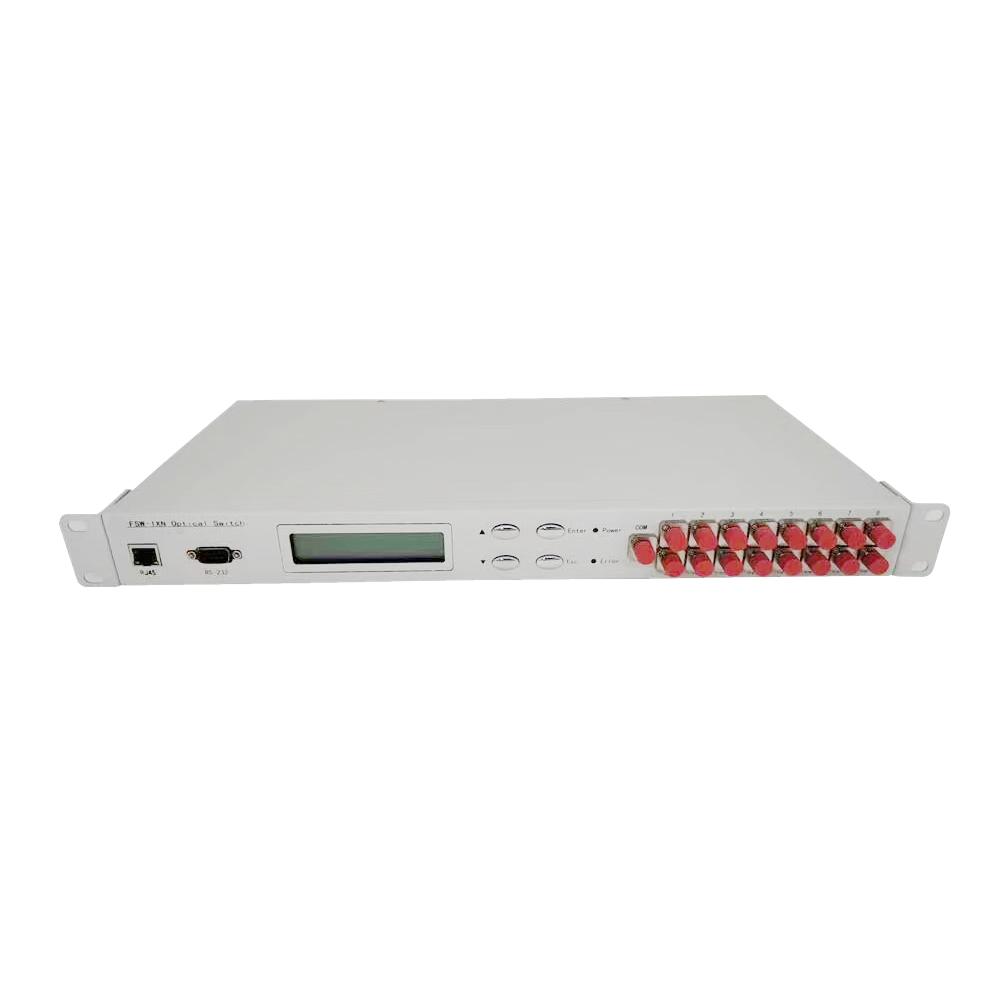
Rack-Mount Optical Switch in Data Centers and Fiber Optic Sensing: Automated Testing and Protection Switching Solutions
With the rapid development of data centers, high-speed optical interconnection, and fiber optic sensing systems, the demand for network stability, automation, and efficient maintenance continues to grow. As a key component in optical communication systems, rack-mount optical switch are widely used in data center link management, fiber monitoring, automated testing, and network protection switching applications.
Compared with traditional manual fiber patching, rack-mount optical switches enable fast, stable, and remote optical path switching, significantly improving system efficiency and reliability.
What Is a Rack-Mount Optical Switch?
Rack-mount optical switch is an optical path switching device integrated into a standard rack chassis, allowing automatic switching between different optical fiber channels through software or control interfaces.
Common configurations include:
- 1×N optical switches
- N×N matrix optical switches
- Bidirectional optical switches
- Multi-channel modular optical switching systems
Typical supported interfaces include:
- RS232 / RS485 control
- Ethernet network control
- (Customizable)
The rack-mount design is ideal for centralized deployment and long-term stable operation in data centers and laboratory environments.
Applications in Data Centers
1. Automatic Optical Link Protection Switching
In data centers, network stability is critical. When the primary optical link experiences issues such as:
- Fiber breakage
- Optical power degradation
- Module failure
- Equipment malfunction
the rack-mount optical switch can automatically switch traffic to a backup link immediately, ensuring uninterrupted network operation.
Key Advantages:
- Millisecond-level switching
- Reduced network downtime risk
- Improved service continuity
- Support for unattended operation
In industries such as finance, cloud computing, and AI computing centers, automatic protection switching has become an essential part of highly reliable networks.
2. Automated Testing for Optical Devices
During the testing of high-speed optical modules, AOC, DAC, and DWDM systems, frequent channel switching is often required.
Traditional manual switching methods suffer from:
- Low efficiency
- High risk of human error
- Poor repeatability
- Lack of remote management capability
Rack-mount optical switches can integrate with automated test platforms to achieve:
- Multi-channel automatic scanning
- Batch product testing
- Automatic insertion loss testing
- BER (Bit Error Rate) testing
- Burn-in and aging test systems
Through software control, 24/7 continuous automated testing becomes possible, significantly improving R&D and production efficiency.
3. Fiber Resource Management
Large-scale data centers usually contain massive numbers of optical fiber links.
Rack-mount matrix optical switches enable:
- Dynamic optical path scheduling
- Fiber resource sharing
- Remote link switching
- Network reconfiguration
Compared with manual patch cord management, they greatly reduce operational complexity.
Applications in Fiber Optic Sensing Systems
In addition to data centers, rack-mount optical switches also play an important role in fiber optic sensing systems, including:
- Distributed fiber optic sensing
- Fiber optic gyroscopes
- Fiber temperature monitoring
- Fiber strain sensing
- Perimeter security systems
1. Multi-Point Sensor Channel Switching
In fiber sensing systems, multiple sensing points often need to be monitored sequentially.
Rack-mount optical switches enable:
- Automatic multi-channel scanning
- Sensor node polling
- Automated data acquisition
- Remote centralized control
These capabilities are especially suitable for:
- Oil pipeline monitoring
- Power cable monitoring
- Bridge structural health monitoring
- Railway safety monitoring
2. Improved System Stability and Reliability
Long-term online sensing systems require excellent stability and reliability.
High-performance rack-mount optical switches typically feature:
- Low insertion loss
- High return loss
- Excellent repeatability
- Long switching lifetime
- Wide operating temperature range
These characteristics make them suitable for industrial-grade and harsh-environment applications.
3. Automated Calibration and Equipment Redundancy
In laboratories and research systems, rack-mount optical switches can also be used for:
- Automated calibration systems
- Laser path switching
- Multi-instrument sharing
- Backup equipment switching
This reduces manual intervention and improves experimental efficiency.
Core Technical Advantages of Rack-Mount Optical Switches
Low Insertion Loss
High-quality optical switches effectively reduce link loss and maintain signal transmission quality.
High Channel Isolation
Excellent isolation minimizes channel crosstalk and enhances overall system stability.
Support for Large-Scale Expansion
Matrix switching architectures can support:
- 8×8
- 16×16
- 32×32
- 64×64
and even larger optical switching configurations.
Remote Network Management Support
Through network interfaces, users can achieve:
- Remote control
- Automated script operation
- Cloud-based monitoring
- Intelligent maintenance
These functions fully meet the requirements of modern intelligent data centers.
Future Development Trends
Driven by AI data centers, 5G communications, industrial internet, and intelligent sensing technologies, rack-mount optical switches are evolving toward:
- Higher port density
- Lower power consumption
- Faster switching speed
- Intelligent management
- Modular design
- Automated network integration
In the future, rack-mount optical switches will become not only optical path switching devices, but also key nodes in intelligent optical networks.
Conclusion
Rack-mount optical switches are playing an increasingly important role in data centers and fiber optic sensing systems. Whether used for automated testing, network protection switching, or remote optical path management, their high reliability, automation capability, and flexible scalability provide strong support for modern optical communication systems.
As high-speed optical networking and intelligent sensing technologies continue to advance, rack-mount optical switches will become even more critical components in future intelligent optical interconnection infrastructures.
Comments are closed