


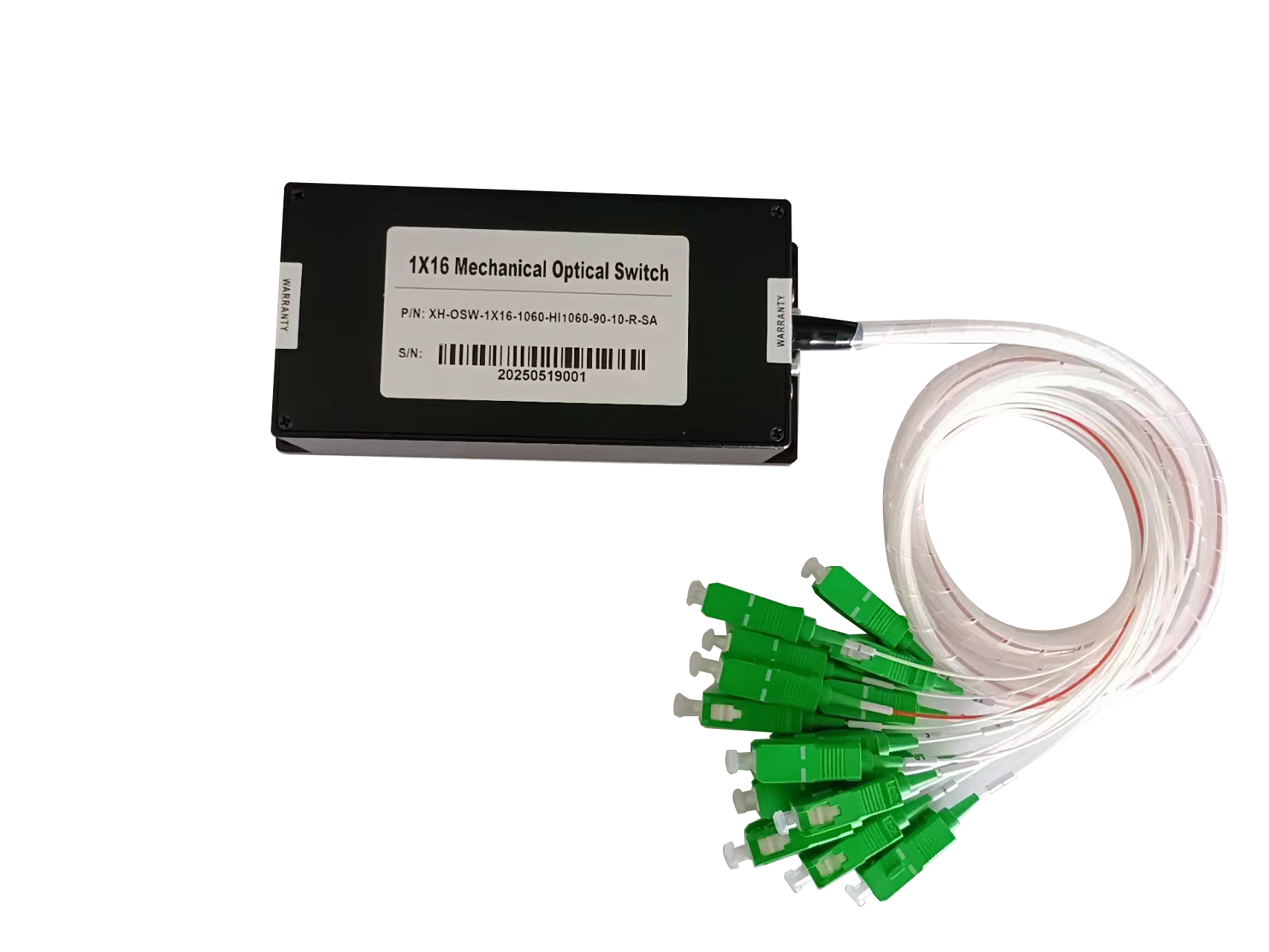
Mechanical Optical Switches: The “Physical Switch” of Optical Communication Networks
With the rapid development of optical communication technology, fiber optic networks have been widely used in data centers, 5G communications, fiber sensing, defense research, and industrial automation. In complex optical fiber systems, efficiently managing and switching optical paths has become essential for ensuring stable network operation. Mechanical optical switches are one of the key components that make this possible, earning them the reputation as the “physical switches” of optical communication networks.
What Is Mechanical Optical Switch?
Mechanical optical switch is a passive optical device that enables optical path switching through mechanical movement. Its working principle is similar to that of a traditional electrical switch, except that the switching object is an optical signal rather than electrical current.
Typically, the switch uses miniature motors, magnetic driving mechanisms, or MEMS structures to control the position of optical fibers, mirrors, or lenses, thereby changing the transmission path of the optical signal and enabling switching between different channels.
In simple terms, the functions of a mechanical optical switch include:
- Switching one optical signal to different output ports;
- Routing multiple input optical paths to designated channels;
- Enabling optical line protection, backup, testing, and resource scheduling.
Main Features of Mechanical Optical Switches
1. Low Insertion Loss
Mechanical optical switches use physical optical alignment, resulting in very low insertion loss and minimal optical power attenuation. This makes them highly suitable for systems with strict signal quality requirements.
2. High Isolation
Since non-working channels are physically disconnected, crosstalk is extremely low, with isolation typically exceeding 50 dB. This effectively prevents signal interference.
3. Wide Wavelength Range
Mechanical optical switches are insensitive to wavelength and can support multiple wavelength bands, including:
- 850 nm
- 1310 nm
- 1550 nm
- 1064 nm
- 2000 nm
This makes them suitable for communication, laser, and sensing applications.
4. Bidirectional Transmission Capability
Most mechanical optical switches support bidirectional operation, allowing input and output ports to be used interchangeably for flexible system integration.
5. High Reliability and Stability
With mature mechanical structure designs, these switches can achieve millions of switching cycles while maintaining long-term operational stability and reliability.
Common Types of Mechanical Optical Switches
1×2 Optical Switch
The most basic configuration, allowing one input signal to switch between two outputs. It is widely used in line protection and backup systems.
1×N Optical Switch
Supports switching one input to multiple output ports, such as:
- 1×4
- 1×8
- 1×16
- 1×32
These switches are commonly used in fiber optic testing systems, automated measurement platforms, and data center line management.
N×N Matrix Optical Switch
Supports arbitrary connections between multiple inputs and outputs, enabling complex optical network routing.
Widely used in:
- Optical Cross-Connect (OXC) systems
- ROADM systems
- Automated optical testing platforms
Core Applications of Mechanical Optical Switches
Data Center Fiber Management
In large-scale data centers, the number of fiber optic connections is enormous. Mechanical optical switches enable:
- Automatic optical line switching
- Backup link protection
- Rapid network fault recovery
- Automated operation and maintenance testing
This significantly improves network reliability in data centers.
Fiber Optic Sensing Systems
Distributed fiber sensing systems often require multiple sensing channels to be monitored sequentially.
Mechanical optical switches enable:
- Multi-point sensing channel switching
- Automatic signal polling
- Dynamic optical path allocation
They are widely used in:
- Power grid monitoring
- Oil pipeline monitoring
- Bridge structural health monitoring
Fiber Optic Testing Systems
In laboratories and production testing platforms, mechanical optical switches can replace manual fiber plugging and unplugging, greatly improving testing efficiency.
Typical applications include:
- Insertion loss testing
- Return loss testing
- Automated aging tests
- Multi-device cyclic testing
Defense and Scientific Research
Mechanical optical switches offer high stability and strong anti-interference capability, making them suitable for:
- Laser systems
- Aerospace applications
- Military communications
- Precision optical experiments
They are especially ideal for high-reliability environments.
Differences Between Mechanical Optical Switches and MEMS Optical Switches
| Comparison Item | Mechanical Optical Switch | MEMS Optical Switch |
|---|---|---|
| Switching Method | Mechanical movement | Micromirror reflection |
| Insertion Loss | Lower | Relatively low |
| Isolation | Higher | Moderate |
| Switching Speed | Millisecond level | Microsecond level |
| Port Scale | Small to medium scale | Large-scale matrix |
| Cost | Lower | Higher |
| Stability | High | Relatively high |
For systems requiring high stability and ultra-low loss, mechanical optical switches remain a mainstream solution.
Future Development Trends
With the growth of AI data centers, 5G networks, and fiber sensing technologies, mechanical optical switches are evolving toward:
- Miniaturization and modularization
- Lower power consumption
- High-density channel integration
- Remote network control
- Longer lifetime and higher stability
At the same time, with interfaces such as IIC, RS232, and RJ45, mechanical optical switches are gradually moving toward intelligent management.
Conclusion
As a key component in optical communication networks, mechanical optical switches play an irreplaceable role in data centers, fiber sensing, communication testing, and industrial optical networks due to their advantages of low loss, high isolation, and high reliability.
In the future development of high-speed, large-capacity, and intelligent optical networks, mechanical optical switches will continue to serve as the core of optical path control, providing stable and efficient connectivity for modern optical communication systems.
Comments are closed