


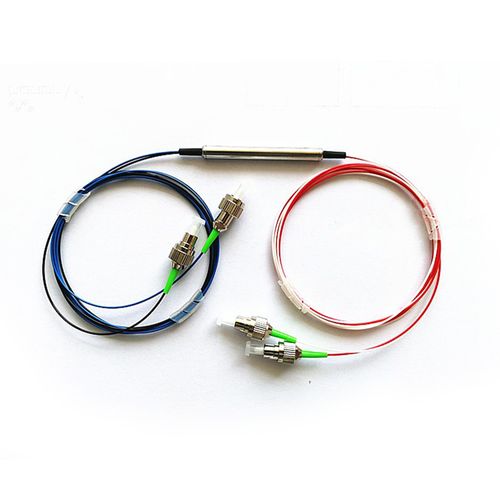
Analysis of the Operating Principle and Applications of Polarization-Maintaining Optical Circulators
Polarization-maintaining optical circulator is a special optical passive device that, in addition to conventional optical circulators, has the ability to maintain the polarization state of optical signals. It is not only a nonreciprocal device (light signals can only be transmitted through a fixed port sequence) but also a polarization-sensitive device.
I. Operating Principle
The core operating principle of a polarization-maintaining optical circulator is based on two physical effects: Faraday rotation and birefringence. Its typical structure (using a three-port circulator as an example) and operating process are as follows:
1. Faraday Rotation:
This is the source of the circulator’s nonreciprocity. When linearly polarized light passes through a Faraday rotator, its plane of polarization rotates.
Key characteristic: The rotation angle (usually 45°) depends only on the direction of the magnetic field and the material used, and is independent of the propagation direction of light. This is fundamental to achieving unidirectional transmission of optical signals.
2. Birefringence:
This is the source of the “polarization-maintaining” function. Polarization-maintaining devices use birefringent crystals (such as yttrium vanadate (YVO₄)) or polarization-maintaining fiber. Birefringent crystals have two principal axes: the fast axis and the slow axis. Light polarized along different principal axes propagates at different speeds. Through carefully designed optical paths, incident polarization-maintaining light (typically polarized along the X or Y axis) can be spatially separated or directed along specific paths while maintaining its polarization alignment with the crystal axes and avoiding polarization crosstalk.
3. Typical Workflow (using a three-port example):
Port 1 → Port 2:
Linearly polarized light (e.g., polarized along the slow axis) is input from port 1 of the polarization-maintaining fiber and enters the circulator.
It first passes through a birefringent walk-off crystal, spatially separating the light into two beams (e.g., ordinary light (o) and extraordinary light (e)) based on their polarization states.
These two beams then pass through a Faraday rotator, rotating their polarization planes by 45° in the same direction.
They then pass through a half-wave plate or another birefringent crystal, where their polarization planes may be further adjusted.
Finally, the optical system recombines the two beams and precisely directs them out of port 2. Throughout this process, the polarization state of the light remains “locked” along the preset axis, ensuring an extremely high polarization extinction ratio.
Port 2 → Port 3:
The light reflected from Port 2 (with its polarization state unchanged) re-enters the circulator.
Due to the nonreciprocity of the Faraday rotation effect, the polarization plane of this light is rotated by 45° in the same direction (rather than reversed) upon passing through the Faraday rotator again.
The cumulative 90° change in polarization plane caused by these two rotations results in a completely different optical path for this light beam.
The optical system ultimately directs this light beam out of Port 3 without it returning to Port 1.
In summary: Unidirectional light transmission (1→2→3) is achieved through the nonreciprocity of the Faraday rotator, while polarization state preservation is achieved through the precise optical path design and axial alignment of the birefringent crystal.
II. Key Features
1. High Polarization Extinction Ratio (PER):
This is the most critical specification of a polarization-maintaining circulator, typically exceeding 20dB (excellent products can reach over 25dB). It measures the device’s ability to maintain the polarization state of the incident light. A higher PER indicates lower polarization crosstalk and better polarization-maintaining performance.
2. Low Insertion Loss (IL):
The power loss of the optical signal passing through the device is minimal, typically less than 1.0 dB.
3. High Isolation:
The device effectively prevents reverse transmission of the optical signal. For example, the isolation from port 2 to port 1 is typically greater than 50 dB, ensuring the unidirectional nature of the optical path.
4. Low Return Loss (RL):
The optical power reflected back from the device’s input port is very low, typically greater than 50 dB, reducing system instability.
5. Wavelength Dependency:
The device is optimized for specific wavelength ranges (e.g., 1310 nm, 1550 nm, C-band, L-band).
III. Applications
Polarization-maintaining circulators are primarily used in optical systems that have strict requirements on the polarization state of light or require the use of polarization state.
1. Polarization-Maintaining Fiber Sensing Systems:
Fiber Optic Gyroscopes (FOGs): This is the most classic and important application. In FOGs, a polarization-maintaining circulator guides light to propagate unidirectionally through a polarization-maintaining fiber loop while maintaining the light’s polarization state. This is crucial for improving the gyroscope’s accuracy and stability. Any fluctuations in the polarization state will cause measurement errors.
2. Free-Space Optical Communications (FSOC):
In atmospheric laser communications, the polarization state of light can change due to effects such as atmospheric turbulence. Using a polarization-maintaining circulator at the receiving end, combined with polarization diversity reception technology, stabilizes the signal and improves communication quality.
3. High-Power Fiber Lasers/Amplifiers:
Used for constructing nonreciprocal polarization components, such as injecting signal light into a polarization-maintaining gain fiber and isolating the back-reflected light while maintaining the linear polarization of the laser output.
4. Quantum Communication and Quantum Computing:
In systems such as quantum key distribution, quantum states (such as the polarization state of photons) are the carriers of information. Polarization-maintaining circulators can be used to construct complex optical paths while ensuring that fragile quantum states remain unchanged during transmission.
5. Advanced Test and Measurement Systems:
In laboratory environments requiring precise control and analysis of optical polarization states, polarization-maintaining circulators are key components for building complex optical experimental platforms.
6. Coherent Optical Communication Systems:
In coherent receivers, polarization-maintaining circulators are sometimes used to separate or combine local oscillator (LO) and signal light while maintaining their respective polarization states for subsequent coherent detection.
Summary
Polarization-maintaining optical circulators are the “high-precision” members of the optical circulator family. Their combination of nonreciprocal unidirectional transmission and excellent polarization-maintaining capabilities makes them essential core components for high-end polarization-sensitive applications such as fiber optic sensing, quantum technology, and specialty lasers.
Comments are closed