


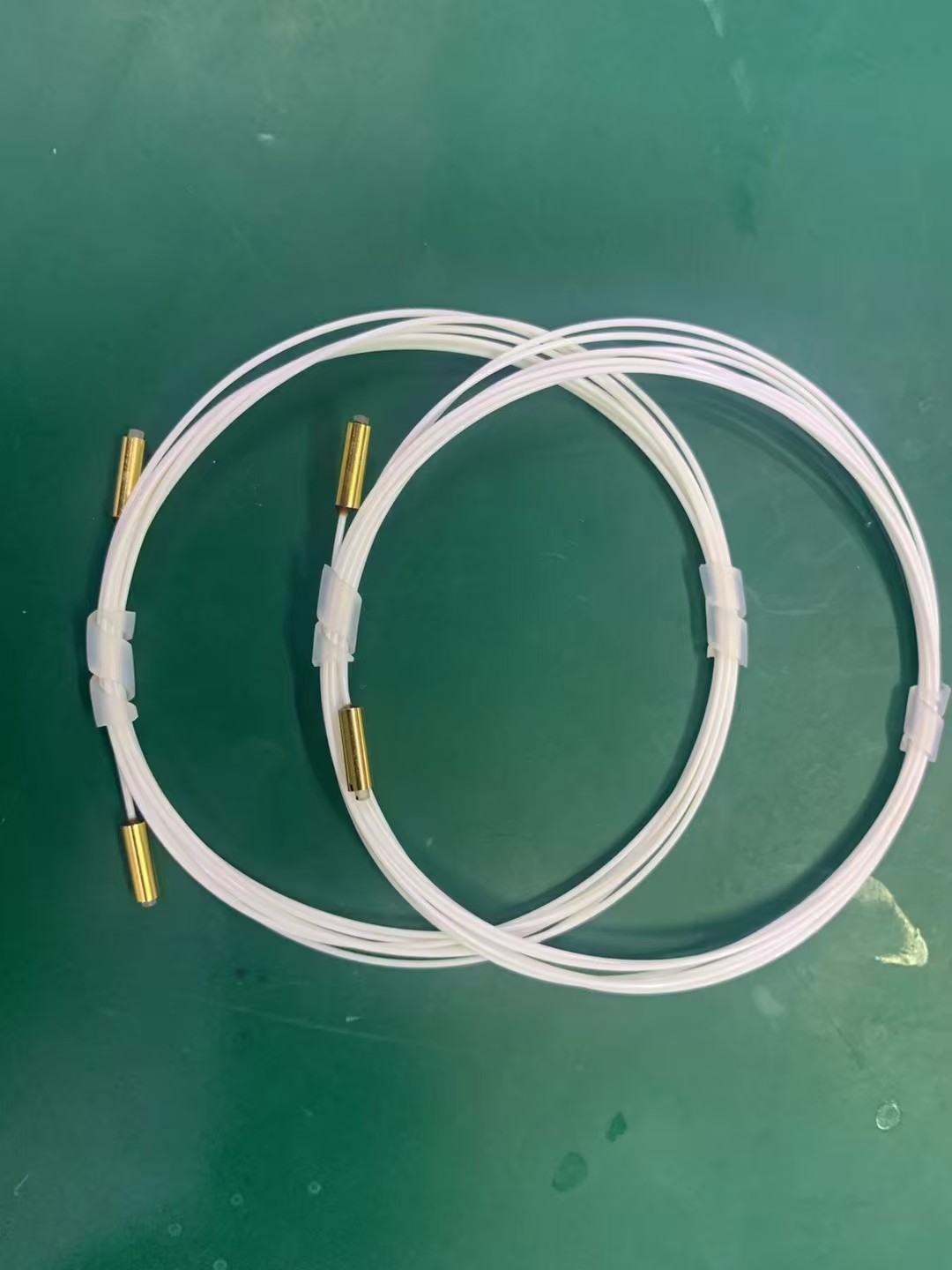
Fiber Optic Collimator: The “Precise Navigator” of Optical Signals
The fiber optic collimator, as a core component of passive optical devices, utilizes integrated optical lenses to efficiently control optical signals – precisely converting the divergent Gaussian beam emitted from the fiber into a parallel collimated beam, and stably coupling external parallel beams into the fiber. With this core capability, it effectively solves the energy loss problem caused by beam divergence, acting as a “precise navigator” for optical signals, guiding them for stable transmission in complex fiber optic networks.
To fully understand the excellent performance and value of fiber optic collimators, this article will systematically introduce the working principle, structural classification, key performance parameters, and typical applications of fiber optic collimators, and share the experience and advantages of producing fiber optic collimators.
I. Collimation of Optical Signals
When an optical signal is output from an optical fiber, it is in a divergent state due to the fiber’s divergence angle. The self-focusing lens built into the fiber optic collimator receives this divergent light and converts it into parallel light (collimated light) through precise focusing, effectively ensuring the stability and directionality of the optical signal transmission.
II. Key Technologies of Fiber Optic Collimators
Matching of Fiber and Lens
The optical lens in the fiber optic collimator is responsible for focusing or collimating the light beam output from the fiber. In the design, factors such as the core size of the fiber, the fiber material, and the refractive index of the lens need to be precisely matched to ensure the maximization of the optical signal output quality. For example, for single-mode fibers, the collimator lens usually needs to be mode-matched with the fiber to avoid distortion of the optical signal during collimation.
Adjustment Function
In practical applications, fiber optic collimators often require fine-tuning to optimize the collimation effect. The fine-tuning components allow the collimator to precisely adjust the collimation direction and focal length of the beam according to the specific conditions of the fiber end face, thereby ensuring the transmission quality of the optical signal in different optical systems.
Resistance to Environmental Interference
The precision of the fiber optic collimator is not only reflected in its design but also in its durability. To adapt to use in different environments, fiber optic collimators typically use materials resistant to vibration and temperature changes, and have functions such as dustproof and waterproof features to ensure long-term stable operation.
III. Applications of Fiber Optic Collimators in Optical Signal Transmission
1. High-Precision Measurement and Sensor Systems
Fiber optic collimators are widely used in high-precision optical measurement systems. In the field of sensors, fiber optic collimators can be used to ensure accurate alignment of the light beam with the detection equipment, avoiding signal attenuation or distortion. For example, in laser rangefinders and fiber optic sensors, fiber optic collimators can significantly improve measurement accuracy and reliability.
2. Laser Communication and Fiber Optic Communication
In laser communication and fiber optic communication systems, fiber optic collimators ensure the precise input and output of laser or optical signals at the fiber ends. Through efficient beam collimation, the optical signal can be transmitted over long distances through the fiber with minimal loss, effectively improving communication speed and transmission quality.
3. Fiber Lasers
Fiber optic collimators also play a crucial role in fiber lasers. The output signal of the laser needs to pass through a collimator to achieve efficient laser beam output. Especially in high-power laser systems, fiber optic collimators not only ensure beam collimation but also effectively prevent light loss and energy scattering.
4. Optical Testing Equipment
In the field of optical testing and research, fiber optic collimators are often used in precision instruments to ensure that the optical signal is accurately directed to the device under test. Applications include calibration of optical lenses and testing of fiber optic connections.
5. Applications in Optical Communication Networks
With the construction of high-speed networks such as 5G and Fiber to the Home (FTTH), fiber optic collimators have become one of the key components. In fiber optic access networks, collimators ensure the stability and accuracy of fiber optic signals, enabling the network to achieve high-speed, high-capacity, and low-latency communication services.
IV. Future Development and Challenges
With the continuous development of fiber optic communication technology, fiber optic collimators are also developing towards higher performance. For example, the design of collimators for multimode fibers and the application of miniaturized fiber optic collimators are current research hotspots. Future fiber optic collimators will focus more on increasing integration, reducing costs, improving transmission efficiency, and adapting to more complex and variable operating environments.
Furthermore, with the development of cutting-edge technologies such as quantum communication and optical computing, the application areas of fiber optic collimators are constantly expanding. These emerging technologies place higher demands on the precision, stability, and response speed of fiber optic collimators.
Conclusion
As a key component in fiber optic communication systems, the fiber optic collimator plays the role of a “precision navigator.” Through high-precision design and technology, it ensures the stability and transmission quality of optical signals. In various fields such as laser communication, optical measurement, and fiber optic sensors, the application of fiber optic collimators has become an indispensable part. With the continuous progress of optical communication technology and related fields, fiber optic collimators will continue to develop, providing support for a faster and more stable communication environment.
Comments are closed