


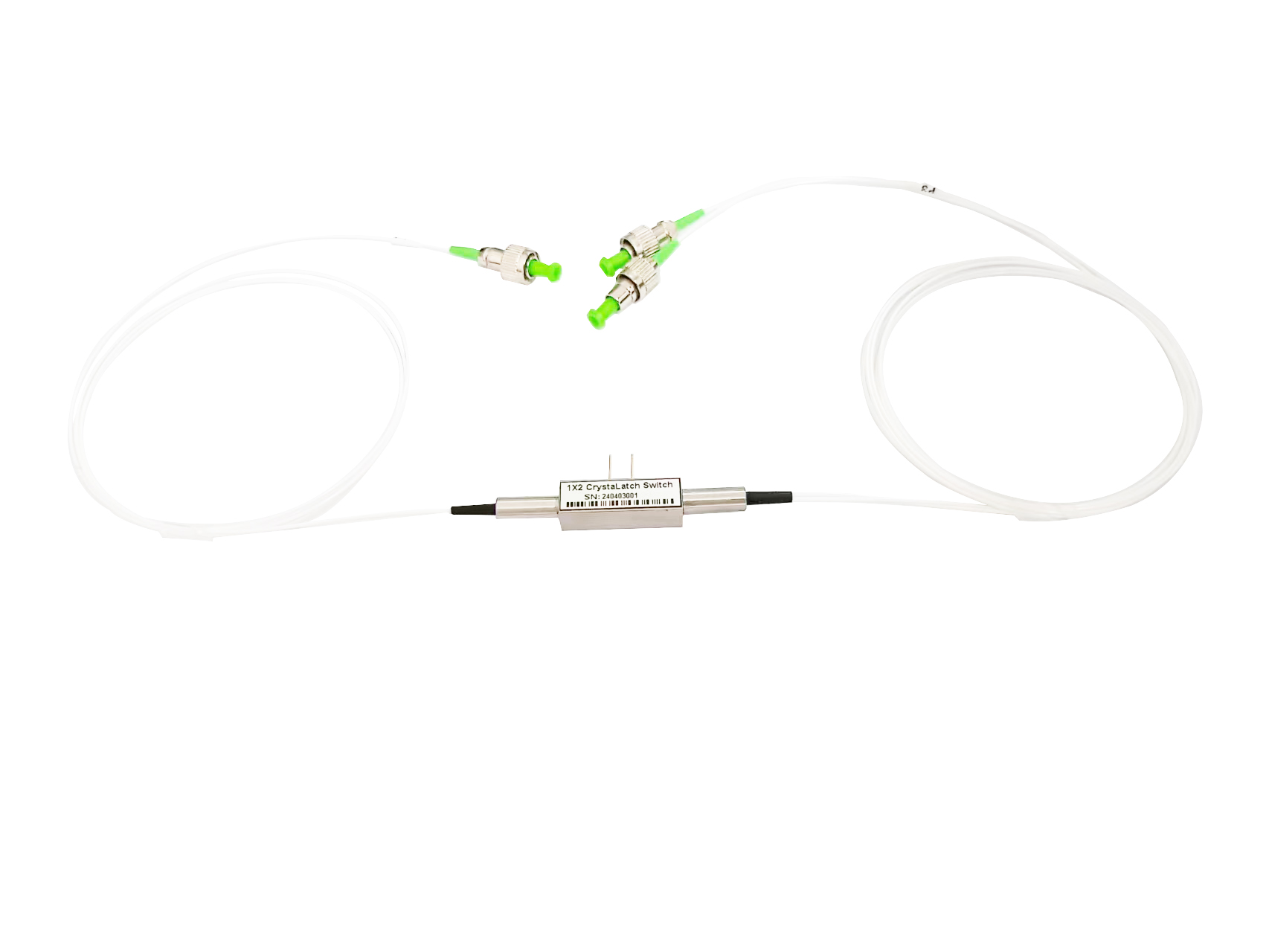
How Optical Switches Enable Fault Protection in FTTH Networks
In Fiber to the Home (FTTH) networks, service continuity and stability are critical requirements. When a primary optical path fails—due to fiber cuts, equipment faults, or signal degradation—the network must recover within milliseconds. Optical switches play a key role in enabling this fault protection (protection switching) mechanism.
This article explains how optical switches achieve fault switching in FTTH from the perspectives of principles, implementation, and practical deployment.
1. Failure Risks in FTTH Networks
FTTH networks are typically based on Passive Optical Network (PON), which includes:
- Optical Line Terminal (OLT, central office)
- Optical Distribution Network (ODN, including splitters)
- Optical Network Unit (ONU, user side)
Common failure points include:
- Backbone fiber breaks (construction damage or aging)
- Splitter or connector failures
- OLT port malfunction
- Excessive optical attenuation
Because PON adopts a point-to-multipoint tree topology, a single failure can impact multiple users. Therefore, protection mechanisms are essential.
2. Basic Principle of Optical Switching for Fault Protection
Optical switches physically redirect light paths between a primary and a backup fiber to ensure service continuity.
System Components
A typical protection switching system includes:
- Primary fiber link
- Backup fiber link
- Optical switch (1×2 or 2×2)
- Optical power monitoring module
Working Process
Normal Operation:
- Signal transmits through the primary path
- Optical switch stays on the primary channel
Fault Detection:
- Real-time monitoring of optical power
- If power drops below a threshold (e.g., -30 dBm), a fault is detected
Switching Action:
- Control unit triggers the optical switch
- Traffic is redirected to the backup path
Recovery Mechanism:
- Once the primary link is restored:
- Automatic revertive switching, or
- Non-revertive (stay on backup path)
3. Key Technologies
3.1 Real-Time Optical Power Monitoring
Photodetectors (PD) are used to continuously monitor link status:
- Response time: microseconds to milliseconds
- Supports upstream and downstream monitoring
3.2 Fast Optical Switching Technologies
(1) Mechanical Optical Switch
- Advantages: low insertion loss (<1 dB), high isolation
- Disadvantages: slower switching time (10–20 ms)
- Application: backbone protection in FTTH
(2) MEMS Optical Switch
- Advantages: long lifetime, high stability
- Switching time: ~5 ms
- Application: advanced access networks
(3) Solid-State Optical Switch
- Advantages: ultra-fast (nanoseconds)
- Disadvantages: higher loss and cost
- Application: core networks (less common in FTTH)
3.3 Control and Protection Protocols
At the system level, switching is often integrated with:
- Automatic Protection Switching (APS)
- Ethernet Protection Switching
Key control logic includes:
- Threshold-based triggering
- Anti-flapping mechanisms (to avoid frequent switching)
- Priority policies
4. Typical Deployment Scenarios
4.1 OLT-Side 1+1 Protection
- Dual OLT ports with optical switching selection
- Fast switching, high reliability
- Higher cost; suitable for enterprise services
4.2 Backbone Fiber Protection (Most Common)
- Primary + backup fiber routes
- Optical switch deployed along the trunk
Advantages:
- Balanced cost and performance
- Protects the entire PON tree
4.3 Critical User Protection
For high-reliability environments (e.g., hospitals, finance):
- Compact optical switch deployed before ONU
- Enables user-level protection
5. Key Parameters for Optical Switch Selection
When designing FTTH protection systems, consider:
- Insertion Loss (IL): impacts link budget (<1 dB typical)
- Return Loss (RL): affects signal quality
- Switching Time: determines service interruption duration
- Lifetime: typically >10⁷ switching cycles
- Operating Wavelength: 1310 / 1490 / 1550 nm
6. Conclusion
Fault protection in FTTH using optical switches is based on three essential steps:
- Detection: real-time optical power monitoring
- Decision: identifying link failure
- Switching: rapid transition to backup path
As FTTH networks evolve toward higher reliability and lower latency, optical switches are becoming a critical infrastructure component rather than an optional feature.
Comments are closed