


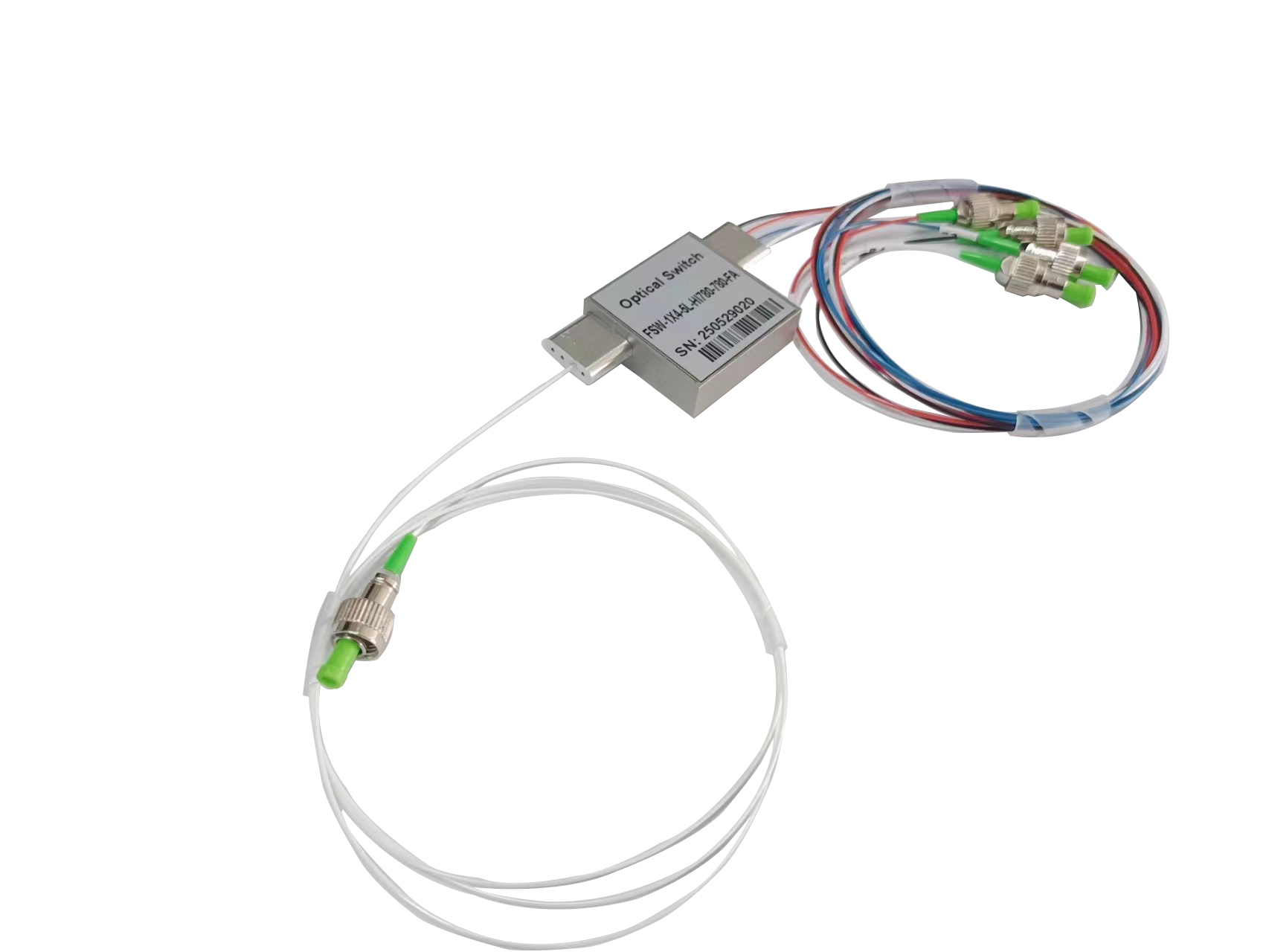
HI780 Fiber Optic Switch: High-Reliability Core Component for Optical Path Switching
In modern optical communication and sensing networks, flexible and reliable control of optical signal transmission paths is crucial. Fiber optic switches, as key passive components for achieving this function, directly impact the stability and efficiency of the entire system. The HI780 series fiber optic switches, with their excellent design and stable performance, have become the preferred solution in many demanding application scenarios.
I. Product Overview
The HI780 is a mechanical fiber optic switch. Its core working principle is to physically move the optical fiber or optical prism through a precise micro-electromechanical system or stepper motor drive, thereby achieving switching of the optical path between two or more ports. Compared with switches based on thermo-optic or electro-optic effects, mechanical switches have inherent advantages such as low insertion loss, low crosstalk, low polarization-dependent loss, and unlimited bandwidth.
The HI780 series typically offers 1×2 (single input, dual output switching) or 2×2 (dual input and output, enabling cross-connection) configurations. It uses a robust metal casing, and the internal optical components are precisely calibrated and use reliable welding processes to ensure long-term stability in harsh environments.
II. Main Features
Low Insertion Loss and High Return Loss: Optimized optical design and alignment processes enable the HI780 to achieve typical insertion loss as low as 0.5dB, and return loss higher than 50dB, minimizing signal power loss and reflection interference.
High Isolation: It has extremely high isolation between non-conducting channels (typically >60dB), effectively preventing crosstalk between channels and ensuring signal purity, which is especially important for multi-wavelength systems and testing applications.
Fast and Stable Switching: Using a high-performance driving mechanism, the switching time is typically in the millisecond range (e.g., 10-20ms), with high repeatability and a lifespan of millions of cycles or more, meeting the real-time requirements of automated testing and network protection switching. Excellent Environmental Stability: The product has undergone rigorous temperature cycling, vibration, and shock testing, and can operate stably within a wide temperature range (e.e., -40℃ to +70℃) with minimal performance parameter variations, making it suitable for outdoor and industrial environments.
Multiple Control Interfaces: Supports various electrical control interfaces such as TTL level, RS-232, or relay remote control, facilitating integration into automatic control systems and existing equipment.
Polarization Independence: The mechanical switching principle ensures that its performance is independent of the polarization state of the input light, simplifying system design.
III. Core Application Areas
Thanks to the above features, the HI780 fiber optic switch plays an indispensable role in the following areas:
Optical Communication Networks:
Network Protection and Restoration: In backbone and metropolitan area networks, when the primary fiber optic link fails, the optical switch can automatically switch the signal to the backup link within milliseconds, greatly improving network survivability.
Fiber Optic Line Monitoring: In operation and maintenance, the optical switch is used to connect test instruments (such as OTDRs and optical power meters) to different branches of the network in turn, enabling online, centralized monitoring of the entire network performance.
Dynamic Optical Add/Drop Multiplexing: As one of the basic components for implementing wavelength-level routing in ROADM nodes.
Fiber Optic Sensing Systems:
Multiplexed Sensing Networks: In distributed fiber optic acoustic sensing and fiber Bragg grating sensing arrays, an optical switch is used to sequentially access multiple sensing fibers or channels, allowing a single demodulation device to monitor a large number of sensing points, significantly reducing costs.
System Redundancy and Calibration: Switching between reference optical paths or backup sensing paths improves the reliability and accuracy of the sensing system.
Laboratory Research and Testing:
Automated Testing Platform: In optical device (such as amplifiers and transceiver modules) production lines or R&D laboratories, integrating optical switches to build automated testing systems allows for rapid and continuous parameter measurement of multiple devices under test, improving testing efficiency.
Multiple Light Source/Multiple Detector Selection: In complex optical path experiments, flexibly select different combinations of light sources, devices under test, and detection instruments. Defense and Aerospace:
Used in radar optical delay lines, electronic warfare systems, and airborne and shipborne communication equipment, requiring devices to possess extremely high reliability and stability under severe vibration and wide temperature ranges. The robust design of the HI780 perfectly meets these stringent requirements.
Medical and Industrial Laser Systems:
Used in laser treatment or laser processing equipment to safely guide the laser to different output ports or tool heads.
IV. Summary
The HI780 fiber optic switch represents the advanced level of high-performance mechanical optical switches. With its comprehensive advantages of low loss, high isolation, fast switching, and high reliability, it has become a cornerstone device for building flexible, robust, and intelligent optical networks and systems. Whether in the network core ensuring smooth global communication, in laboratories exploring cutting-edge technologies, or in harsh environments, the HI780 silently plays a crucial role as a “light path traffic controller” with its stable performance. With the further development of 5G, the Internet of Things, and intelligent sensing, the demand for high-performance optical switches will continue to grow, and devices like the HI780 will continue to evolve, empowering the future optical technology ecosystem.
Comments are closed