


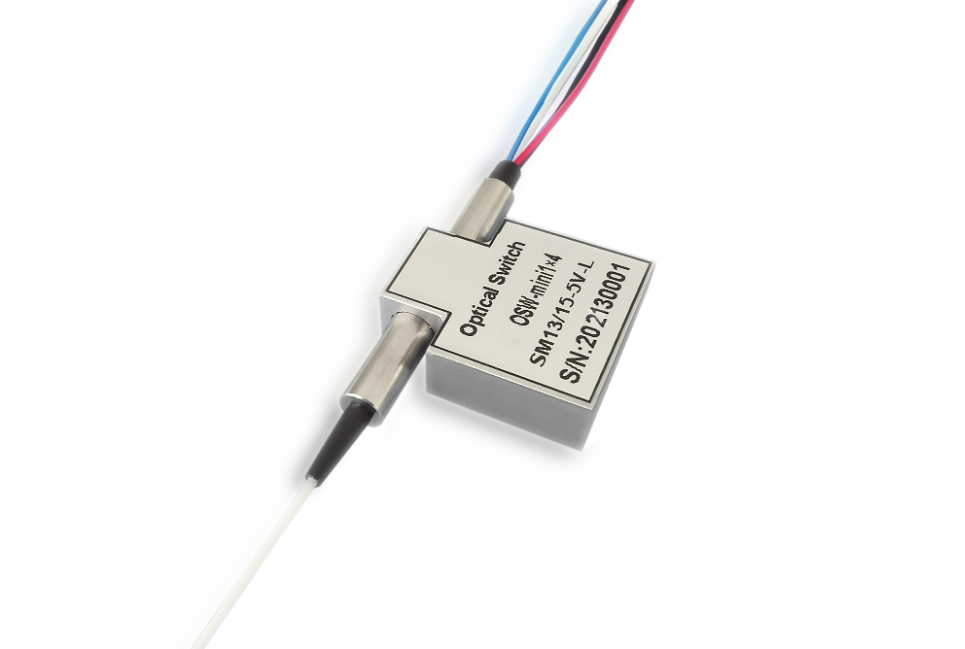
Non-Latching Hi 760nm 1×4 Mechanical Optical Switch: Reliable Choice for Precise Light Path Control at 760nm
With the continuous segmentation of optical communication and photonics applications, precise control of specific wavelengths—such as 760nm—has become increasingly important. The Non-Latching Hi 760nm 1×4 Mechanical Optical Switch, featuring high stability and robust structure, has emerged as a key solution for light path switching in visible and near-infrared applications.
1. What Is 1×4 Mechanical Optical Switch?
1×4 mechanical optical switch is a device that uses physical movement of optical paths to switch one input signal to any of four output ports.
Its core principle relies on micro-mechanical components (such as prisms, mirrors, or fiber alignment mechanisms) to redirect light propagation paths, enabling optical connection and disconnection.
Compared with electronic or MEMS-based solutions, this design is simple, highly reliable, and well-suited for long-term operation in industrial and laboratory environments.
2. The Importance of the 760nm Wavelength
The 760nm wavelength lies in the near-infrared region and is widely used in:
- Biomedical sensing (e.g., blood oxygen analysis)
- Spectroscopy and optical sensing
- Laser measurement and positioning
- Industrial inspection systems
Different wavelengths serve different purposes. The 700–850nm range is particularly important for short-range communication and sensing applications. Therefore, an optical switch optimized for 760nm ensures lower insertion loss and better wavelength matching.
3. Advantages of Non-Latching Design
A non-latching optical switch automatically returns to its default channel when power is removed. Key benefits include:
- Real-time control: Ideal for dynamic switching systems
- Enhanced safety: Automatic fallback upon power loss
- Immediate response: No need to retain switching state
Compared to latching designs, non-latching switches are better suited for test systems, laboratory setups, and automated optical routing applications.
4. Key Performance Features
4.1 High Reliability Mechanical Structure
Mechanical optical switches use mature physical actuation mechanisms, ensuring stable long-term operation even in demanding environments.
4.2 Excellent Optical Performance
- Low insertion loss
- Low crosstalk
- High repeatability
These characteristics maintain signal integrity during switching.
4.3 Flexible Multi-Channel Switching
The 1×4 configuration allows flexible routing, suitable for:
- Optical path redundancy switching
- Multi-point testing systems
- Signal distribution and routing
4.4 Cost-Effective Solution
Compared with MEMS optical switches, mechanical switches are more economical, making them ideal for large-scale deployment.
5. Typical Applications
✔ Optical Testing and Laboratory Systems
Enables efficient switching between multiple optical paths
✔ Biomedical Equipment
Used in 760nm-based systems such as oxygen saturation detection
✔ Industrial Inspection Systems
Supports multi-channel signal acquisition and switching
✔ Laser Systems and Optical Sensing
Allows rapid switching between different measurement paths
6. Mechanical vs. MEMS: How to Choose?
| Feature | Mechanical Optical Switch | MEMS Optical Switch |
|---|---|---|
| Working Principle | Physical movement | Micro-mirror control |
| Reliability | High (simple structure) | High (complex structure) |
| Speed | Millisecond level | Faster (μs–ms) |
| Cost | Lower | Higher |
| Applications | Industrial, testing, stable systems | High-speed communication, integration |
Mechanical switches rely on physical motion, while MEMS switches use micro-mirror arrays to direct light beams.
👉 For 760nm-specific applications where stability and cost-effectiveness are priorities, mechanical optical switches are often the better choice.
7. Conclusion
The Non-Latching Hi 760nm 1×4 Mechanical Optical Switch stands out with:
- Optimization for the 760nm wavelength
- Highly reliable mechanical design
- Flexible multi-channel switching capability
- Cost advantages
It is an ideal solution for precise optical path control in visible and near-infrared applications.
For systems that prioritize reliability and stability over ultra-fast switching speed, this device is a trusted and practical choice.
No responses yet