


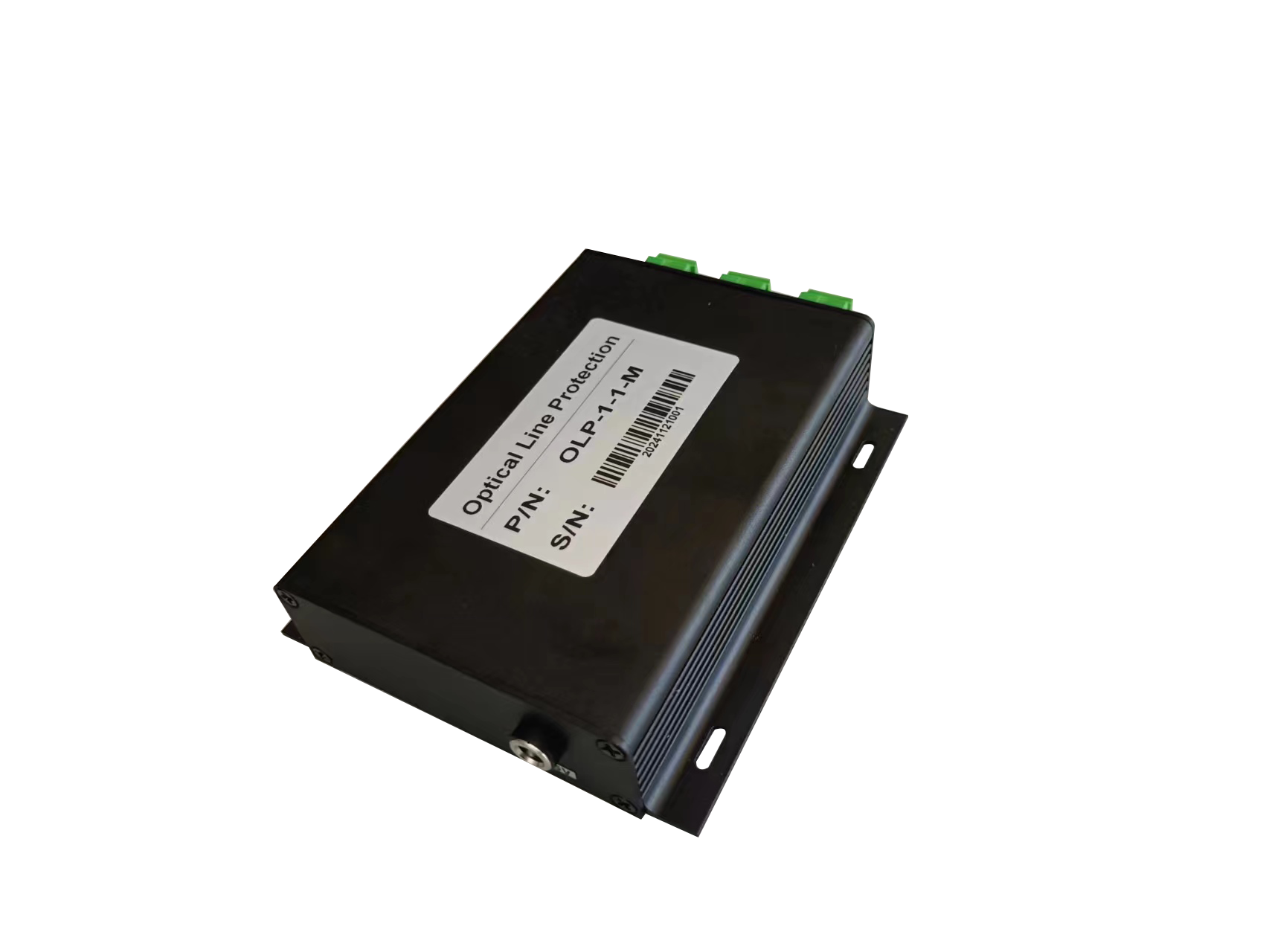
“Optical Bypass Protection System: Enhancing the Reliability of Fiber Optic Communication”
In modern society, information is like blood, and the fiber optic network that carries this information is the “main artery” that sustains the functioning of society. Financial transactions, telemedicine, cloud computing, online education… every critical business relies on network connections that are accurate to the millisecond. The consequences of a fiber optic transmission link failure would be immeasurable. It is this relentless pursuit of “zero downtime” that has led to the development of the BOP optical bypass protection system, an indispensable “intelligent fuse” in optical communication networks.
I. What is the BOP Optical Bypass Protection System?
BOP, or Bypass Optical Protection, is an optical bypass protection system. Its core function is: when a critical network device (such as a firewall, router, switch, DDoS scrubbing device, etc.) fails, loses power, or requires maintenance, the system can automatically or manually “bypass” the faulty node, directly connecting the upstream and downstream fiber optic cables, thus ensuring that the main optical path is not interrupted.
Simply put, it’s like an “emergency lane” or “alternative ramp” on a highway. When the main road (network equipment) is blocked due to an accident (failure), the traffic flow (optical signal) can be immediately diverted to the bypass, ensuring the overall smooth flow of traffic (network).
II. Core Working Principle and Architecture
1. The BOP system is typically deployed on both sides of the critical equipment that needs protection. Its core component is an optical switch matrix.
2. Normal operation state: The optical signal travels along the path: Fiber input -> BOP device A -> Protected network device -> BOP device B -> Fiber output, ensuring normal transmission. In this state, the BOP system is in transparent channel mode, with minimal impact on the signal.
3. Fault trigger state: When the BOP system detects a power failure or malfunction of the protected equipment through dry contact, network SNMP protocol, or power monitoring, it immediately triggers an action.
4. Bypass protection state: The optical switches within the system switch rapidly within milliseconds. The optical signal path becomes: Fiber input -> BOP device A — (internal direct connection) –> BOP device B -> Fiber output. The faulty equipment is completely isolated from the optical path, and business traffic continues to transmit without loss (only a very short switching time is added). III. Main Technical Features and Advantages
● Ultra-high reliability: Based on pure physical optical switching principles, it does not rely on the state of any faulty equipment, and can reliably perform bypass even if the equipment is completely down or powered off.
● Millisecond-level switching: The switching time is typically within 10 milliseconds, far below the TCP/IP session timeout time, making it almost imperceptible to upper-layer services, achieving “zero interruption” protection.
● Transparent transmission: Supports various optical protocols (SDH/SONET, Ethernet, OTN, etc.) from 1G to 400G and even higher speeds, completely transparent to wavelength, protocol, and rate.
● Flexible control modes:
* Automatic protection: Automatically triggered based on power supply, signal loss (LOS), or API commands.
* Remote manual control: Remote switching through the network interface for easy maintenance.
* Local manual control: Operated through the device panel buttons to handle extreme situations.
● Comprehensive monitoring and management: Provides network management interfaces based on Web, SNMP, and CLI, real-time monitoring of optical power, equipment status, switching history, etc., and supports alarm reporting.
IV. Typical Application Scenarios
1. Data center exit/entry security equipment protection: Protects next-generation firewalls (NGFW), intrusion prevention systems (IPS), DDoS mitigation equipment, etc. When security equipment is upgraded or fails, business traffic can be bypassed, ensuring network security without sacrificing availability.
2. Protection of critical nodes in the transmission network: Protects core routers, wavelength division multiplexing (WDM) equipment, etc., to avoid single-point failures causing the entire ring network or link to be interrupted.
3. Network maintenance and upgrades: During planned maintenance, hardware replacement, or software upgrades of critical equipment, bypass can be actively enabled to achieve “seamless” maintenance, greatly reducing maintenance window pressure.
4. Critical industries such as finance, power, and government: These industries have mandatory requirements for network continuity, and the BOP system is a key technical means to meet their high availability (e.g., 99.999%) SLA (Service Level Agreement).
V. Future Development Trends
As networks evolve towards all-optical and intelligent networks, the BOP system is also constantly developing:
● Integration with SDN/NFV: The BOP controller can be linked with the Software Defined Networking (SDN) controller to achieve intelligent and dynamic protection strategies based on network-wide traffic. ● Smarter Predictive Switching: Combining AI analysis, it provides early warnings or performs preventive switching at the initial stages of device performance degradation or before predicted failures.
● Miniaturization and Integration: With the development of technologies such as CPO and silicon photonics, BOP functionality may be more deeply integrated into optical modules or equipment boards.
Conclusion
The BOP optical bypass protection system, with its simplicity, reliability, and efficiency, builds a robust defense line at the physical layer of optical networks. It is not only a “first-aid kit” for unexpected failures but also a “lubricant” for seamless planned maintenance. In the era of the Internet of Everything and cloud computing across all industries, the value of the BOP system, as an invisible guardian ensuring the stability of the network foundation, will become increasingly prominent, becoming a standard configuration for building high-availability network architectures.
Comments are closed