


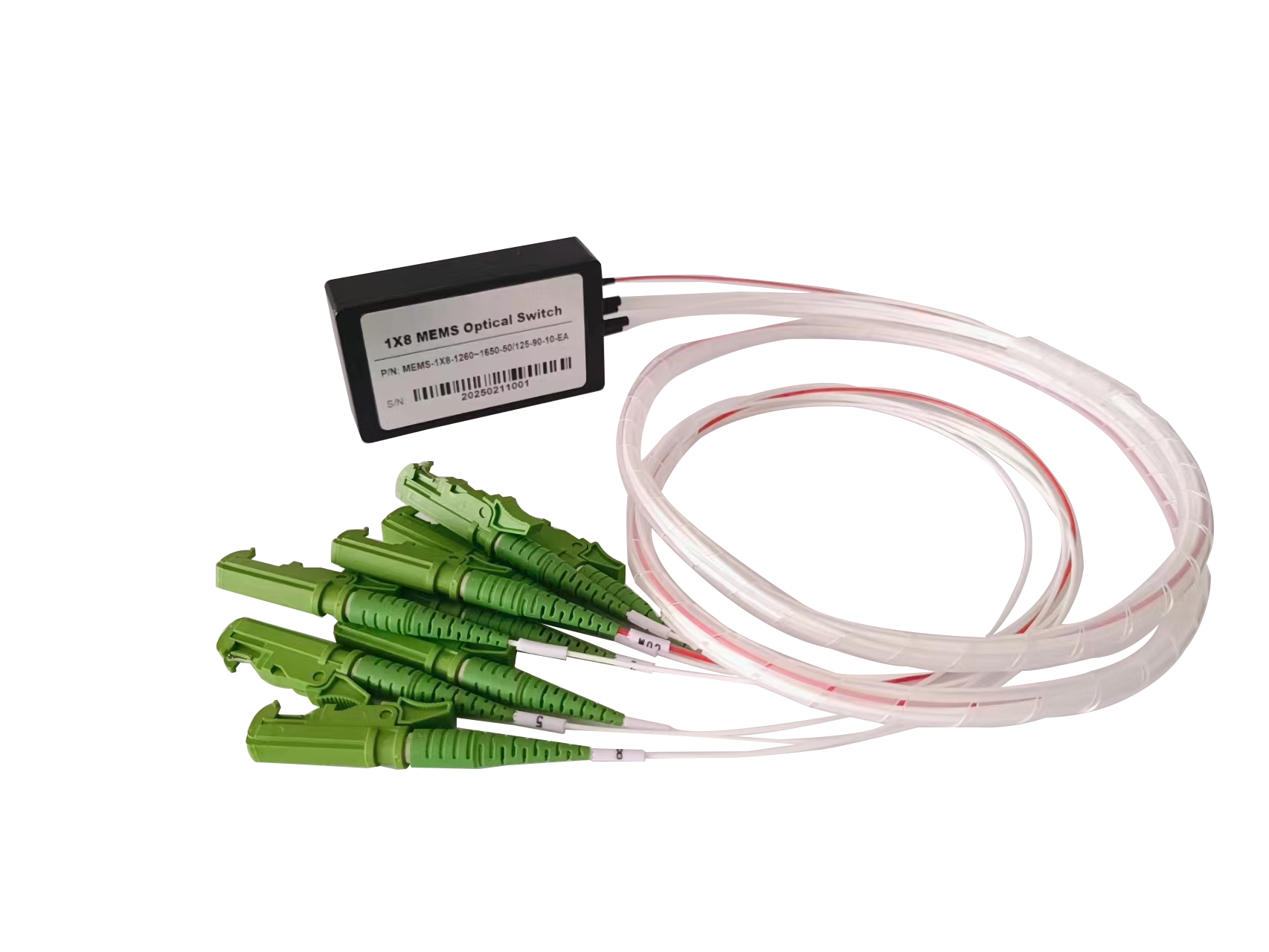
Polarization-Insensitive Optical Switch Technology: A New Era of All-Optical Switching
With the continuous evolution of high-speed optical communications and networks, optical switches—core devices for routing optical signals—are advancing toward higher performance, lower loss, and stronger environmental adaptability. Among these, polarization-insensitive optical switches have emerged as a key technology, driving the development of next-generation all-optical switching networks.
1. What Is a Polarization-Insensitive Optical Switch?
In fiber optic communication systems, optical signals can exist in various polarization states. Due to environmental disturbances such as temperature changes, mechanical stress, and fiber bending, the polarization state of light constantly fluctuates during transmission.
Traditional optical switches are sensitive to polarization, meaning different polarization states can lead to variations in insertion loss and crosstalk. In contrast, a polarization-insensitive optical switch maintains stable optical performance regardless of the input polarization state, achieving:
- Consistent insertion loss
- Stable extinction ratio
- Uniform switching performance
This significantly enhances system reliability and consistency.
2. Core Technical Approaches
Polarization-insensitive optical switches are typically realized through several key methods:
2.1 Polarization Beam Splitting/Combining (PBS/PBC)
This approach uses a polarization beam splitter (PBS) to divide the input light into two orthogonal polarization components. Each component is switched independently and then recombined using a polarization beam combiner (PBC).
Advantages:
- High stability
- Excellent polarization isolation
Disadvantages:
- Complex structure
- Higher cost
2.2 MEMS (Micro-Electro-Mechanical Systems) Technology
MEMS-based optical switches utilize micro-mirrors to direct light paths. By optimizing optical symmetry and design, polarization dependence can be minimized.
Features:
- High reliability
- Low insertion loss
- Scalable to large port counts (e.g., 1×N, M×N)
2.3 Planar Lightwave Circuit (PLC) Technology
PLC-based switches use integrated waveguide structures. Through symmetric design and material optimization, TE and TM modes exhibit similar propagation characteristics, enabling polarization independence.
Advantages:
- Compact size
- High integration capability
- Suitable for mass production
2.4 Advanced Materials and Structural Design
Using low-birefringence materials or polarization compensation structures (such as polarization rotators) can effectively reduce polarization sensitivity.
3. Key Performance Parameters
The performance of a polarization-insensitive optical switch is typically evaluated based on:
- Insertion Loss: The lower, the better
- Polarization Dependent Loss (PDL): Typically ≤ 0.1 dB
- Crosstalk: The lower, the better
- Switching Time: Millisecond or microsecond level
- Repeatability & Stability: Long-term operational reliability
4. Typical Applications
4.1 All-Optical Networks (AON)
In all-optical networks, signals are routed entirely in the optical domain without electrical conversion. Polarization-insensitive switches ensure consistent performance regardless of polarization variations, making them essential for high-performance optical switching.
4.2 Data Center Optical Interconnects
As bandwidth demand in data centers continues to surge, optical switching is gradually replacing traditional electronic switching. Polarization-insensitive designs prevent performance fluctuations caused by fiber disturbances.
4.3 Optical Line Protection (OLP)
In protection systems, optical switches rapidly switch between primary and backup paths. Polarization-insensitive performance ensures stable operation without additional loss variations during switching.
4.4 Fiber Optic Sensing and Testing Systems
In precision sensing applications, polarization fluctuations can introduce measurement errors. Using polarization-insensitive switches significantly improves measurement accuracy and repeatability.
5. Key Advantages
Compared to conventional optical switches, polarization-insensitive optical switches offer:
- ✔ Improved system stability
- ✔ Reduced polarization-dependent loss (PDL)
- ✔ Better adaptability to environmental changes
- ✔ Enhanced reliability in communication networks
- ✔ Support for next-generation all-optical switching
6. Future Trends
With the rapid development of 5G/6G, data centers, and quantum communications, polarization-insensitive optical switches are expected to evolve toward:
- Lower loss and higher integration
- Faster switching speeds (microsecond or even nanosecond level)
- Large-scale switching matrices (e.g., ROADM applications)
- Deep integration with silicon photonics
Conclusion
Polarization-insensitive optical switches are not only a critical advancement in optical device performance but also a fundamental building block for true all-optical networks. As the technology continues to mature, it will play an increasingly vital role in future high-speed and intelligent optical communication systems, ushering in a new era of optical networking.
Comments are closed