


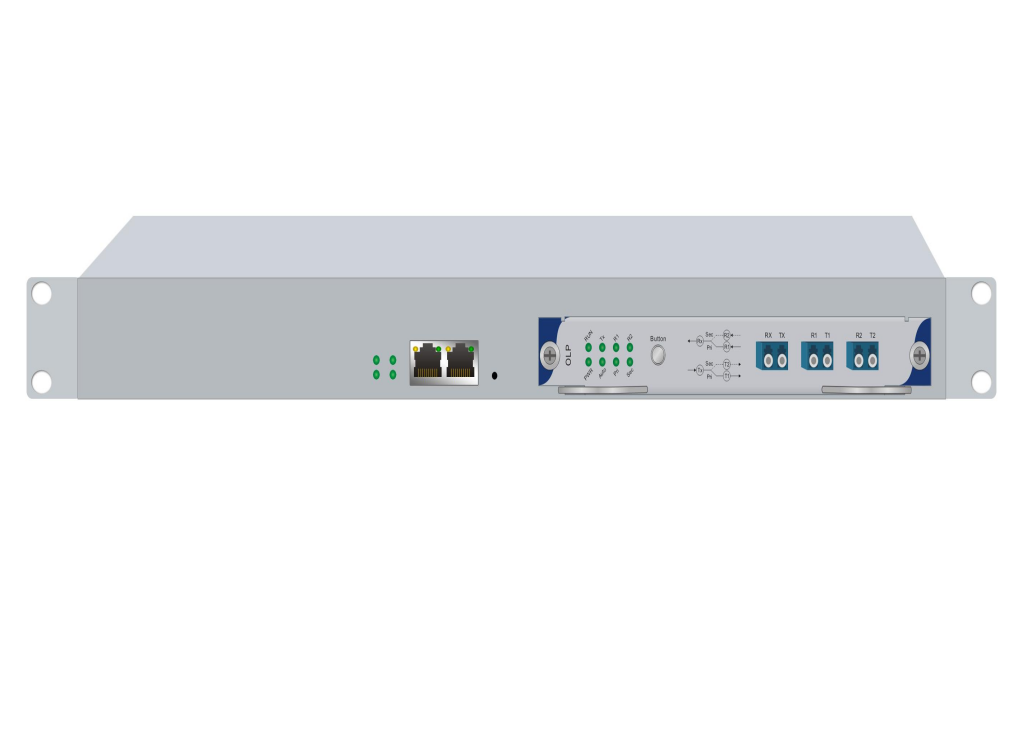
Proposal for Replacing Optical Line Protection (OLP) with Optical Bypass Protection System (OBPS)
Introduction
With the widespread deployment of optical fiber communication networks in telecommunications, data centers, and industrial control systems, network reliability and continuity have become critical performance metrics. Traditional Optical Line Protection (OLP) is widely used in core trunks and important service links. However, in high-density and flexible network environments, OLP faces challenges such as high cost, limited scalability, and complex maintenance. The Optical Bypass Protection System (OBPS) emerges as a next-generation optical network protection solution, offering a more flexible and efficient alternative. This article explores the technical approach and advantages of using OBPS to replace OLP.

I. Overview of Optical Line Protection (OLP)
OLP is a conventional optical network protection scheme that uses dual fiber paths and switching devices to achieve primary and backup redundancy. When the primary line fails, the system automatically switches to the backup line to maintain uninterrupted service. Key characteristics of OLP include:
-
Fast switching: Line switching typically occurs within tens to hundreds of milliseconds after a failure.
-
High reliability: Dual-path redundancy enhances network fault tolerance.
-
Device-dependent: Requires dedicated OLP switches and complex optical management, resulting in high costs.
However, as networks scale up, OLP faces several limitations:
-
High capital expenditure: Every primary line requires a backup line and OLP device.
-
Limited flexibility for expansion: Adding new services or expanding the network requires additional hardware and complex modifications.
-
Complex maintenance: Backup lines and switching logic increase operational overhead.
II. Overview of Optical Bypass Protection System (OBPS)
OBPS achieves fault isolation and service restoration through optical signal bypass technology. Its core idea is to add bypass protection units in the service path, enabling automatic bypass switching when the primary optical path fails, without relying on a fully redundant dual-fiber or traditional OLP switch.
Technical Principle
-
Bypass path: A bypass optical path is added between the main optical path and key nodes, allowing traffic to continue during primary path failures.
-
Intelligent monitoring: OBPS integrates optical power and signal quality monitoring modules to track the status of the primary path in real time.
-
Automatic switching: Using optical switches or WDM devices, traffic can switch to the bypass path within tens of milliseconds.
System Components
-
Optical Bypass Unit (OBU)
-
Optical switch modules (1×2 or 2×2)
-
Optical monitoring unit (power, OSNR monitoring)
-
Control logic unit (fault detection and switching strategy)
III. Advantages of OBPS over OLP
-
Cost optimization
-
OBPS usually requires only a single bypass path rather than full dual-path redundancy, saving on fiber and OLP device costs.
-
-
Flexible deployment
-
Bypass protection units can be added at critical nodes, accommodating business growth and topology changes.
-
-
Simplified maintenance
-
Automated monitoring and switching reduce manual intervention and operational complexity.
-
-
High compatibility
-
OBPS can integrate with existing optical networks, WDM systems, and optical switches for smooth upgrades.
-
IV. Implementation Plan
-
Network analysis
-
Identify critical nodes and high-priority service paths, evaluate failure risks and traffic requirements.
-
-
OBPS deployment
-
Install OBUs at key nodes and connect the bypass path.
-
Configure optical switches and monitoring modules for automatic switching and signal monitoring.
-
-
Switching strategy design
-
Set fault detection thresholds (optical power, OSNR, BER) to trigger automatic bypass switching.
-
Prioritize critical services to ensure they are restored first.
-
-
System testing and optimization
-
Simulate primary path failures to test switching speed, signal quality, and system stability.
-
Optimize bypass paths and switching strategies based on test results.
-
V. Application Scenarios
-
High-reliability optical links within data centers
-
Key nodes in metropolitan and access networks
-
Industrial control and smart city optical networks
-
Critical optical paths in fiber sensing and research laboratories
VI. Conclusion
OBPS provides flexible bypass path design and intelligent switching control, ensuring service continuity while reducing capital costs and simplifying maintenance. Compared with traditional OLP, OBPS is more advantageous for high-density and dynamically changing networks. As networks expand and service requirements become more diverse, OBPS is poised to become the mainstream solution for next-generation optical network protection.
Comments are closed