


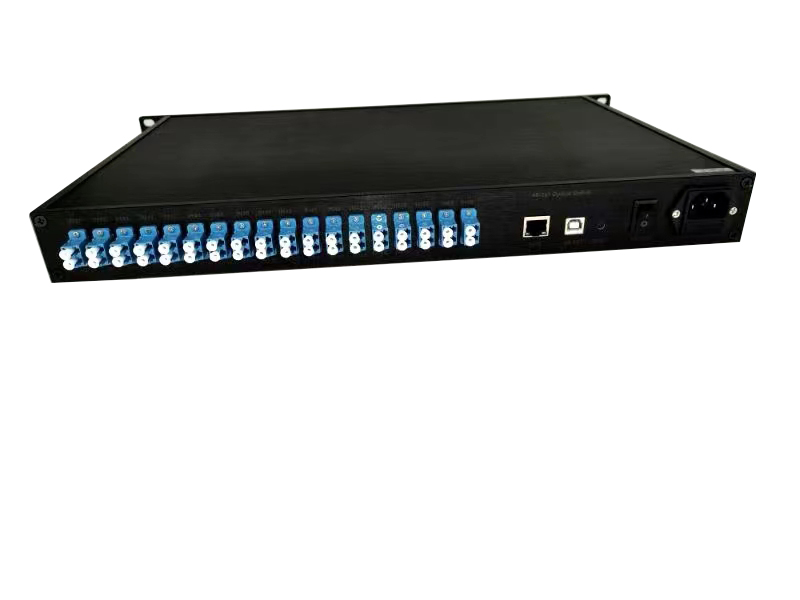
Single-mode 4×8 Matrix Fully Switched Optical Switch: The Core Engine for Building Flexible Optical Networks
In high-speed optical communication, data center interconnection, and next-generation optical computing systems, optical switches play a crucial “traffic hub” role. Among them, the single-mode 4×8 matrix fully switched optical switch, as a medium-sized, highly flexible key device, is becoming the core engine for realizing dynamic, reconfigurable optical networks. This article will delve into its technical principles, core advantages, application scenarios, and future challenges.
I. Technical Definition and Principles
- Single-mode: Refers to the device operating in the transmission mode of single-mode optical fiber. Single-mode fiber allows only one fundamental mode to be transmitted, effectively avoiding modal dispersion and ensuring high fidelity and low loss of signals during long-distance, high-speed transmission. Therefore, single-mode optical switches are the foundation for realizing high-speed, high-capacity backbone networks and metropolitan area networks (MANs) optical switching.
- 4×8 Matrix: Defines the port size of the optical switch. It has 4 input ports and 8 output ports. This asymmetric structure (input ≠ output) makes it particularly suitable for broadcast/multicast or signal distribution scenarios, such as flexibly distributing a single core signal to multiple branch nodes.
- Full switching: This is the core capability of the device. It means that the optical signal at any input port can be independently and non-blockingly switched to any output port. Simultaneously, connections from multiple input ports to output ports can be established concurrently, achieving parallel optical path switching. A 4×8 fully switched matrix theoretically supports all connection combinations from unicast to broadcast.
Its technical implementation principle is mainly based on the following mainstream solutions:
1. Microelectromechanical systems (MEMS) technology: Utilizing the physical deflection of a micromirror array to reflect input light to a designated output fiber. MEMS technology is mature, has low loss, and is currently the mainstream for large-scale matrix switches.
2. Silicon-based photonics technology: Integrating a Mach-Zehnder interferometer or microring resonator array on a silicon chip, changing the waveguide phase through thermo-optic or electro-optic effects to achieve optical path switching and routing. This solution has high integration, high speed, and is easy to mass-produce, representing the future development direction.
3. Liquid Crystal Technology: This technology uses an electric field to change the orientation of liquid crystal molecules, thereby controlling the polarization or phase of light to achieve switching functionality. Its advantages include no mechanical movement and high reliability.
II. Core Performance Advantages
- Compared to fixed optical connections or small-scale switches, single-mode 4×8 matrix fully switched optical switches exhibit significant advantages:
- High Flexibility: The core physical support for software-defined networks. Optical paths can be reconfigured in real-time and remotely according to service needs, enabling on-demand allocation of network resources.
- Low Insertion Loss and High Extinction Ratio: Ensures that signals maintain sufficient strength and quality after passing through the switch, reducing the need for repeaters. The single-mode design further optimizes loss performance.
- Fast Switching Speed: From milliseconds (MEMS) to nanoseconds (silicon photonics, liquid crystal), it can meet the diverse application requirements from protection switching to high-speed packet switching.
- Compact Structure and Scalability: Especially the silicon photonics solution, paving the way for device miniaturization and integration with higher port counts (e.g., 16×16, 32×32).
III. Typical Application Scenarios
1. Reconfigurable Optical Add-Drop Multiplexer: Dynamically “drops” or “inserts” specific wavelength channels from the trunk line at metropolitan area network or backbone nodes. The 4×8 structure is ideal for flexibly connecting local services to trunk lines in multiple directions.
2. Data Center Optical Interconnect Architecture: Used to build the optical switching layer in Spine-Leaf or Clos architectures, enabling ultra-low latency, high bandwidth dynamic connections between server clusters and improving resource utilization.
3. Optical Test and Measurement System: The core of an automated test platform. Programmably connects the device under test (DUT) to multiple light sources, spectrometers, power meters, and other instruments, greatly improving test efficiency and coverage.
4. Broadcast and Content Delivery Network: Simultaneously distributes signals from content sources (input) to multiple regional centers or edge nodes (output) to achieve efficient content delivery.
5. Photonic Computing and Sensor Network: Used in laboratories or dedicated systems to dynamically configure the topology of optical computing units or sensor networks.
IV. Technological Challenges and Development Trends
- Despite its significant advantages, this technology still faces challenges:
- Cost Control:Manufacturing costs, especially for high-performance, low-loss MEMS or silicon photonic chips, still need to be reduced to facilitate large-scale deployment.
- Power Consumption Optimization: Power consumption in the drive and control circuits of large-scale matrix switches cannot be ignored, particularly for thermo-optical silicon photonic switches.
- Integration and Packaging: Efficiently and with low-loss coupling and packaging of optical chips with drive and control circuits and single-mode fiber arrays is a key bottleneck for industrialization.
Future development trends will focus on:
- Silicon Photonics Dominance: As silicon photonics technology matures, its high speed, high integration, and low cost potential will gradually make it the market mainstream.
- Deep Integration with WDM Technology: Supporting wavelength-selective switching functions, enabling finer-grained switching across wavelength dimensions.
- Intelligent and Collaborative Control: Built-in intelligent algorithms and deep collaboration with upper-layer SDN controllers enable network self-optimization and fault self-healing.
V. Conclusion
The single-mode 4×8 matrix fully switched optical switch, with its moderate size, full-switching flexibility, and high-performance single-mode transmission, precisely fills the equipment needs of key nodes in optical networks. It is not only a crucial cornerstone for the current evolution of optical networks towards dynamic and intelligent operation, but also an indispensable stepping stone to the future era of all-optical switching. With continuous breakthroughs in technologies such as silicon-based photonics, these devices will continue to evolve in performance, cost, and scale, injecting even stronger “optical” power into the upgrading of global information infrastructure.
Comments are closed