


The Real Root Cause of “Aligned but Unstable” Polarization-Maintaining Fiber
In high-precision applications such as fiber optic sensing, fiber optic gyroscopes, coherent communication, and quantum devices, almost every engineer has encountered the same frustrating situation: the polarization-maintaining fiber manual/automatic coupling stage is clearly aligned, the extinction ratio is instantly maximized, and the power reaches its peak, but as soon as the stage is released, heated, or left to stand, the polarization immediately drifts, the power immediately fluctuates, and the extinction ratio drops drastically.
The first reaction is often: misalignment, improper soldering, or equipment malfunction.
Repeated readjustments and repairs yield the same result—aligned, but unstable.
The problem isn’t actually with “alignment accuracy,” but rather with five unseen root causes: stress, temperature, structure, manufacturing process, and system matching. This article explains the principles thoroughly, helping you solve the “alignment-is-drifting” problem at its root.
I. The Most Fundamental Misconception: Mistaking “Instantaneous Alignment” for “Long-Term Stability”
Many people have a fatal misconception about polarization-maintaining fibers: as long as the fast and slow axes are aligned, the polarization will definitely be stable.
The truth is: polarization-maintaining fiber is not “actively polarized locked,” but rather passively maintains polarization through strong birefringence.
It can only maintain polarization under one condition: pure axial incidence + no external stress + uniform temperature + no structural deformation.
In reality:
– The light source itself is not perfectly linearly polarized.
– Coupling inevitably introduces a slight orthogonal component.
Environmental micro-stress is ubiquitous.
These small errors are continuously amplified in birefringent fiber, ultimately manifesting as: perfect alignment initially, but drifting after a while.
The “instability” you see is not misalignment,
but rather the system’s inherent sensitivity to disturbances.
II. Root Cause 1: Mechanical Stress—The Invisible Force, the Most Fatal
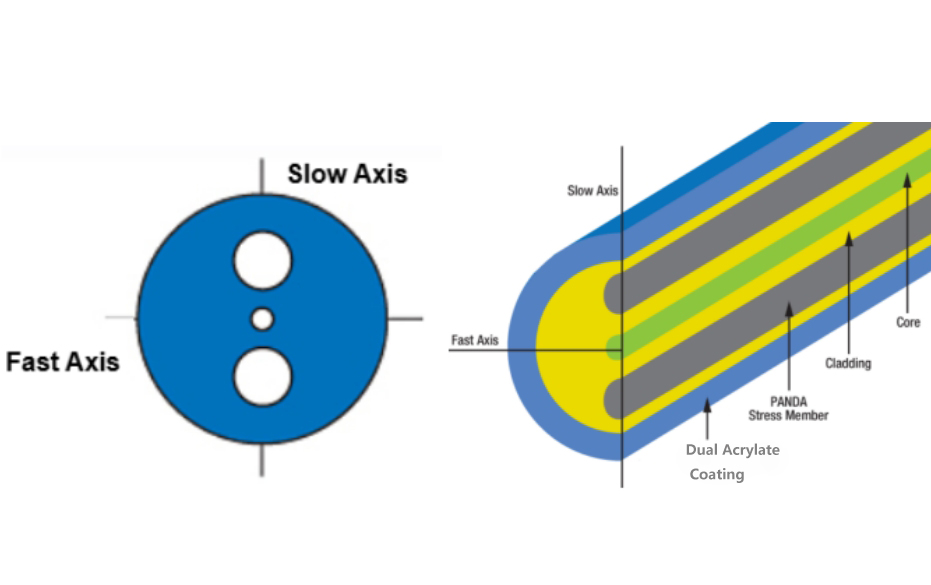
The birefringence of polarization-maintaining fiber (especially panda-type and bowtie-type) comes half from the structure and half from internal stress bars.
This means that any tiny external force will directly rewrite the birefringence, directly twisting the polarization state.
The most common invisible stresses encountered daily:
– Excessive compression or bending of the fiber optic coating
– Uneven clamping force
– Adhesive application too close to the bare fiber
– Stress release at solder joints
– Deformation of the packaging shell
These invisible forces cause micro-rotation of the speed control axis,
manifesting as: Even when properly aligned, instability immediately occurs with jig movement, adhesive loosening, or cooling.
The real solution isn’t simply “aligning again,”
but rather eliminating stress through process improvements:
– Clamping away from the splice point
– Applying less, lighter, and more even adhesive
– Leaving a slight bend in the fiber for buffering, avoiding tension
– Implementing a stress-relieving structure between the outer shell and the fiber
III. Root Cause Two: Temperature Drift—The Deadliest Killer of Birefringence
Polarization-maintaining fibers are extremely sensitive to temperature for a simple reason:
– The thermal expansion coefficients of the fiber cladding, stress bar, and coating are different
– A change in temperature causes internal stress redistribution
– The effective refractive index difference between the fast and slow axes changes
→ Direct polarization drift
This is particularly problematic in many scenarios: Perfect alignment at room temperature, but completely ruined at high/low temperatures.
Especially in:
– Fiber optic gyroscopes
– Automotive sensors
– Outdoor LiDAR
– High-temperature industrial environments
Temperature-induced drift is far more dangerous than alignment errors.
There are only three approaches to stabilizing the temperature:
1. Use polarization-maintaining fibers with low birefringence temperature drift.
2. Use symmetrical, identical material encapsulation.
3. Ensure uniform fiber arrangement and avoid localized heating.
IV. Root Cause Three: Fusion/Coupled Process—Even with perfect alignment, it’s ruined after soldering.
This is the most common real-world reason: the coupling stage has very high alignment precision, but it’s immediately disrupted by a single fusion or application of adhesive.
Three major pitfalls in the process:
1. Excessive discharge current/duration: The stress bar is annealed, causing a decrease in birefringence and unstable polarization.
2. Excessive exposure of bare fiber: Extremely susceptible to stress, dust, and moisture.
3. Applying adhesive too close to the fiber core: The adhesive’s curing shrinkage directly skews the fast and slow axes.
Many people believe “alignment = success,”
but they don’t realize that 70% of the instability in a polarization-maintaining system comes from subsequent process disruptions.
V. Root Cause Four: Alignment of the Fast and Slow Axes Isn’t Just About “Alignment,” It’s About “Low Crosstalk”
What you perceive as alignment:
→ Axis alignment
Real engineering requirements:
→ Extremely low polarization crosstalk + no cross-coupling
Even a tiny bit of orthogonal light coupling into the other axis,
will cause:
– Polarization rotation
– Power jitter
– Extinction ratio decreases over time/temperature
Therefore: Stable polarization maintenance isn’t about “perfect alignment,” but about “minimal crosstalk under disturbances.”
VI. Root Cause Five: System-level Mismatch—An unstable front-end renders even the most sophisticated back-end useless
The last often overlooked root cause: The light source, collimator, and isolator in front of the polarization-maintaining fiber are themselves not cleanly polarized.
For example:
– A regular collimator converted for polarization-maintaining operation results in misalignment of axes.
– The polarization-maintaining isolator itself has a low extinction ratio.
– The jumper wire is not polarization-maintaining, or its axis is erratically twisted.
The light source has low polarization and drifts with temperature.
If the incoming light is “irregularly polarized,”
even if your backend polarization-maintaining fiber is perfectly aligned,
it’s impossible to maintain long-term stability.
In summary: A single sentence succinctly explains “aligned but unstable”:
The instability of aligned polarization-maintaining fiber is never due to “misalignment,”
but rather because you haven’t controlled these five things:
1. Hidden mechanical stress
2. Temperature-induced birefringence drift
3. Welding/adhesive damage to the fast and slow axes
4. Unsuppressed polarization crosstalk
5. Impure polarization of the front-end device itself
Truly high-quality polarization-maintaining devices/modules are not judged by their initial alignment accuracy,
but by their stability under disturbances.
Comments are closed