


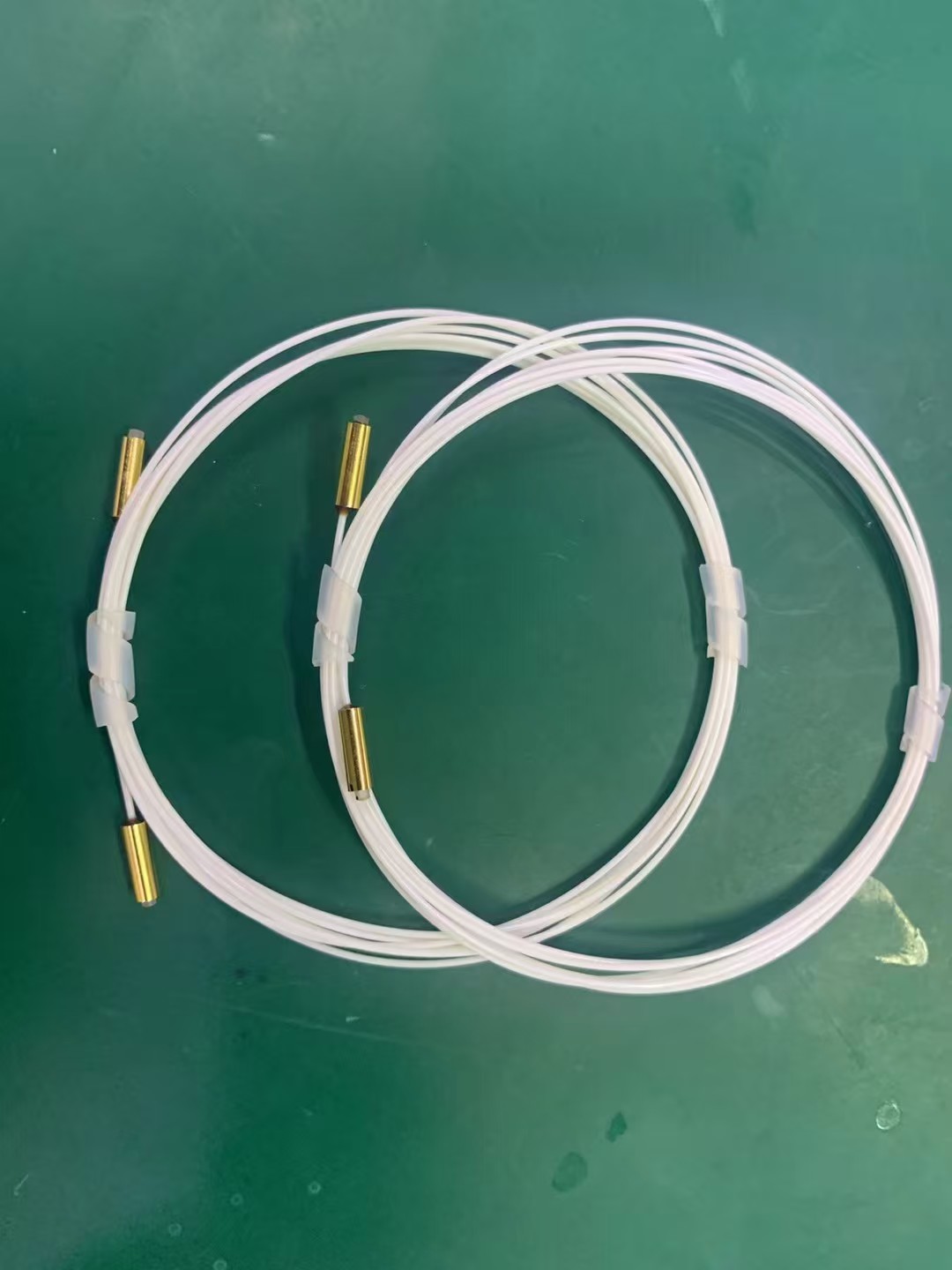
100um Fiber Collimator: Why is 1550nm the Most Commonly Used Wavelength?
In fiber optic communication, sensing, and precision optical systems, fiber collimators are crucial bridges connecting optical fibers to free-space optical paths. When you see a fiber collimator specified as “100μm,” it is almost always designed and optimized for the 1550nm wavelength. This is not a coincidence, but a necessary choice determined by fiber characteristics, physical laws, and industry demands.
This article will delve into the reasons behind 1550nm becoming the “gold standard” for 100μm fiber collimators and explain its core application scenarios.
I. Core Reason: Natural Compatibility with Single-Mode Fiber
To understand the wavelength selection, we must first understand the meaning of the number “100μm.” This usually refers to the cladding diameter of the optical fiber, while the core diameter, which transmits light, is only about 8-10μm. This size design is intended to achieve single-mode transmission at a specific wavelength – that is, only one fundamental mode light spot is transmitted in the fiber, which avoids multimode dispersion and ensures high fidelity and long-distance transmission quality of the signal.
The key point is: the single-mode condition is directly related to the wavelength.
1. Low-Loss Window: The loss curve of silica glass fiber has two low points, near 1310nm and 1550nm. The loss at 1550nm is even lower (typically 0.2 dB/km), which is more advantageous than 1310nm (typically 0.35 dB/km), especially for long-distance transmission.
2. Zero-Dispersion Point and Low-Dispersion Region: 1310nm is the zero-dispersion point of standard single-mode fiber, but 1550nm is located in the lowest loss window of the fiber. Modern fibers, through techniques such as “dispersion shifting,” can also make the dispersion in the 1550nm region very small, perfectly balancing the two core requirements of low loss and low dispersion. 3. Mode Field Diameter Matching: At a wavelength of 1550nm, the mode field diameter (MFD) of a 100μm clad single-mode fiber is approximately 10.4μm. The lenses of fiber collimators (such as C-lenses and GRIN lenses) are specifically optimized for this wavelength and mode field size to ensure the highest coupling efficiency and minimum return loss. If other wavelengths (such as 850nm) are used, the mode field matching will be poor, resulting in significant insertion loss.
II. Industry-Driven Amplifier Technology: The Rise of EDFA
*The establishment of the dominant position of 1550nm is largely due to a revolutionary technology—the erbium-doped fiber amplifier (EDFA).
*The operating bandwidth of EDFA (C-band: 1530nm-1565nm) perfectly covers the 1550nm window.
*EDFA can directly amplify optical signals without prior photoelectric conversion, which has greatly promoted the development of wavelength division multiplexing (WDM/DWDM) technology, making it possible to transmit dozens or hundreds of channels of different wavelengths in a single fiber, and all of this is centered around the 1550nm wavelength.
Therefore, all related passive components, including 100μm fiber collimators, isolators, circulators, and wavelength division multiplexers, naturally use 1550nm as the standard operating wavelength.
III. Typical Application Scenarios of 100μm/1550nm Collimators
Based on the above advantages, these collimators are widely used in:
1. Long-haul trunk lines and metropolitan optical networks: As key components for optical path routing, isolation, and switching in DWDM systems and optical cross-connect (OXC) nodes.
2. Fiber optic sensing systems: In high-performance sensors based on interference principles, such as fiber optic gyroscopes (FOGs), hydrophones, and seismic wave detection, extremely low noise and stable interference are required, and 1550nm single-mode light sources and collimators are standard configurations.
3. Optical instruments and test and measurement: As the starting and ending points of the optical path, used to test the performance of other optical components (such as filters and modulators). LiDAR and Free-Space Communication: Used to collimate 1550nm laser light (eye-safe wavelength) from optical fibers into a parallel beam for transmission in free space.
IV. Other Wavelength Options: When would they differ?
*Although 1550nm is the absolute mainstream, in specific circumstances, 100μm collimators can also be designed for other wavelengths:
*1310nm window: Primarily used in some metropolitan area network access or short-distance transmission scenarios, where loss is less critical than in long-distance transmission, and equipment costs may be slightly lower.
*Special wavelengths: Such as 1064nm (commonly used in laser processing and medical applications), 980nm/1480nm (as pump wavelengths for EDFA), etc. These are usually customized requirements and require special specifications and customized lens coatings.
Conclusion
Choosing 1550nm as the standard wavelength for 100μm fiber collimators is the optimal solution resulting from the combined effects of fiber physical characteristics, the evolution of communication technology (especially EDFA and WDM), and market scale effects. It represents the perfect combination of low loss, low dispersion, high performance, and high compatibility. In most systems involving single-mode fiber transmission and processing, the 100μm collimator at 1550nm is your default and reliable choice.
Comments are closed