


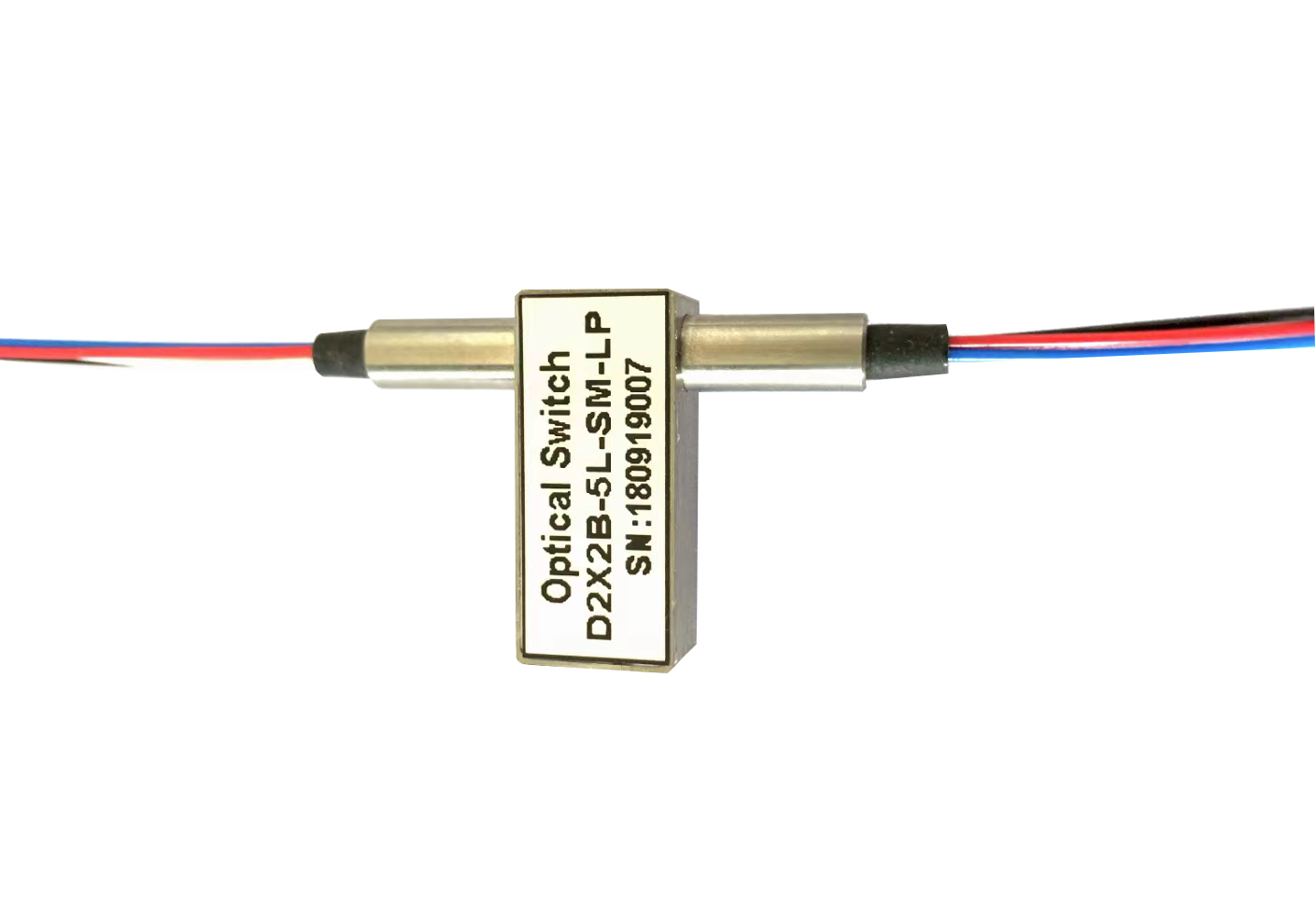
D2X2B Mechanical Optical Switch: Stable and Reliable Optical Path Switching Solution
Overview
The D2X2B mechanical optical switch is a passive optical device that achieves optical path switching through a precision mechanical structure. It is widely used in optical fiber communication, test and measurement, optical network protection, and other fields. Its core function is to physically switch an input optical signal between two or more output ports by mechanically moving optical components (such as mirrors, prisms, or the optical fibers themselves).
Working Principle
The D2X2B model typically represents a basic 2×2 configuration (Dual Input, Dual Output). Its working principle is as follows:
- Mechanical Drive: Utilizes driving mechanisms such as micro-motors, electromagnets, or piezoelectric ceramics.
- Optical Component Movement: The driving mechanism moves mirrors or fiber collimators to alter the optical path direction.
- Optical Path Switching: Directs the optical signal from any input port (Input 1 or Input 2) to the designated output port (Output 1 or Output 2).
- State Retention: Typically features self-locking or power-off hold functions to ensure optical path stability after switching.
Key Features
- High Reliability: Mature mechanical structure with a typical lifespan exceeding one million switching cycles.
- Low Insertion Loss: Typically ranges from 0.5 dB to 1.5 dB, depending on manufacturing quality.
- High Isolation: Port-to-port isolation is usually >50 dB, effectively preventing inter-channel crosstalk.
- Low Polarization-Dependent Loss (PDL): Insensitive to the polarization state of the optical signal.
- Moderate Switching Speed: Typically in the range of 10 ms to 50 ms, suitable for non-real-time rapid switching scenarios.
- Power-Off State Retention: Maintains the current optical path state during power loss, enhancing system reliability.
Typical Application Scenarios
- Optical Network Protection Switching: Automatically switches to a backup route when the primary optical path fails.
- Test and Measurement Systems: Switches between multiple optical signal sources or devices under test to enable automated testing.
- Sensing Networks: Switches sensing channels in distributed optical fiber sensing systems.
- Laboratory Optical Path Setup: Used for flexible configuration of experimental optical paths, replacing manual fiber plugging and unplugging.
Example Technical Specifications (Typical Values)
| Parameter | Typical Value |
|---|---|
| Wavelength Range | 1260 nm – 1650 nm |
| Insertion Loss | ≤1.0 dB |
| Return Loss | ≥50 dB |
| Isolation | ≥55 dB |
| Switching Time | ≤20 ms |
| Lifespan | ≥1,000,000 cycles |
| Operating Temperature | -5°C to +70°C |
Selection and Usage Considerations
- Interface Type: Choose fiber optic interfaces such as FC/PC, SC/APC, etc., based on system requirements.
- Drive Method: Options include TTL level, relay, or RS-232 control.
- Installation Environment: Avoid environments with severe vibration, dust, or corrosive gases.
- Power Handling Capacity: Ensure the input optical power is within the device’s allowable range to avoid damage to optical surfaces.
Development Trends
As optical networks evolve toward intelligence and higher density, mechanical optical switches are also advancing in the following directions:
- Miniaturization: Adoption of MEMS (Micro-Electro-Mechanical Systems) technology for smaller form factors.
- Integration: Combining with WDM, optical attenuators, and other devices into a single module.
- Low Power Consumption: Optimizing drive circuits to reduce power consumption and heat generation.
- Intelligent Control: Supporting network management protocols such as SNMP and NETCONF.
Conclusion
The D2X2B mechanical optical switch continues to play a vital role in optical communication and testing fields due to its stability, reliability, and excellent performance. Although it faces competition from newer technologies like MEMS and all-optical switches, it remains an economical and practical choice for applications requiring high isolation, low loss, and moderate switching speed.
Comments are closed