


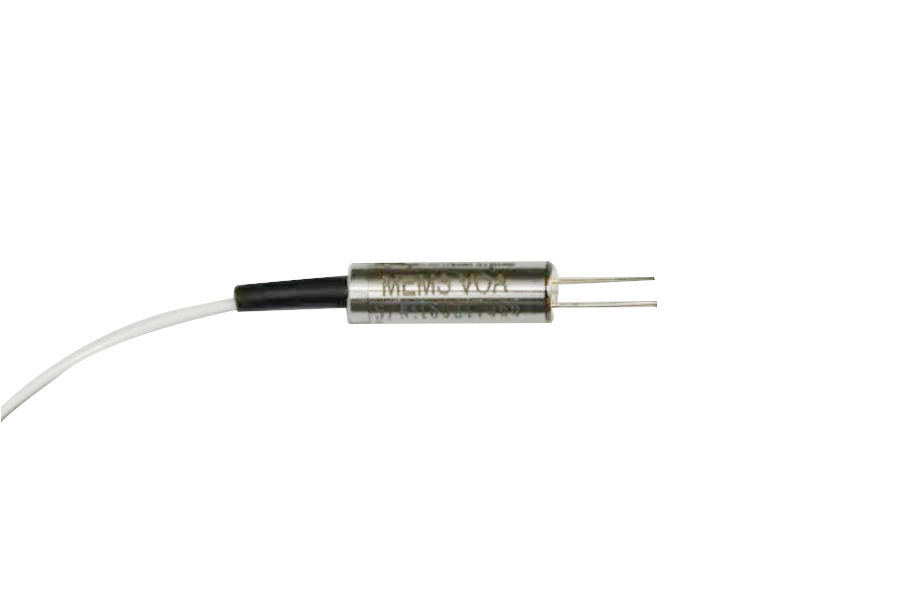
Performance Analysis and Testing of Low-Power MEMS VOA in Optical Communication Links
1. Introduction
With the rapid evolution of optical communication networks toward higher speed, larger capacity, and lower power consumption, the performance requirements for optical components are becoming increasingly stringent. In the field of optical power control and dynamic adjustment, MEMS-based Variable Optical Attenuators (MEMS VOAs) are widely used in DWDM systems, EDFAs, and optical transmission links due to their low insertion loss, high precision, and excellent stability.
Among them, low-power MEMS VOAs have become a key focus in the industry. They not only reduce overall system energy consumption but also improve long-term reliability and operational stability.
This article provides a comprehensive analysis of key performance parameters, testing methods, and real-world applications of low-power MEMS VOAs in optical communication systems.
2. Working Principle of MEMS VOA
MEMS VOA (Micro-Electro-Mechanical System Variable Optical Attenuator) utilizes micro-mechanical structures—such as movable mirrors or shutters—to precisely control optical signal intensity.
Key features include:
- Optical attenuation controlled by electrical signals
- High mechanical stability and repeatability
- Support for multiple control interfaces (e.g., RS232, USB,)
- Low power consumption, ideal for high-density integration
Low-power designs are achieved by optimizing MEMS structures and drive circuits, reducing operating voltage and current requirements.
3. Key Performance Parameters of Low-Power MEMS VOA
3.1 Insertion Loss
Insertion loss refers to the optical power loss when the device operates at minimum attenuation.
- Typical value: ≤ 1.0 dB
- Critical for link budget design
Low-power designs must maintain low insertion loss while reducing energy consumption.
3.2 Attenuation Range
The adjustable attenuation range defines the maximum optical power reduction capability.
- Typical range: 0 ~ 40 dB or higher
- Used for power equalization and dynamic control
3.3 Resolution and Accuracy
- Resolution: Minimum adjustment step (e.g., 0.1 dB)
- Accuracy: Deviation between set and actual attenuation
High precision is especially important in DWDM systems.
3.4 Switching Time
The response time of the MEMS structure affects system adaptability.
- Typical value: < 10 ms
- Low-power optimization may slightly impact speed, requiring design trade-offs
3.5 Polarization Dependent Loss (PDL)
- Measures loss variation under different polarization states
- Typical value: ≤ 0.2 dB
Critical for high-performance optical networks.
3.6 Power Consumption
A core metric for low-power MEMS VOA:
- Static power: Energy required to maintain state
- Dynamic power: Energy during switching
Optimization goals:
- Lower driving voltage
- Improved mechanical efficiency
4. Testing Systems and Methods
4.1 Test Setup
A standard testing platform typically includes:
- Stable laser source
- Optical power meter
- Optical spectrum analyzer (OSA)
- Control interface (RS232 / USB )
- MEMS VOA under test
4.2 Insertion Loss Testing
Procedure:
- Measure baseline power without the device
- Insert MEMS VOA (minimum attenuation state)
- Calculate power difference
4.3 Attenuation Accuracy Testing
Steps:
- Set attenuation levels (e.g., 0–40 dB)
- Measure output optical power
- Compare with theoretical values
Evaluation metrics:
- Linearity
- Repeatability
4.4 Power Consumption Testing
Using power monitoring equipment:
- Measure current under different attenuation states
- Analyze static and dynamic consumption
4.5 Stability and Reliability Testing
Includes:
- Long-term operation (>1000 hours)
- ताप度 cycling (-40°C to +85°C)
- Vibration and shock testing
5. Application Performance in Optical Communication Links
5.1 Optical Power Equalization
In DWDM systems:
- Channel power imbalance is common
- MEMS VOA enables precise per-channel adjustment
5.2 EDFA Gain Control
In erbium-doped fiber amplifiers:
- Prevent gain saturation
- Improve system stability
5.3 Automatic Power Control (APC)
Integrated with monitoring systems:
- Real-time feedback adjustment
- Enhanced link reliability
5.4 Data Centers and Energy-Efficient Networks
Low-power advantages include:
- Reduced overall energy consumption
- Lower thermal load
- Higher integration density
6. Advantages of Low-Power MEMS VOA
Compared with conventional VOAs, low-power MEMS VOAs offer:
- Reduced energy consumption for green networks
- Higher reliability with lower thermal stress
- Suitability for large-scale deployment
- Support for remote and intelligent control
7. Conclusion
Low-power MEMS VOAs play a critical role in modern optical communication systems by enabling precise optical power control while significantly reducing energy consumption. Through systematic performance testing and optimization, they demonstrate excellent performance in DWDM systems, EDFA control, and data center networks.
As optical networks continue evolving toward intelligence and sustainability, low-power MEMS VOAs will become increasingly important in high-density and energy-efficient optical infrastructures.
Comments are closed