


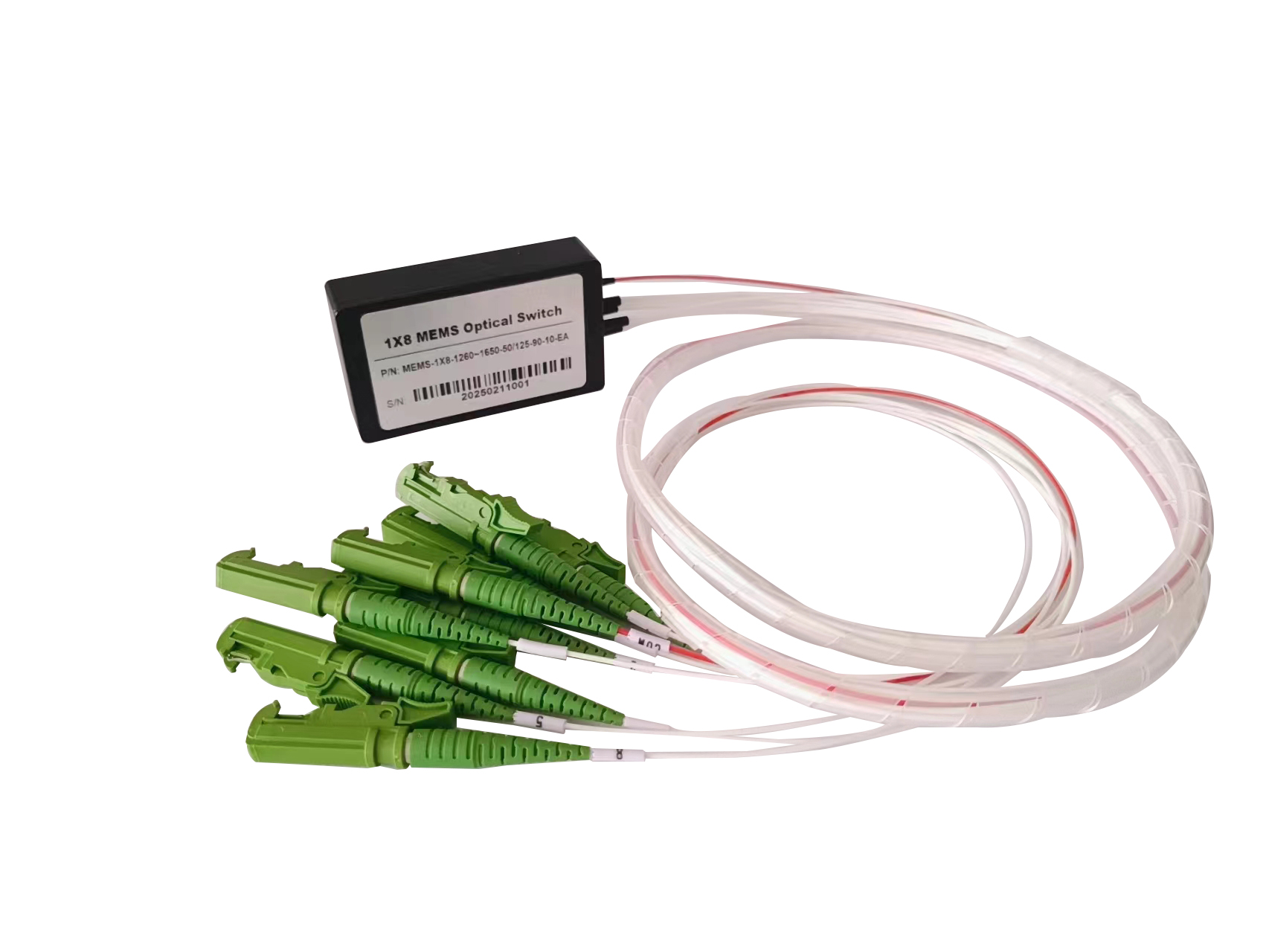
1×8 MEMS Optical Switch Module: Key Device for Automatic Fiber Line Protection Switching
In the era of high-speed optical communication, network stability and service continuity have become critical. Whether in data centers, 5G transport networks, or long-haul fiber transmission systems, any fiber link failure can lead to service interruption and significant losses. Therefore, building optical networks with automatic protection switching capabilities has become an industry standard.
In this context, the 1×8 MEMS optical switch module stands out as a key component, thanks to its high reliability, fast response, and flexible control.
1. What is a 1×8 MEMS Optical Switch Module?
1×8 MEMS optical switch is a micro-electro-mechanical system (MEMS)-based device that directs one input optical signal to any of eight output channels.
Its core working principle relies on micro-mirrors that precisely tilt to redirect the optical path. Since it uses non-contact optical switching, it offers higher stability and longer lifespan compared to traditional mechanical optical switches.
2. Automatic Protection Switching Mechanism
In practical applications, the 1×8 MEMS optical switch works together with optical power monitoring systems or network management systems to form a complete protection solution:
- Real-time monitoring of the primary link status (e.g., power drop or signal loss)
- Automatic triggering of switching commands
- Fast switching to a backup fiber path
- Automatic or manual switching back after recovery
This mechanism enables link recovery within milliseconds, significantly reducing the risk of network downtime.
3. Key Features and Advantages
. Multi-channel redundancy protection
The 1×8 configuration supports one primary path with multiple backup channels, greatly improving network reliability.
. High reliability and ultra-long lifetime
With no mechanical wear, MEMS devices typically achieve switching lifetimes exceeding 10⁹ cycles.
. Low insertion loss and excellent optical performance
Optimized optical design ensures low signal loss and minimal crosstalk, meeting high-performance communication requirements.
. Fast switching speed
Millisecond-level switching meets real-time protection and dynamic routing needs.
. Flexible control interfaces (optimized)
Supports multiple control methods, including:
- TTL (level control)
- RS232 (serial communication)
- I²C (IIC) interface
Among them, the I²C interface is especially suitable for embedded and board-level integration, offering:
- Simple wiring and fewer I/O requirements
- Multi-device support via bus architecture
- Low power consumption
- Cost-effective for large-scale deployment
Compared to Ethernet-based control, I²C is better suited for internal device communication rather than remote network management.
4. Typical Applications
. Optical Transport Networks (OTN)
Enables automatic switching between primary and backup paths to ensure backbone network stability.
. Data Center Optical Link Management
Supports dynamic routing and redundancy between servers and switches.
. Fiber Optic Testing and Monitoring Systems
Allows automated multi-channel switching to improve testing efficiency.
. Fiber Sensing and Research Systems
Suitable for multi-point signal acquisition and path selection.
5. Key Parameters and Selection Guide
When selecting a 1×8 MEMS optical switch module, consider the following:
- Operating wavelength: 1310 nm / 1550 nm or broadband
- Insertion loss: impacts overall link budget
- Return loss & crosstalk: affect signal quality
- Switching time: determines protection speed
- Repeatability & stability: critical for long-term performance
- Control interface: TTL / RS232 / I²C (recommended for embedded systems)
- Package type: module or rack-mounted (1U system)
👉 Selection tips:
- For embedded systems → choose I²C control
- For lab/testing environments → choose RS232
- For simple switching → choose TTL control
6. Why Choose Us
As a professional manufacturer of optical communication components, we provide high-performance MEMS optical switch solutions with the following advantages:
- ✔ Mature MEMS technology platform with proven reliability
- ✔ Low insertion loss design (typ. ≤ 1.0 dB)
- ✔ High channel uniformity for stable system performance
- ✔ Multiple control interfaces (TTL / RS232 / I²C)
- ✔ Flexible customization (wavelength, package, interface, etc.)
- ✔ Strict quality control for telecom and industrial-grade applications
7. Conclusion
As network reliability requirements continue to rise, the 1×8 MEMS optical switch module has become a core component in fiber line protection systems. Its multi-channel redundancy, fast switching capability, and flexible I²C control make it indispensable in modern optical networks.
For users seeking higher system reliability and intelligent operation, deploying MEMS optical switches is not just a technical upgrade—it is a critical step toward ensuring uninterrupted service continuity.
Comments are closed