


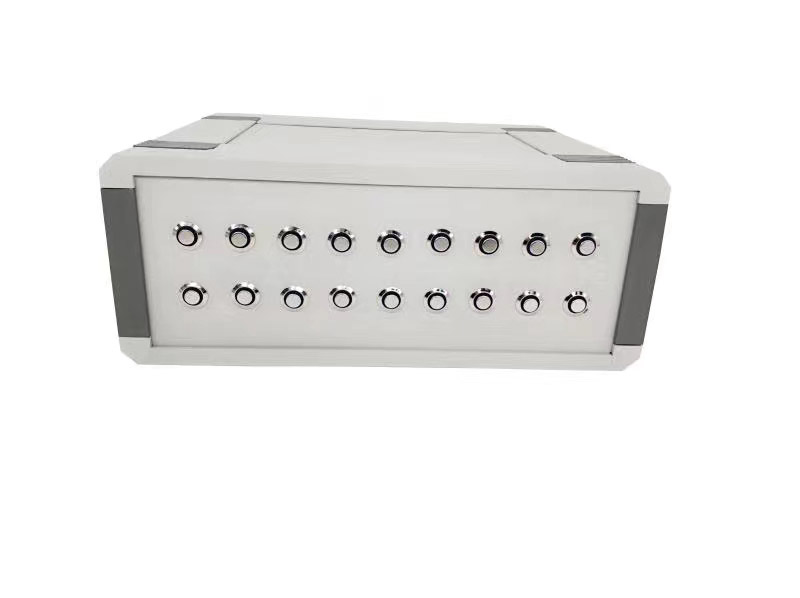
1×16 Desktop Optical Switch with Independent Push Buttons: An Ideal Solution for Efficient Optical Routing and Automated Testing
As optical communication systems, fiber optic sensing networks, and photonic research platforms continue to expand in complexity, efficient optical path management has become increasingly important. The 1×16 Desktop Optical Switch with Independent Push Buttons and RS232 Serial Control provides a reliable and flexible solution for routing optical signals among multiple channels, enabling fast switching, automated testing, and simplified system integration.
Designed for both manual operation and remote control, this optical switch combines user-friendly front-panel push buttons with RS232 communication capabilities, making it suitable for laboratories, manufacturing environments, optical network monitoring, and automated test systems.
Product Overview
The 1×16 Desktop Optical Switch allows a single optical input signal to be switched to any one of sixteen output channels. The compact desktop enclosure features sixteen dedicated push buttons on the front panel, allowing users to select channels directly without additional software.
In addition to manual operation, the switch is equipped with an RS232 serial communication interface, enabling remote control through a PC, industrial controller, PLC, or automated testing platform. This dual-control architecture provides maximum flexibility for both standalone and integrated system applications.
Operating Principle
The system consists of:
- One common input port (COM)
- Sixteen output ports (CH1–CH16)
- High-precision mechanical switching mechanism
- Front-panel independent channel buttons
- RS232 serial control interface
When a channel is selected either through the front panel or via an RS232 command, the internal mechanical actuator aligns the optical path with the corresponding output port.
At any given moment, only one output channel is connected to the input signal, ensuring dedicated signal transmission without optical splitting or unwanted interference.
Key Features and Advantages
Independent Push-Button Operation
The front-panel push-button design offers immediate channel selection without requiring a computer or software installation.
Benefits include:
- Simple operation
- Fast channel switching
- Reduced training requirements
- Convenient field deployment
- Ideal for laboratory environments
Users can manually switch channels with a single button press, significantly improving operational efficiency.
RS232 Remote Control Capability
For automated systems, the integrated RS232 serial interface provides seamless remote operation.
Functions include:
- Remote channel selection
- Automatic scanning sequences
- Integration with test software
- PLC and industrial controller compatibility
- Computer-based optical path management
The RS232 interface enables users to incorporate the optical switch into larger automated testing and monitoring systems, reducing manual intervention and improving productivity.
High-Reliability Mechanical Switching Technology
The switch utilizes proven mechanical optical switching technology, offering:
- Low insertion loss
- High return loss
- Excellent repeatability
- High channel isolation
- Long operational lifetime
Mechanical switching ensures stable optical performance over millions of switching cycles.
Excellent Optical Performance
Typical specifications include:
| Parameter | Typical Value |
|---|---|
| Insertion Loss | ≤ 1.0 dB |
| Return Loss | ≥ 55 dB |
| Crosstalk | ≥ 70 dB |
| Switching Time | ≤ 20 ms |
| Repeatability | ≤ ±0.02 dB |
| Lifetime | > 10 Million Cycles |
These characteristics provide reliable and accurate optical signal routing for demanding applications.
Support for Multiple Fiber Types
The optical switch can be customized for various fiber types, including:
- Single-Mode Fiber (SMF)
- Multimode Fiber (MMF)
- Polarization-Maintaining Fiber (PMF)
Available operating wavelengths include:
- 850 nm
- 980 nm
- 1064 nm
- 1310 nm
- 1550 nm
- C+L Band
This versatility makes the switch suitable for communication, sensing, laser, and research applications.
Typical Applications
Automated Optical Testing Systems
By utilizing RS232 control, the optical switch can be integrated into automated test platforms for:
- Optical transceiver testing
- WDM component characterization
- Optical amplifier evaluation
- Production-line inspection
Automated channel switching significantly improves testing efficiency while reducing labor costs.
Fiber Optic Sensing Networks
The switch allows a single interrogation unit to access multiple sensing channels sequentially.
Applications include:
- Structural health monitoring
- Power grid monitoring
- Pipeline surveillance
- Perimeter security systems
This approach reduces equipment costs while maintaining system flexibility.
Research and Development Laboratories
Researchers can easily switch among multiple experimental setups using either manual buttons or software-controlled RS232 commands.
Suitable for:
- Laser experiments
- Optical measurement systems
- Interferometers
- Fiber optic device research
Optical Communication Network Management
The switch can be used for:
- Backup path selection
- Network monitoring
- Link testing
- Fault isolation
Remote RS232 control enables centralized operation and faster troubleshooting.
Dual-Control Design: Manual and Remote Operation
One of the most significant advantages of this 1×16 desktop optical switch is its dual-control architecture.
Manual Control
- Independent channel buttons
- Instant operation
- No software required
- Ideal for local testing
RS232 Remote Control
- Computer-controlled switching
- Automated testing support
- PLC integration
- Remote management capability
This combination provides the flexibility to operate the switch either as a standalone device or as part of a sophisticated automated system.
Conclusion
The 1×16 Desktop Optical Switch with Independent Push Buttons and RS232 Serial Control combines high-performance optical switching, intuitive manual operation, and powerful remote-control capabilities in a compact desktop platform.
With low insertion loss, high reliability, excellent repeatability, and seamless automation support, it is an ideal solution for optical communications, fiber sensing, research laboratories, manufacturing test systems, and network management applications.
Whether used for manual optical routing or fully automated testing environments, this versatile optical switch delivers dependable performance, operational convenience, and long-term reliability.
Comments are closed