


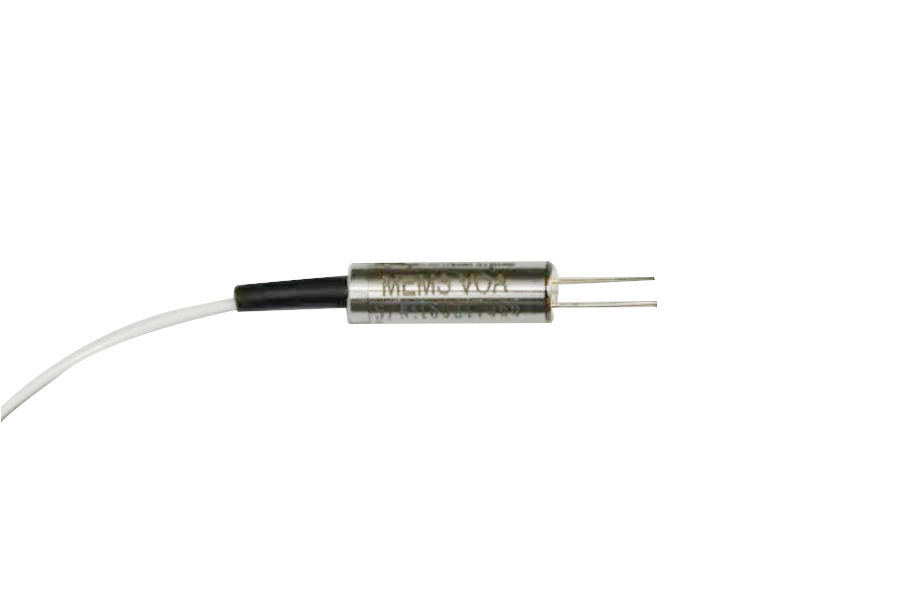
MEMS Variable Optical Attenuator: Key Device for Precise Optical Power Control
With the rapid development of optical communication networks, fiber optic sensing systems, and optical testing equipment, the demand for precise optical power control continues to grow. As a critical passive component in optical networks, the MEMS Variable Optical Attenuator (MEMS VOA) has become an indispensable device in modern optical communication systems due to its high precision, low power consumption, fast response, and excellent reliability.
What is a MEMS Variable Optical Attenuator?
MEMS Variable Optical Attenuator is an optical power control device based on Micro-Electro-Mechanical Systems (MEMS) technology. Its primary function is to continuously or stepwise attenuate optical signals without altering their wavelength or transmission characteristics, thereby enabling precise control of output optical power.
By adjusting the position of a microscopic mirror or attenuation structure, the MEMS VOA dynamically controls the amount of optical energy passing through the optical path, ensuring optimal power balancing and system performance.
Working Principle of MEMS VOA
MEMS Variable Optical Attenuators utilize micro-mechanical structures that produce precise displacement under electrical control, thereby changing the optical coupling efficiency.
The basic operating process is as follows:
- The input optical signal is converted into a collimated beam through a fiber collimator.
- A MEMS micro-mirror or attenuation mechanism partially deflects or blocks the optical beam.
- The amount of light coupled into the output fiber is adjusted.
- Continuous and precise optical attenuation is achieved.
Through accurate control of the driving voltage, the attenuation level can be adjusted with excellent stability and repeatability.
Key Features of MEMS VOA
1. High-Precision Attenuation Control
MEMS technology enables sub-micron displacement control, providing highly accurate attenuation adjustment suitable for DWDM systems and high-speed optical communication networks.
2. Low Insertion Loss
Optimized optical design ensures extremely low insertion loss at minimum attenuation, maximizing transmission efficiency.
3. Wide Attenuation Range
Typical attenuation ranges include:
- 0–30 dB
- 0–40 dB
- Customized higher attenuation ranges available
This flexibility allows the device to meet various application requirements.
4. High Reliability
The non-contact MEMS structure eliminates mechanical wear, providing an operational lifetime of billions of switching cycles.
5. Low Power Consumption
Compared with traditional motor-driven attenuation solutions, MEMS-based devices consume significantly less power, making them ideal for large-scale optical network deployments.
6. Fast Response Time
Typical response times are in the millisecond range, enabling rapid adaptation to dynamic network conditions.
Typical Technical Specifications
| Parameter | Typical Value |
|---|---|
| Operating Wavelength | 1260–1650 nm |
| Insertion Loss | ≤ 0.8 dB |
| Attenuation Range | 0–30 dB / 0–40 dB |
| Return Loss | ≥ 50 dB |
| Polarization Dependent Loss (PDL) | ≤ 0.2 dB |
| Response Time | ≤ 10 ms |
| Repeatability | ±0.1 dB |
| Operating Temperature | -40°C to +85°C |
Typical Applications of MEMS VOA
DWDM Systems
In Dense Wavelength Division Multiplexing (DWDM) networks, power levels may vary among wavelength channels. MEMS VOAs help equalize channel power, improving overall transmission performance.
EDFA Optical Amplifiers
Erbium-Doped Fiber Amplifiers (EDFAs) require stable output power control. MEMS VOAs dynamically adjust optical power levels to prevent amplifier saturation and maintain optimal performance.
ROADM Intelligent Optical Networks
In Reconfigurable Optical Add-Drop Multiplexers (ROADMs), MEMS VOAs are used for dynamic power management and automatic optical path optimization.
Optical Test and Measurement Equipment
MEMS VOAs are widely used in:
- Optical Power Meters
- Optical Spectrum Analyzers
- Optical Network Test Platforms
- Automated Test Systems
They provide accurate optical power calibration and control during testing procedures.
Fiber Optic Sensing Systems
In fiber optic gyroscopes, distributed sensing networks, and various fiber sensing applications, MEMS VOAs are used for signal balancing and system calibration.
MEMS VOA vs. Traditional Variable Optical Attenuators
| Feature | MEMS VOA | Mechanical VOA |
|---|---|---|
| Response Speed | Fast | Relatively Slow |
| Control Precision | High | Moderate |
| Power Consumption | Low | Higher |
| Service Life | Long | Shorter |
| Stability | Excellent | Average |
| Size | Compact | Larger |
As optical communication systems continue to evolve toward higher speeds, greater capacity, and increased intelligence, MEMS VOA technology has become one of the preferred solutions for optical power management.
Future Development Trends
Driven by the growth of data centers, 5G transport networks, AI computing infrastructure, and quantum communication technologies, optical power management requirements are becoming increasingly demanding. Future MEMS Variable Optical Attenuators are expected to offer:
- Lower insertion loss
- Higher attenuation accuracy
- Faster response times
- Smaller package sizes
- Greater integration density
- Intelligent closed-loop control
By integrating with optical switches, MEMS mirror arrays, and advanced photonic systems, MEMS VOAs will play an increasingly important role in next-generation intelligent optical networks.
Conclusion
With advantages such as high precision, low power consumption, rapid response, and outstanding reliability, MEMS Variable Optical Attenuators have become essential components in optical communication systems, fiber optic sensing networks, and test and measurement equipment. As demand for intelligent optical networking and high-speed data transmission continues to grow, MEMS VOA technology will play a vital role in the future of the photonics industry, helping to build more efficient, stable, and intelligent optical networks.
Comments are closed