


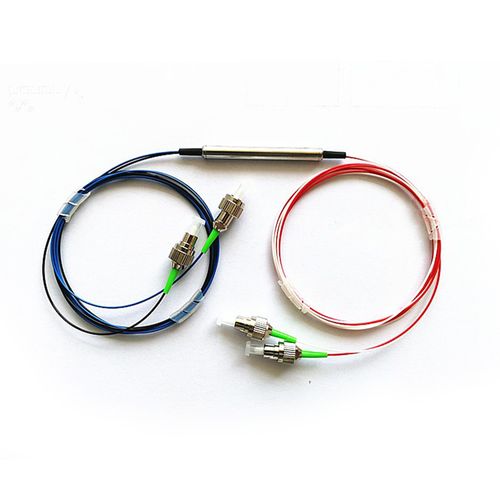
Applications of Wavelength 1064 nm Fiber Optic Circulators
Wavelength 1064 nm fiber optic circulator is a crucial passive optical component. Its core function is to enable low-loss, unidirectional transmission of optical signals among multiple ports. The specific wavelength of 1064 nm lies in the near-infrared spectrum and is the typical operating wavelength for many high-performance light sources, especially Ytterbium-doped fiber lasers. Therefore, its applications are highly concentrated in laser technology and related fields.
The following outlines its main application areas, listed from core to extended applications:
1. Fiber Laser Systems (Core Application)
-
High-Power Ytterbium-doped (Yb) Fiber Lasers/Amplifiers: This is the primary and most widespread application for 1064 nm circulators. The gain band of Ytterbium-doped fiber is around 1060-1100 nm, with 1064 nm being one of the most commonly used and efficient wavelengths within it. Key roles of circulators in these systems include:
-
Bidirectional Pumping Integration: Efficiently coupling pump laser light from different directions into the gain fiber to improve pumping efficiency.
-
Backward Reflection Isolation: Preventing reflected light from within the laser cavity or target reflections from returning to the sensitive seed source or earlier amplifier stages, protecting the system and ensuring stable operation.
-
Multi-stage Amplifier Cascading: In MOPA (Master Oscillator Power Amplifier) architectures, circulators are used to isolate amplifier stages, preventing backward-traveling Amplified Spontaneous Emission (ASE) or reflections from affecting preceding stages.
-
2. Lidar and Ranging Systems
-
Coherent Lidar: Used for wind measurement, atmospheric monitoring, 3D imaging, etc. The circulator directs light from the continuous-wave or pulsed seed source (1064 nm is common in solid-state and fiber lidars) to the transmitting antenna, while simultaneously directing the extremely weak backscattered light from the target to the highly sensitive receiver detector. This enables single-antenna transceiver integration, simplifying system architecture and improving signal-to-noise ratio.
-
Laser Ranging and Mapping: Operating on a similar principle, the circulator is a key component for achieving a common transmit/receive optical path, ensuring high-power transmitted light does not damage sensitive receiver modules.
3. Fiber Optic Sensing Systems
-
Distributed Fiber Sensing: Such as Phase-Sensitive Optical Time-Domain Reflectometry based on coherent Rayleigh scattering, which often uses 1064 nm or 1550 nm sources. The circulator is the core routing device for transmitting pulses and receiving backscattered signals.
-
Fiber Bragg Grating (FBG) Sensing Systems: When the reflection wavelength of FBGs is around 1064 nm, circulators are used to direct light from a broadband source into the FBG array and separate the narrowband reflected signals from the FBGs toward the demodulator.
-
Biomedical Sensing: Some near-infrared biochemical sensing applications may also utilize light sources and circulators at this wavelength.
4. Scientific Research and Advanced Technology Fields
-
Nonlinear Optical Frequency Conversion: In experiments generating second harmonic (SHG, 532 nm green light), third harmonic, or for optical parametric oscillation, circulators can be used to separate the fundamental wave (1064 nm) from the generated harmonic waves or to recycle unused fundamental light to improve conversion efficiency.
-
Quantum Optics Experiments: In some quantum communication or quantum light source generation experiments based on near-infrared wavelengths, circulators are used to control the routing of single photons or entangled photon pairs.
-
Optical Coherence Tomography (OCT): While OCT more commonly uses 1300 nm and 850 nm bands, the 1064 nm window can reduce scattering in some specialized deep-tissue imaging studies. Circulators are used to construct Michelson interferometer optical paths.
5. Test and Measurement Equipment
-
Optical Test Benches: During R&D and production, circulators are often used to build flexible test setups, such as isolating light sources, constructing return loss measurement systems, or for device characterization.
Summary of Key Technical Advantages:
-
High Isolation: Effectively protects the light source from damage by back-reflections, which is crucial for high-gain systems.
-
Low Insertion Loss: Minimizes system power loss.
-
High Power Handling: Circulators designed specifically for high-power laser applications can withstand optical powers ranging from tens to hundreds of watts.
-
Compactness and Reliability: All-fiber structure offers good stability and is easy to integrate into systems.
In summary, the applications of 1064 nm fiber optic circulators are centered around “high-power Ytterbium-doped fiber laser systems” and their derived fields such as lidar, industrial processing, scientific research, and sensing. Their essential role is to manage, route, and protect valuable 1064 nm laser light paths, making them a key foundational component in modern high-performance laser and optical systems.
Comments are closed