


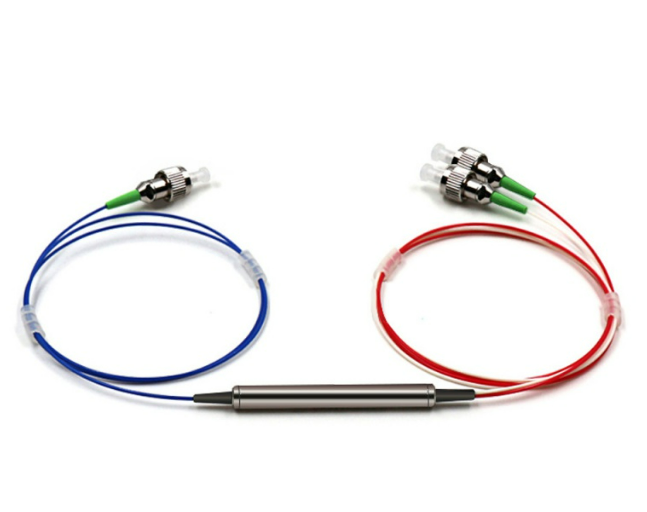
PM Fiber Circulators for Fiber Optic Sensing Systems: Anti-Interference and High-Stability Solutions
With the rapid development of fiber optic sensing technology in fields such as oil and gas monitoring, structural health monitoring, fiber optic gyroscopes, LiDAR, and industrial automation, the requirements for optical component stability and anti-interference performance are becoming increasingly demanding. In complex environments, conventional fiber optic components are easily affected by polarization fluctuations, temperature drift, and mechanical vibration, resulting in reduced sensing accuracy.
As one of the key passive optical devices, the Polarization Maintaining Fiber Circulator (PM Fiber Circulator) has become an essential component in high-performance fiber optic sensing systems due to its excellent polarization-maintaining capability, low crosstalk, and high stability.
What Is a PM Fiber Circulator?
PM Fiber Circulator is a non-reciprocal optical device based on the Faraday rotation principle, enabling directional transmission of optical signals between designated ports.
Typical signal routing includes:
- Port 1 → Port 2
- Port 2 → Port 3
- Port 3 → Port 1
Unlike standard circulators, PM circulators are packaged with polarization-maintaining fiber (PM Fiber), which effectively preserves the polarization state of the input light and minimizes polarization dependent loss (PDL) and polarization crosstalk.
Interference Challenges in Fiber Optic Sensing Systems
In practical applications, fiber optic sensing systems often operate continuously in harsh environments and are susceptible to several interference factors.
1. Polarization Disturbance
In standard single-mode fibers, the polarization state can vary randomly, leading to:
- Signal fluctuations
- Increased measurement errors
- Reduced interference stability
This issue is especially critical in interferometric fiber sensing systems.
2. Temperature Drift
Environmental temperature changes can cause:
- Optical path variations
- Wavelength drift
- Phase errors
These effects directly impact long-term system stability.
3. Back Reflection Interference
Connector reflections and device reflections can generate back-reflection noise, causing:
- Laser instability
- Reduced signal-to-noise ratio (SNR)
- Degraded sensing accuracy
4. Mechanical Vibration and Stress Changes
Industrial vibration and external stress can alter fiber birefringence characteristics, affecting polarization consistency.
How PM Fiber Circulators Improve System Stability
Excellent Polarization Maintaining Performance
PM circulators typically use Panda Fiber or Bow-Tie PM Fiber structures to maintain stable linear polarization.
Key advantages include:
- Reduced polarization mode coupling
- Improved interference stability
- Lower phase noise
- Enhanced measurement repeatability
They are particularly suitable for:
- Fiber Optic Gyroscopes (FOG)
- Fiber interferometers
- Phase-modulated sensing systems
High Isolation for Reduced Back Reflection Noise
High-performance PM circulators usually feature:
- High isolation
- Low insertion loss
- Low back reflection
These characteristics effectively suppress:
- Back reflections
- Rayleigh scattering
- Multi-path interference
As a result, the overall signal-to-noise ratio of the sensing system is significantly improved.
Advantages in Distributed Fiber Optic Sensing Systems
In distributed sensing systems such as BOTDR, BOTDA, and OTDR, PM fiber circulators can:
- Separate transmitting and receiving optical paths
- Reduce crosstalk
- Improve weak signal detection capability
- Enhance long-distance transmission stability
Their advantages become even more significant in ultra-long-distance monitoring applications.
High-Reliability Packaging Design
For industrial-grade and military-grade fiber sensing systems, PM circulators are commonly designed with highly reliable packaging technologies.
Low-Stress Packaging Process
Minimizes the influence of thermal drift and mechanical stress.
Wide Operating Temperature Range
Typical operating temperature:
- -40°C to +85°C
Suitable for harsh environments.
High Power Compatibility
Supports:
- High-power narrow linewidth lasers
- Pulsed laser systems
- Fiber laser sensing platforms
Key Specifications of PM Fiber Circulators
The following parameters should be carefully considered when selecting a PM circulator:
| Parameter | Typical Value |
|---|---|
| Operating Wavelength | 1310 / 1550 nm |
| Insertion Loss | ≤ 1.0 dB |
| Isolation | ≥ 40 dB |
| Extinction Ratio | ≥ 20 dB |
| Return Loss | ≥ 50 dB |
| Fiber Type | PM Panda Fiber |
| Operating Temperature | -40°C to +85°C |
Typical Applications
Fiber Optic Gyroscopes (FOG)
Used to stabilize optical signal transmission and improve angular velocity measurement accuracy.
Fiber Interferometric Sensors
Enhances phase detection stability and resistance to polarization interference.
Distributed Temperature and Strain Monitoring
Widely used in:
- Oil and gas pipelines
- Power cables
- Bridge structures
- Railway monitoring systems
Fiber Laser Systems
Applied in laser feedback control and reflection isolation.
Why High-End Fiber Optic Sensing Systems Prefer PM Devices
As fiber optic sensing technology evolves toward higher precision, system requirements are shifting from simply “functional” to “highly stable, reliable, and consistent over long-term operation.”
Although conventional components are less expensive, they are more vulnerable to:
- Temperature variations
- Polarization drift
- Environmental vibration
In contrast, PM fiber circulators significantly improve:
- System stability
- Measurement consistency
- Long-term reliability
- Environmental resistance
Therefore, PM circulators are increasingly becoming standard components in advanced fiber optic sensing systems.
Conclusion
In modern fiber optic sensing systems, anti-interference capability and long-term stability have become critical performance requirements. With their superior polarization-maintaining capability, high isolation, and industrial-grade reliability, PM fiber circulators provide a stable and dependable optical path solution for high-precision sensing applications.
As distributed sensing, fiber optic gyroscopes, and intelligent monitoring systems continue to advance, PM fiber circulators will play an increasingly important role in future high-end optical sensing technologies.
Comments are closed