


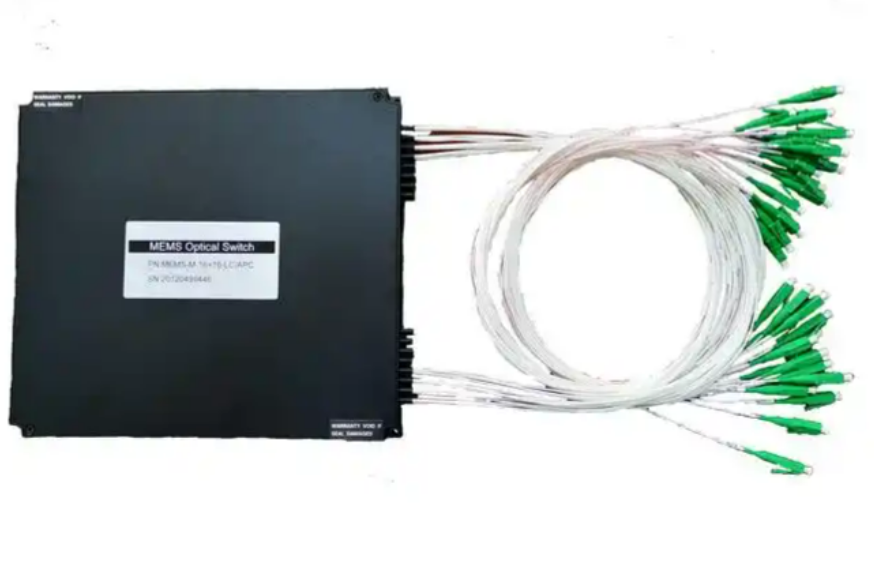
What are MEMS Optical Switches and 4×4 Full Switching Structures?
MEMS (Micro-Electro-Mechanical Systems) optical switches utilize micro-electromechanical mirror technology to achieve optical path switching, and are one of the important technological routes for high-performance optical switching equipment. 4×4 full switching structure means a fully interconnected capability of 4 inputs × 4 outputs, used to build small optical matrices or as fundamental building blocks for larger matrix modules. MEMS switches offer low loss, high reliability, and fast switching performance.
I. Key Considerations Before Purchase
When selecting a 4×4 MEMS optical switch, the following parameters and features are particularly important:
✅ 1. Optical Performance Parameters
- Insertion Loss
- Represents the signal loss when passing through the switch (typically in the 1~2 dB range). Lower insertion loss means less signal attenuation.
Crosstalk - Lower values indicate less interference between different channels, and its importance increases with the sensitivity of the application.
- Return Loss
- Characterizes the loss of the reflected signal; higher values are better and affect system stability.
- Polarization Dependent Loss (PDL) & Wavelength Dependent Loss (WDL)
- Especially important for high-performance links (e.g., DWDM systems).
✅ 2. Mechanical and Reliability Indicators
- Switching Time / Response Time
- Typical MEMS switch switching time is in the millisecond range.
- Cycle Life / Durability
- MEMS typically support over 10⁹ cycles, making them ideal for frequent switching scenarios.
- Operating/Storage Temperature Range
- Depends on whether it is used in a laboratory, room temperature environment, or harsh environment.
✅ 3. Electrical and Control Interfaces
Common control methods include UART, USB, I2C/SMBus, network (SNMP/TCP-IP), etc. Selection should consider compatibility with existing control systems.
✅ 4. Port Type and Fiber Specifications
Determine single-mode (SM) or multi-mode (MM) fiber
Fiber connector type (e.g., FC/PC, LC/UPC, SC/APC, etc.)
These will affect system link design and optical loss performance.
🏷️ Recommended MEMS Optical Switch Suppliers/Products
⚠️ Note: MEMS optical switches are professional optical communication components. Products usually require direct communication with the manufacturer to customize specific specifications (wavelength, port type, control interface, chassis form factor, etc.). The following are typical options available on the market:
📌 1. High-End/Matrix-Grade MEMS Optical Switches
MEMS Matrix Fiber Optical Switch – 48×48
A multi-port large-scale matrix optical switching device, suitable for building high-density switching systems or as a large system module. Higher price but comprehensive performance.
📌 2. Small to Medium-Scale MEMS Optical Switches
4×4 MEMS Optical Switch Matrix
Dedicated 4×4 MEMS optical matrix module, suitable for experiments, R&D, small network expansion, or monitoring and splitting.
- Typical specifications example (referencing similar products):
- Wavelength range: 1260~1620 nm
- Insertion loss: typically 1.2 dB, maximum ~2 dB
- Crosstalk: ≥50 dB
- Switching time: <5 ms
- Reliability: ≥10⁹ cycles
⚠️ Actual specifications need to be confirmed with the supplier. The above is only a reference based on similar products.
Is it for monitoring, splitting, system switching, or R&D verification?
- Determine the data rate, wavelength, number of fiber cores (SM/MM), etc.
- Preliminary screening of suppliers and specifications
- Then compare key indicators such as insertion loss, crosstalk, and control interface.
- Obtain samples/technical manuals and perform testing
- Negotiate with the supplier to obtain evaluation samples and conduct experimental verification.
- Confirm compatibility & standard support
- Confirm that the fiber type, connector type, and system control protocol match.
For customized matrix MEMS optical switches, please contact our sales representatives.
Comments are closed