


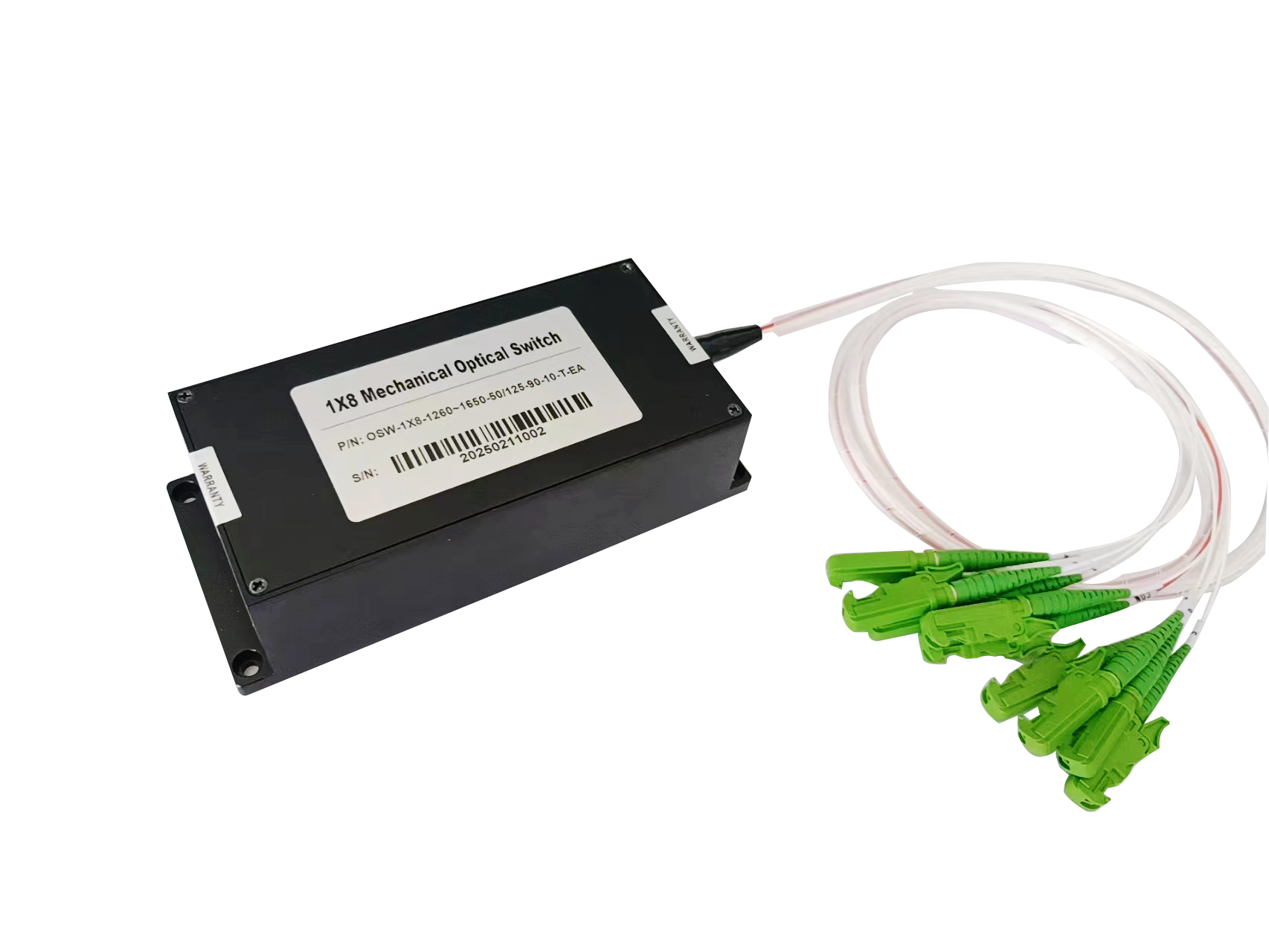
Mechanical Optical Switch: The “Traffic Hub” of Intelligent Optical Networks
In today’s rapidly evolving optical communication era, networks demand ever-increasing bandwidth, stability, and flexibility. As a key foundational component in optical systems, the mechanical optical switch plays a role similar to a “traffic hub,” enabling precise routing and management of optical signals, and providing a solid foundation for the efficient operation of intelligent optical networks.
1. What is a Mechanical Optical Switch?
Mechanical optical switch is a device that changes the transmission path of optical signals by physically moving optical elements such as mirrors, prisms, or optical fibers. Its core function is to switch between different optical paths, enabling signal distribution, backup protection, and testing or monitoring.
Compared with semiconductor or MEMS optical switches, mechanical optical switches feature a simpler structure, higher stability, and lower insertion loss, making them particularly suitable for applications that demand high reliability.
2. Key Advantages
. Low Insertion Loss
Mechanical designs typically use direct fiber alignment or precision collimation, ensuring minimal signal loss during switching and maintaining signal integrity.
. High Isolation
They effectively prevent signal crosstalk, ensuring independence between channels and improving system stability and security.
. High Reliability and Long Lifetime
Optimized mechanical designs can support millions of switching cycles, making them ideal for long-term operation.
. Wide Wavelength Range
They support a broad spectrum from visible to infrared wavelengths (e.g., 1310 nm, 1550 nm), meeting diverse application requirements.
3. Typical Applications
. Optical Network Protection
In backbone fiber networks, mechanical optical switches enable automatic protection switching (OLP systems). When the primary link fails, the system rapidly switches to a backup link to ensure uninterrupted communication.
. Data Center Optical Routing
In large-scale data centers, optical switches enable flexible fiber routing, improving resource utilization and supporting dynamic network architectures.
. Fiber Optic Testing Systems
In laboratories and production environments, mechanical optical switches allow fast switching between test paths, significantly improving testing efficiency.
. Fiber Optic Sensing Systems
In distributed sensing applications, optical switches enable multi-point monitoring and enhance system scalability.
4. Common Types
- 1×2 Optical Switch: One input with two outputs, commonly used for protection switching
- 1×N Optical Switch: One input to multiple outputs, suitable for signal distribution
- N×N Optical Switch Matrix: Allows arbitrary input-output connections for complex network routing
5. Technology Trends
With the advancement of intelligent optical networks and photonic integration, mechanical optical switches continue to evolve:
- Miniaturization and modular design for easier system integration
- Smart control interfaces such as TTL, RS232, and Ethernet
- Faster switching speeds, improving from milliseconds toward higher performance
- Enhanced environmental robustness for industrial and military-grade applications
6. Conclusion
As the “traffic hub” of optical networks, mechanical optical switches not only handle critical signal routing tasks but also play a vital role in ensuring network stability. In the future, as intelligent optical networks continue to evolve, their high reliability and strong performance will remain indispensable.
For optical communication equipment manufacturers and system integrators, selecting stable and well-designed mechanical optical switch solutions is key to building efficient and reliable optical network infrastructures.
Comments are closed