


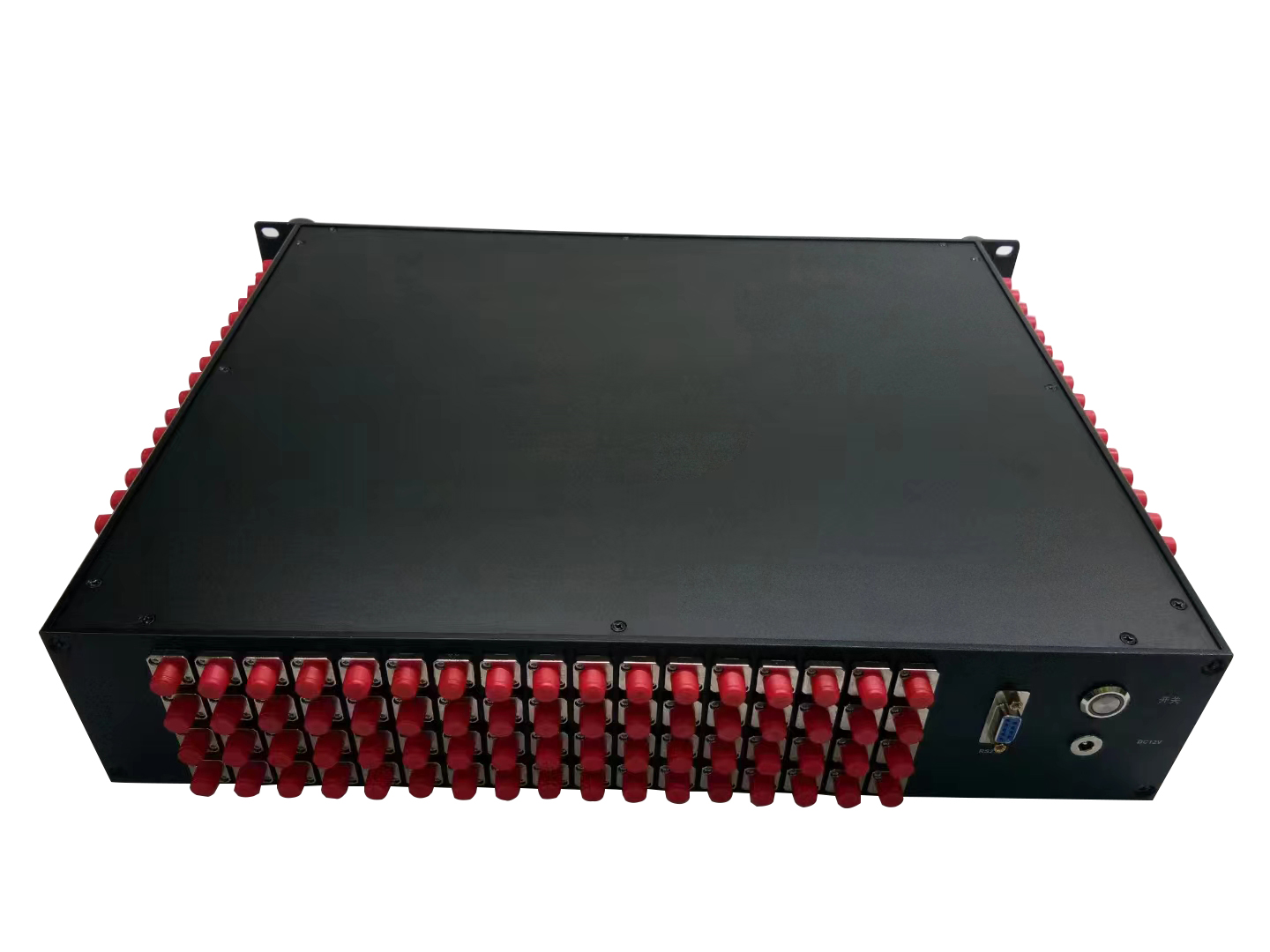
Why Do Data Centers Use MEMS Optical Switches?
With the rapid growth of cloud computing, artificial intelligence, large-scale data storage, and high-speed networks, modern data centers demand greater bandwidth, higher reliability, and increased network flexibility. As a key device for dynamic optical path management, MEMS (Micro-Electro-Mechanical Systems) optical switches have become an important component of data center optical networks.
What Is MEMS Optical Switch?
MEMS optical switch uses microscopic mirror arrays to redirect optical signals by changing the angle of the mirrors, enabling optical path switching without optical-electrical-optical (O-E-O) conversion.
Compared with traditional electronic switching methods, MEMS optical switches can process optical signals directly, providing true all-optical switching.
Why Are MEMS Optical Switches Needed in Data Centers?
1. Improved Network Flexibility
Data centers contain numerous servers, switches, and storage devices, while traffic loads constantly change.
MEMS optical switches can:
- Dynamically adjust optical connections;
- Rapidly reconfigure network topologies;
- Enable on-demand resource allocation;
- Improve network utilization.
When certain links become congested, optical switches can automatically redirect traffic to available channels, reducing bottlenecks.
2. Lower Power Consumption
Traditional electronic switching requires:
Optical → Electrical → Optical (O-E-O)
This conversion process consumes considerable power.
MEMS optical switches employ:
Optical → Optical (O-O)
Since no signal conversion is required, they offer:
- Lower power consumption;
- Reduced heat generation;
- Higher energy efficiency.
For large-scale data centers with tens of thousands of servers, the energy savings can be significant.
3. Support for Massive Connectivity
MEMS technology enables switching matrices such as:
- 8×8
- 16×16
- 32×32
- 64×64
- 128×128
- 384×384 and beyond
The high port density makes MEMS optical switches ideal for:
- Hyperscale data centers;
- AI computing clusters;
- GPU server networks;
- Spine-Leaf architectures.
A single optical switching matrix can interconnect hundreds of fiber channels, significantly reducing cabling complexity.
4. Fast Failure Recovery
Link failures in data centers can interrupt services and affect availability.
MEMS optical switches can work with:
- Optical Line Protection (OLP);
- Automatic protection switching systems;
- Software-Defined Networking (SDN) platforms;
to achieve optical path switching within milliseconds to tens of milliseconds.
When the primary link fails:
- The fault is detected automatically;
- A backup path is activated;
- Service continuity is restored.
This greatly improves network reliability and availability.
5. Ideal for AI Data Centers
AI training clusters require extensive interconnections among GPU nodes, such as:
- NVIDIA GPU clusters;
- InfiniBand networks;
- RoCE networks.
As the number of GPUs scales to thousands or even tens of thousands, fixed network architectures become increasingly inefficient.
MEMS optical switches enable:
- Dynamic GPU interconnections;
- Higher computing resource utilization;
- Reduced network congestion;
- Faster AI model training.
Therefore, MEMS optical switches are regarded as a key infrastructure technology for next-generation AI data centers.
6. Simplified Automated Testing and Maintenance
MEMS optical switches are widely used in:
- Optical transceiver test systems;
- Automated production lines;
- Data center monitoring systems;
- OTDR testing platforms.
Through software control, dozens or even hundreds of ports can be switched automatically, greatly improving testing efficiency and reducing manual intervention.
7. High Reliability and Long Service Life
MEMS optical switches feature:
- Low insertion loss;
- High return loss;
- Low crosstalk;
- Excellent repeatability;
- Service life exceeding one billion switching cycles.
These characteristics make them suitable for the continuous 24/7 operation required in modern data centers.
Typical Applications of MEMS Optical Switches in Data Centers
Optical Cross Connect (OXC)
Enables flexible connections between any input and output ports, enhancing network scalability and traffic management.
Optical Line Protection (OLP)
Provides automatic switchover between primary and backup links to ensure uninterrupted services.
Software-Defined Networking (SDN)
Supports intelligent and programmable optical path management.
AI Cluster Interconnection
Dynamically configures GPU network topologies to maximize computing efficiency.
Automated Test Platforms
Facilitates large-scale testing of optical modules and photonic devices.
MEMS Optical Switches vs. Mechanical Optical Switches
| Parameter | MEMS Optical Switch | Mechanical Optical Switch |
|---|---|---|
| Port Scale | 8×8 to 384×384 | 1×2 to 1×64 |
| Switching Method | MEMS mirror array | Mechanical fiber movement |
| Power Consumption | Very low | Low |
| Scalability | Excellent | Moderate |
| Network Reconfiguration | Supported | Supported |
| Large Matrix Capability | ★★★★★ | ★★ |
| Suitability for Data Centers | Excellent | Suitable for small and medium systems |
Conclusion
With the rapid evolution of 800G and 1.6T optical interconnects as well as AI-driven computing infrastructure, the demand for bandwidth and network scalability continues to grow. Thanks to their high port density, low power consumption, programmability, and all-optical switching capability, MEMS optical switches are emerging as a core technology for next-generation data center networks.
Driven by cloud computing, artificial intelligence, high-performance computing (HPC), and software-defined networking (SDN), MEMS optical switches will play an increasingly important role in building faster, smarter, and more energy-efficient data centers.
Comments are closed