


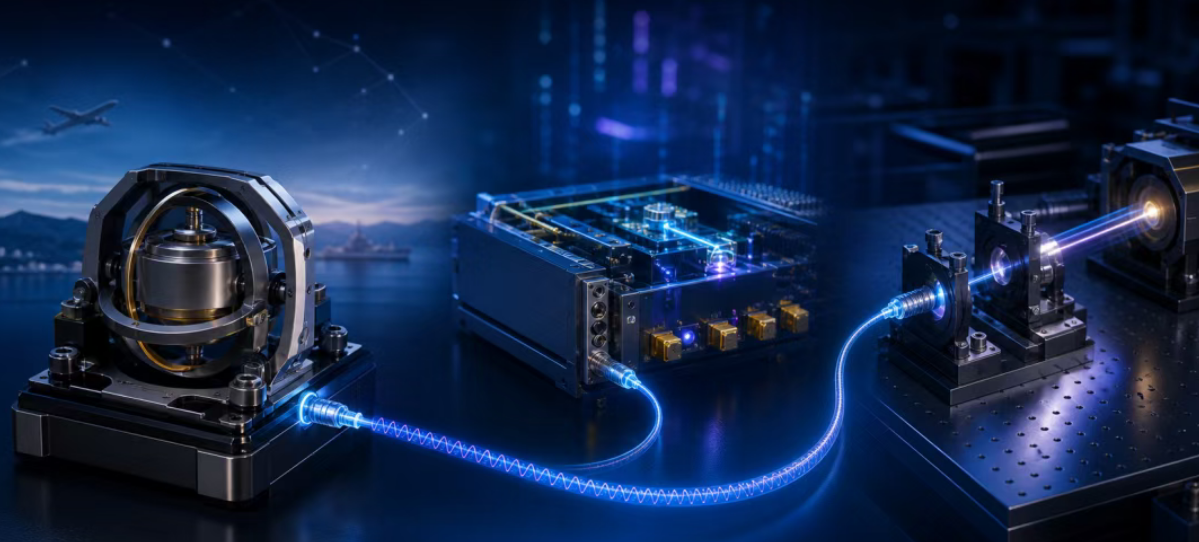
Polarization Maintaining Fiber: Keeping Light on the Right Path, Even Over Long Distances
In modern photonics applications such as fiber optic communications, fiber sensing, fiber lasers, quantum communications, and aerospace systems, light must travel not only over long distances but also maintain its original polarization state. If the polarization changes during transmission, system performance can degrade significantly, reducing measurement accuracy and signal quality. This is why Polarization Maintaining Fiber (PM Fiber) has become an essential component in high-performance optical systems.
What Is Polarization Maintaining Fiber?
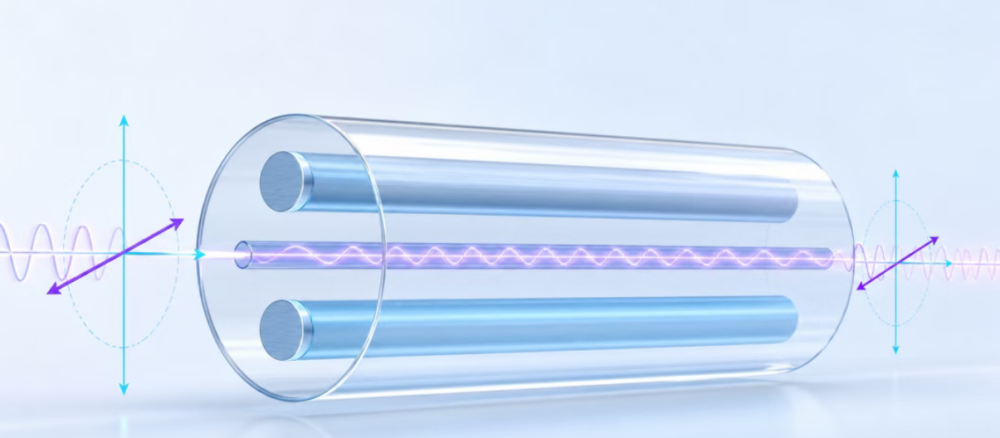
Polarization Maintaining Fiber (PM Fiber) is a specialty optical fiber designed to preserve the polarization state of light throughout transmission. Unlike standard single-mode fiber, PM fiber incorporates a specially engineered internal structure that creates high birefringence, forcing light to propagate along a designated polarization axis while minimizing polarization coupling.
Simply put, PM fiber acts like a highway with dedicated lanes, ensuring that light stays on the correct path without “losing its direction” due to environmental disturbances.
Why Is Polarization Maintenance Important?
In conventional single-mode fibers, factors such as temperature fluctuations, mechanical stress, bending, and vibration can continuously alter the polarization state of light. For many precision optical systems, these changes can lead to:
- Unstable laser output power
- Reduced interferometer accuracy
- Lower fiber optic sensor sensitivity
- Higher bit error rates in coherent communication systems
- Increased polarization-dependent loss (PDL)
By maintaining a stable polarization state, PM fiber significantly improves system reliability, repeatability, and overall performance.
Key Features of Polarization Maintaining Fiber
High Extinction Ratio (ER)
PM fiber maintains a high degree of polarization purity, making it ideal for applications requiring stable and consistent polarization.
Low Polarization Crosstalk
Its high birefringence minimizes energy coupling between orthogonal polarization modes, ensuring stable optical transmission.
Excellent Environmental Stability
PM fiber maintains excellent performance even under temperature variations, vibration, mechanical stress, and long-term operation.
Wide Wavelength Compatibility
Polarization maintaining fibers are available for a variety of operating wavelengths, including:
- 780 nm
- 850 nm
- 980 nm
- 1064 nm
- 1310 nm
- 1550 nm
This makes them suitable for telecommunications, industrial lasers, scientific research, and sensing applications.
Common Types of PM Fiber
Several types of polarization maintaining fibers are available to meet different application requirements, including:
- Panda PM Fiber
- Bow-Tie PM Fiber
- Elliptical Core PM Fiber
- PM980 Fiber
- PM1550 Fiber
- PM780HP Fiber
- High-Power PM Fiber
- PM Ytterbium-Doped Fiber
Among these, Panda PM Fiber is the most widely used due to its excellent stability, mature manufacturing process, and cost-effectiveness.
Typical Applications
As optical technologies continue to evolve, PM fiber has become indispensable in numerous high-precision systems.
Fiber Lasers
Maintains stable laser polarization, improving beam quality, output stability, and processing precision.
Fiber Optic Sensors
Widely used in fiber optic gyroscopes (FOG), hydrophones, strain sensing, temperature monitoring, and distributed sensing systems.
Optical Communications
In coherent optical communication networks, PM fiber helps maintain signal integrity and reduces polarization-related impairments.
Optical Test & Measurement
Used in interferometers, polarization analyzers, optical spectrum analyzers, and other precision testing equipment.
Medical and Scientific Research
Ideal for biomedical imaging, quantum optics, laboratory instrumentation, and advanced scientific experiments.
How to Choose the Right PM Fiber
When selecting a polarization maintaining fiber, consider the following key specifications:
- Operating wavelength
- Fiber structure (Panda, Bow-Tie, etc.)
- Mode Field Diameter (MFD)
- Extinction Ratio (ER)
- Insertion Loss (IL)
- Return Loss (RL)
- Optical power handling capability
- Fiber length and jacket type
- Connector type (FC/APC, FC/PC, LC, etc.)
Choosing the appropriate specifications ensures optimal performance and long-term system reliability.
Conclusion
The “polarization-maintaining” capability of polarization-maintaining fiber does not essentially lock the light in a fixed state; rather, it employs strong birefringence to minimize energy coupling between the two orthogonal polarization modes.
For the fiber to function effectively, three factors are critical: precisely aligning the input light with the principal axes, minimizing bending and external stress during transmission, and maintaining a consistent axial orientation throughout the entire optical path.
From fiber-optic gyroscopes to coherent communications, and from precision sensing to fiber lasers, the competition among high-performance optical systems has shifted beyond the mere presence of light to the ability to control it with precision. As polarization becomes integral to information, accuracy, and stability, polarization-maintaining fiber safeguards that invisible yet vital “line of direction” within these systems.
Comments are closed