


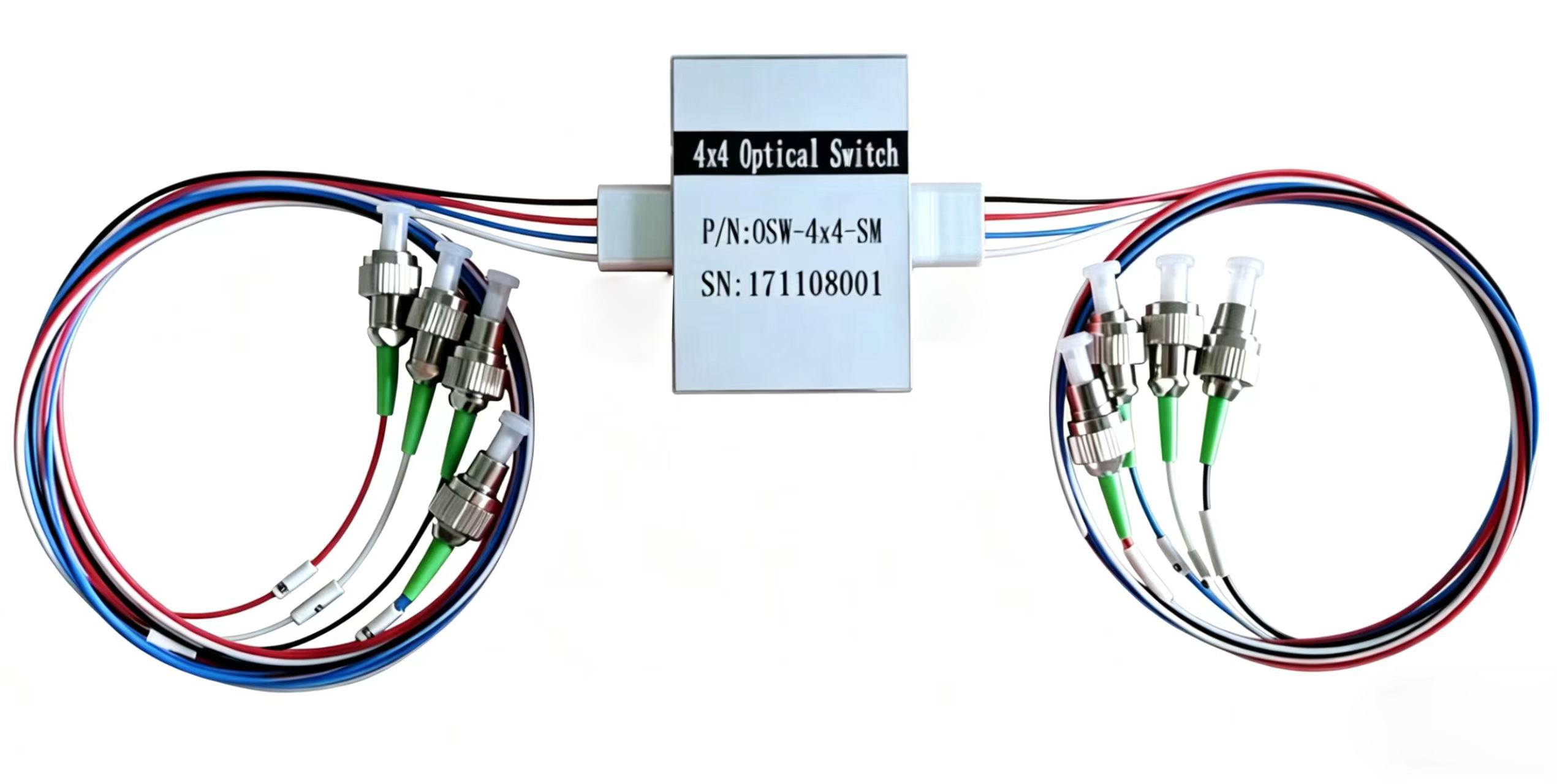
Latching vs. Non-latching Optical Switch: How to Choose?
As fiber optic communication, optical sensing, test and measurement, and data centers continue to evolve, optical switches have become essential components in modern optical networks. However, one common question engineers often face during product selection is:
Should you choose a Latching Optical Switch or a Non-Latching Optical Switch?
Although the difference lies primarily in the switching mechanism, these two types of optical switches vary significantly in terms of power consumption, reliability, fail-safe behavior, and application scenarios. This article explains their differences and helps you select the right optical switch for your system.
What Is a Latching Optical Switch?
Latching Optical Switch maintains its switching state without continuous power.
Once a short electrical pulse is applied, the switch changes to the desired optical path and remains in that position even after power is removed.
Key Features
- Requires power only during switching
- Maintains its position after power is removed
- No optical path change during a power outage
- Ideal for applications requiring long-term optical path stability
What Is a Non-Latching Optical Switch?
Non-Latching Optical Switch requires continuous electrical power to maintain its switching state.
If power is interrupted, the switch automatically returns to its default position (typically the Normally Closed, or NC, port) using an internal spring mechanism.
Key Features
- Requires continuous power
- Automatically resets to the default state upon power loss
- Fast response time
- Simple control logic
Latching vs. Non-Latching Optical Switch: What’s the Difference?
| Feature | Latching Optical Switch | Non-Latching Optical Switch |
|---|---|---|
| Holding State | No continuous power required | Continuous power required |
| Power Consumption | Very low | Higher |
| Behavior After Power Loss | Retains the last switching state | Returns to the default port |
| Heat Generation | Minimal | Higher due to continuous energization |
| Control Method | Pulse control | Continuous voltage control |
| System Reliability | Optical path remains unchanged during power failure | Automatic reset during power failure |
| Service Life | Longer in most applications | Slightly shorter under continuous operation |
| Typical Applications | Long-term optical routing | Systems requiring automatic reset |
Why Are More Systems Choosing Latching Optical Switches?
Modern communication systems often operate continuously for years.
If a non-latching optical switch is used, the coil must remain energized throughout operation.
For example:
- A 16-channel optical switch
- Operating 24 hours a day
- Running continuously throughout the year
Continuous power consumption not only increases energy usage but also generates additional heat, which may affect long-term system reliability.
By contrast, a latching optical switch consumes power only during switching, providing several important advantages:
- Lower power consumption
- Reduced heat generation
- Higher long-term stability
- Ideal for unattended operation
As a result, latching optical switches are widely used in:
- Fiber optic communication networks
- Optical Line Protection (OLP) systems
- Optical Cross Connect (OXC) systems
- Fiber optic test equipment
- Fiber optic sensing systems
- Data centers
Why Are Non-Latching Optical Switches Still Used?
Despite the advantages of latching switches, non-latching optical switches remain the preferred choice for many applications.
Their greatest advantage is:
Automatic return to the default optical path when power is lost.
For example, in a testing system:
- Under normal operation, the optical path is connected to the test equipment.
- If power fails, the switch automatically reconnects the main communication line.
This provides a natural Fail-Safe function, ensuring system protection without additional control logic.
Typical applications include:
- Automatic Test Equipment (ATE)
- Optical laboratories
- Medical devices
- Industrial automation
- Safety-critical systems
How to Choose the Right Optical Switch
Choose a Latching Optical Switch if you need:
- Long-term optical path retention
- Low power consumption
- High system stability
- Optical path preservation during power outages
- Communication equipment or data centers operating 24/7
Choose a Non-Latching Optical Switch if you need:
- Automatic return to a default optical path after power loss
- Fail-safe system protection
- Simple control circuitry
- Automatic reset functionality
- Laboratory instruments or specialized testing equipment
Xionghua Optical Switch Solutions
Xionghua Photonics offers a comprehensive range of Mechanical Optical Switches and MEMS Optical Switches, available in both Latching and Non-Latching configurations to meet various application requirements.
Our solutions include:
- 1×2, 2×2, 1×N, and N×N optical switches
- Single-mode (SM), Multimode (MM), and Polarization Maintaining (PM) fiber options
- Operating wavelengths including 850 nm, 980 nm, 1064 nm, 1310 nm, 1550 nm, and 1650 nm
- Low insertion loss, high reliability, and long service life
Our optical switches are widely used in fiber optic communications, data centers, fiber sensing, laser systems, scientific research, and automated test equipment. Customized solutions are available to meet your specific requirements.
Conclusion
Neither Latching nor Non-Latching Optical Switches are inherently better—the right choice depends entirely on your application.
If your system prioritizes low power consumption, long-term stability, and maintaining the optical path during power outages, a Latching Optical Switch is the ideal solution.
On the other hand, if your application requires automatic reset and fail-safe protection, a Non-Latching Optical Switch is the better option.
By carefully evaluating your system’s power requirements, control strategy, fail-safe needs, and operating environment, you can select the optical switch that delivers the highest performance and reliability for your optical network.
Comments are closed