


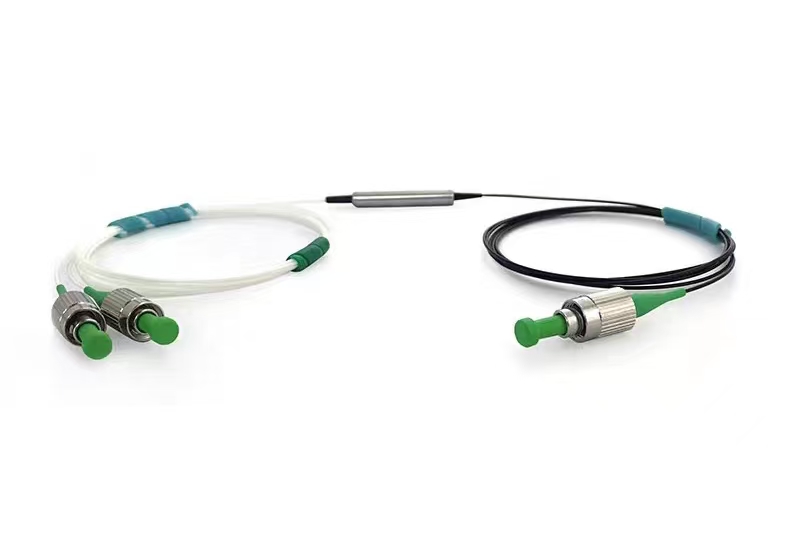
What PER Is Required for a 1×2 50:50 PM Fiber Coupler?
In fiber optic interferometric systems, the 1×2 50:50 Polarization Maintaining (PM) Fiber Coupler is one of the most critical optical components. It is widely used in fiber optic gyroscopes (FOG), fiber optic sensing, Optical Coherence Tomography (OCT), laser interferometers, phase modulation systems, and precision optical measurement equipment.
One of the most frequently asked questions by engineers is:
What Polarization Extinction Ratio (PER) is required for a 1×2 50:50 PM fiber coupler used in interferometric measurements?
The answer is not simply “the higher, the better.” Instead, the appropriate PER depends on the required measurement accuracy and system performance.
What Is Polarization Extinction Ratio (PER)?
Polarization Extinction Ratio (PER) measures a polarization-maintaining component’s ability to preserve the input state of polarization.
A higher PER indicates that the output light remains in the desired polarization state with minimal cross-polarized leakage.
For interferometric systems, a higher PER provides:
- Lower polarization crosstalk
- Higher fringe visibility
- Improved phase stability
- Better signal-to-noise ratio (SNR)
- Higher measurement accuracy
As a result, PER is one of the key specifications that directly affects interferometer performance.
Recommended PER for Different Interferometric Applications
The following values are commonly accepted in the industry:
| Application | Recommended PER |
|---|---|
| General laboratory interferometers | ≥20 dB |
| Fiber optic sensing systems | ≥23 dB |
| Optical Coherence Tomography (OCT) | ≥25 dB |
| Precision laser interferometers | ≥25–30 dB |
| Fiber Optic Gyroscopes (FOG) | ≥30 dB |
| Ultra-high precision scientific instruments | ≥35 dB |
For most industrial interferometric measurement systems, a PER of 23–25 dB provides an excellent balance between performance and cost.
If long-term nanometer- or picometer-level stability is required, a PER of 30 dB or higher is strongly recommended.
What Happens If the PER Is Too Low?
An insufficient PER can significantly degrade the performance of an interferometric system.
1. Reduced Fringe Visibility
When part of the optical power is coupled into the orthogonal polarization state, it can no longer interfere effectively with the desired signal.
This results in:
- Lower fringe visibility
- Reduced signal-to-noise ratio
- Decreased measurement sensitivity
2. Increased Phase Noise
Cross-polarized light introduces unwanted phase fluctuations.
Typical consequences include:
- Measurement drift
- Phase jitter
- Reduced long-term stability
These effects become increasingly noticeable in high-precision measurement systems.
3. Poor Temperature Stability
A lower PER makes the system more sensitive to environmental changes.
Temperature variations can alter the polarization state, causing:
- Fluctuating interference signals
- Reduced repeatability
- Lower measurement reliability
This is particularly critical in industrial, aerospace, and outdoor sensing applications.
Is a Higher PER Always Better?
From a performance perspective, yes.
However, practical considerations include:
- Manufacturing complexity
- Cost
- Insertion loss
- Delivery time
For example:
Increasing PER from 20 dB to 25 dB generally requires only moderate improvements in the manufacturing process.
However, increasing PER from 25 dB to 30 dB typically demands:
- More precise fused-biconical taper (FBT) fabrication
- Better stress control during packaging
- Higher-quality PM fibers
- More stringent testing and screening procedures
As a result, higher-PER PM couplers are generally more expensive.
Other Important Parameters to Consider
PER is only one aspect of PM fiber coupler selection. Engineers should also evaluate the following specifications.
Coupling Ratio
Most interferometric systems use:
- 50:50 ±1%
- 50:50 ±2%
A coupling ratio closer to the ideal 50:50 generally provides higher interference contrast.
Insertion Loss
Recommended specification:
≤0.3 dB
Lower insertion loss helps maximize optical power and improve overall system efficiency.
Operating Wavelength
Common wavelength options include:
- 780 nm
- 850 nm
- 980 nm
- 1064 nm
- 1310 nm
- 1550 nm
The PM fiber coupler should always be matched to the operating wavelength and fiber type.
Return Loss
Recommended specification:
≥55 dB
High return loss minimizes unwanted back reflections that could interfere with lasers and sensitive interferometric systems.
Operating Temperature
For industrial applications, a typical operating range is:
–40°C to +85°C
This ensures stable performance under demanding environmental conditions.
How to Choose the Right PER
The following recommendations can serve as a practical guide:
| Application | Recommended PER |
| General testing | ≥20 dB |
| Industrial measurements | ≥23 dB |
| Precision measurement | ≥25 dB |
| High-stability systems | ≥30 dB |
| Scientific research | ≥35 dB |
For most customers, a PER around 25 dB offers the best compromise between optical performance, long-term stability, and overall cost.
Advantages of Xionghua 1×2 50:50 PM Fiber Couplers
Xionghua offers high-performance Polarization Maintaining Fiber Couplers designed for demanding interferometric applications.
Our products feature:
- Operating wavelengths available at 780, 850, 980, 1064, 1310, and 1550 nm
- Compatible with Panda PM Fiber and Bow-Tie PM Fiber
- PER options of 23 dB, 25 dB, 30 dB, or higher (customized)
- Various coupling ratios, including 50:50, 30:70, 10:90 and 1:99
- Low insertion loss and low polarization-dependent loss (PDL)
- High return loss and excellent long-term reliability
- Multiple package styles and connector configurations available upon request
Whether your application involves fiber optic sensing, fiber optic gyroscopes, OCT imaging, laser interferometry, or scientific research, Xionghua provides reliable PM fiber couplers engineered for stable, high-precision optical performance.
Conclusion
For interferometric measurement systems, there is no universal PER requirement. The ideal specification depends on the desired measurement accuracy and application.
As a general guideline:
- 20 dB is suitable for standard laboratory testing.
- 23–25 dB meets the needs of most industrial interferometric systems.
- 30 dB or higher is recommended for fiber optic gyroscopes, ultra-stable sensing systems, and scientific research.
When selecting a PM fiber coupler, engineers should evaluate not only PER, but also coupling ratio, insertion loss, return loss, operating wavelength, and long-term environmental stability. Considering all these factors together ensures optimal system performance and reliable measurement results.
Comments are closed