


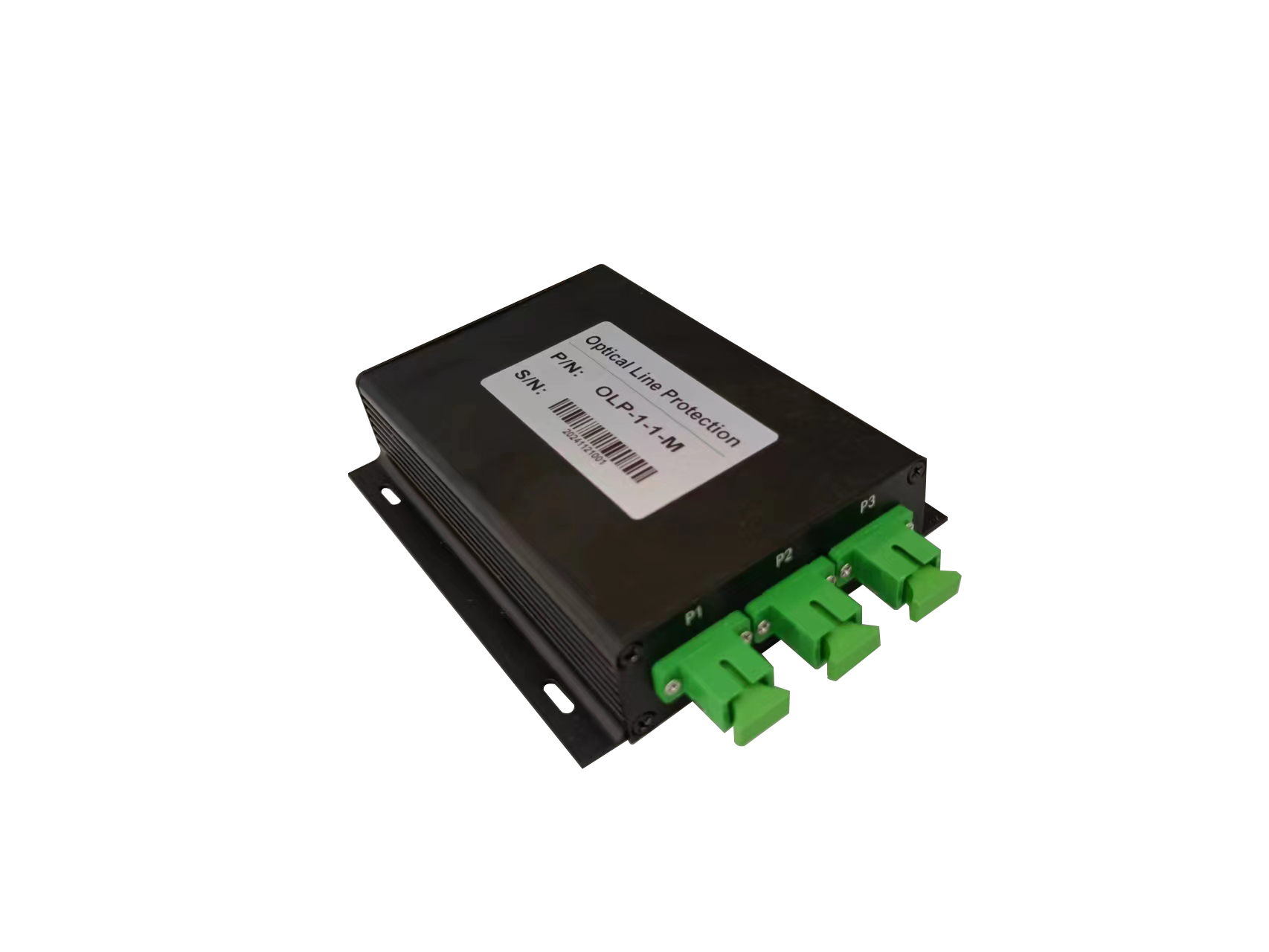
How Does an Optical Line Protection Module (OLP) Reduce the Risk of Fiber Link Interruptions?
In fiber optic communication, data centers, industrial networks, and long-distance optical networks, a fiber link failure can interrupt communication and affect critical services.
To improve network reliability, more communication systems are using Optical Line Protection (OLP) modules. By combining primary and backup fiber paths with automatic optical switching, an OLP can switch the communication path to a standby fiber when a fault is detected on the primary line, helping reduce the impact of fiber link failures.
What Is an Optical Line Protection Module (OLP)?
An Optical Line Protection (OLP) module is an optical device designed to monitor and protect fiber optic communication links.
A typical OLP system includes:
- Primary fiber link
- Backup fiber link
- Optical power monitoring unit
- Optical switch
- Control and switching circuit
Under normal operating conditions, the system uses the primary fiber link for communication while continuously monitoring the optical power status of the primary and backup paths.
When the primary fiber experiences abnormal optical power, fiber breakage, or another link fault, the OLP can switch the communication path from the primary fiber to the backup fiber according to the configured monitoring threshold and control logic.
The basic operating principle can be summarized as:
Primary link normal → Communication through primary link
Primary link failure → OLP detects the fault → Automatic switching → Communication through backup link
This helps reduce the need for manual intervention during a fiber link failure.
How Does OLP Reduce the Risk of Fiber Link Interruptions?
1. Primary and Backup Fibers Provide Redundancy
If a system relies on a single fiber link, a fiber break or other optical fault can directly interrupt communication.
An OLP system adds a backup fiber path to provide redundancy for critical communication links.
For example:
Primary path: Device A → Fiber 1 → Device B
Backup path: Device A → Fiber 2 → Device B
If Fiber 1 fails, the OLP can switch the communication path to Fiber 2.
As a result, the backup fiber can continue carrying the communication signal even when the primary fiber is unavailable.
2. Continuous Optical Power Monitoring
An OLP is more than a conventional optical switch. One of its key functions is monitoring the condition of the optical links.
The system continuously monitors the optical power of the primary and backup fibers. When the optical power on the primary line falls below a predefined threshold, the system can identify a potential link fault and initiate the corresponding protection action.
Common conditions that can be monitored include:
- Optical power loss
- Fiber breakage
- Connector problems
- Increased optical loss
- Abnormal optical link conditions
This allows the system to detect certain fiber link problems without relying entirely on manual inspection.
3. Automatic Optical Path Switching
When a primary fiber fails, one of the major challenges is the time required to detect the failure and respond to it.
With a traditional manual approach, network personnel may need to identify the fault, inspect the fiber path, confirm the cause, and manually switch or reconnect the fiber. This process can increase service recovery time.
An OLP combines optical power monitoring with an optical switch to automate part of the protection process.
A typical sequence is:
Primary fiber abnormal
↓
OLP detects an optical power drop
↓
Control system determines that the switching threshold has been reached
↓
Optical switch changes to the backup path
↓
Communication is restored through the backup fiber
This enables the optical network to respond to certain link failures more automatically.
OLP vs. Traditional Manual Protection
In a traditional optical network, a fiber failure may require network personnel to identify the problem and manually restore the optical path.
With an OLP, part of the fault recovery process can be automated.
| Feature | Traditional Method | OLP Protection |
|---|---|---|
| Link monitoring | Manual / equipment monitoring | Automatic optical power monitoring |
| Backup path switching | Manual | Automatic switching |
| Fault response | Depends on manual operation | Can be automated |
| Fiber redundancy | Depends on system design | Supports primary/backup paths |
| Typical applications | General communication networks | Critical optical links |
It is important to note that OLP mainly provides optical-layer protection and switching. It does not replace the fault protection mechanisms of network equipment itself.
Where Can OLP Be Used?
OLP can be considered for applications where communication continuity and fiber link reliability are important.
Data Centers
Data centers carry large volumes of critical data traffic. Using primary and backup fiber paths can help reduce the impact of a single fiber failure on communication links.
Telecom and Optical Communication Networks
Telecommunication networks typically require high levels of reliability. OLP can be used as part of an optical-layer redundancy and protection solution.
Industrial Communication
Industrial environments may expose fiber links to vibration, construction activities, accidental damage, and other risks. For critical communication paths, redundant fiber links combined with OLP can improve link protection.
Fiber Optic Sensing Systems
Fiber optic sensing systems often require stable optical paths. Adding a backup optical path to critical sensing links can help reduce the impact of a single fiber failure.
Long-Distance Fiber Links
Fault detection and maintenance can be more complicated on long-distance fiber routes. A backup fiber path combined with automatic switching can provide additional protection for these links.
How to Select the Right OLP?
When selecting an Optical Line Protection module, several system parameters should be considered.
1. Protection Configuration
Common protection configurations include 1+1 optical line protection and other primary/backup optical path configurations.
The appropriate configuration should be selected according to the network topology and application requirements.
2. Operating Wavelength
Common operating wavelengths include 1310 nm and 1550 nm.
For systems using other wavelengths, verify the OLP’s operating wavelength range and optical specifications before selection.
3. Switching Time
Switching time is an important parameter for many communication systems.
The required switching speed should be selected according to the system’s tolerance for temporary optical path interruption.
4. Optical Power and Insertion Loss
Because the OLP is installed directly in the optical path, parameters such as insertion loss, return loss, and maximum allowable input optical power can affect overall system performance.
5. Control Interface
Depending on the system architecture, different control methods may be required, including automatic control, external control, or other interfaces.
For applications that need to be integrated into an automated network management system, the control interface and communication protocol should also be confirmed.
OLP Is More Than Just a Backup Fiber
A backup fiber by itself only provides an alternative optical path.
The key to effective optical line protection is the combination of:
Backup optical path + optical power monitoring + automatic optical switching
Together, these functions allow the system to detect certain primary-link failures and automatically switch to the backup path.
Therefore, when designing a highly reliable optical communication system, it is important to consider not only whether a backup fiber is available, but also:
- How is a fiber fault detected?
- When should the system switch?
- How can the switching process be automated?
- How quickly can the backup path be activated?
Conclusion
Fiber link failures cannot always be completely avoided, but their impact on communication systems can be reduced through appropriate redundancy and protection design.
An Optical Line Protection (OLP) module combines optical power monitoring, primary/backup fiber paths, and automatic optical switching to provide an effective optical-layer protection solution for critical fiber links.
For applications such as data centers, telecom networks, industrial communication, fiber optic sensing, and other systems requiring high link reliability, OLP can be an important part of a redundant optical network design.
Comments are closed