


What Makes Polarization-Maintaining Fiber Special? Why Are PM Components Essential for High-End Applications?
In conventional fiber optic communication systems, polarization is not always the most critical parameter. However, in applications such as fiber lasers, quantum communications, fiber optic gyroscopes, coherent optical communications, precision optical measurement, and high-precision fiber sensing, polarization stability can directly affect overall system performance.
This is why polarization-maintaining (PM) fiber and PM fiber optic components are increasingly important in high-performance optical systems.
So, what makes PM fiber different from standard single-mode fiber? And why can’t conventional fiber optic components always replace PM components?
1. What Is Polarization-Maintaining Fiber?
Standard single-mode fiber can transmit single-mode optical signals, but its polarization state can be affected by external conditions.
When the fiber is exposed to:
- Bending
- Pressure
- Temperature changes
- Mechanical vibration
- External stress
the two orthogonal polarization components may couple with each other, causing changes in the original polarization state.
The main purpose of polarization-maintaining fiber (PM Fiber) is to reduce coupling between the two orthogonal polarization modes and maintain a stable polarization state during transmission.
In other words, PM fiber is not simply designed to transmit light. It is designed to provide better control and stability of the polarization state of light.
2. How Does PM Fiber Maintain Polarization?
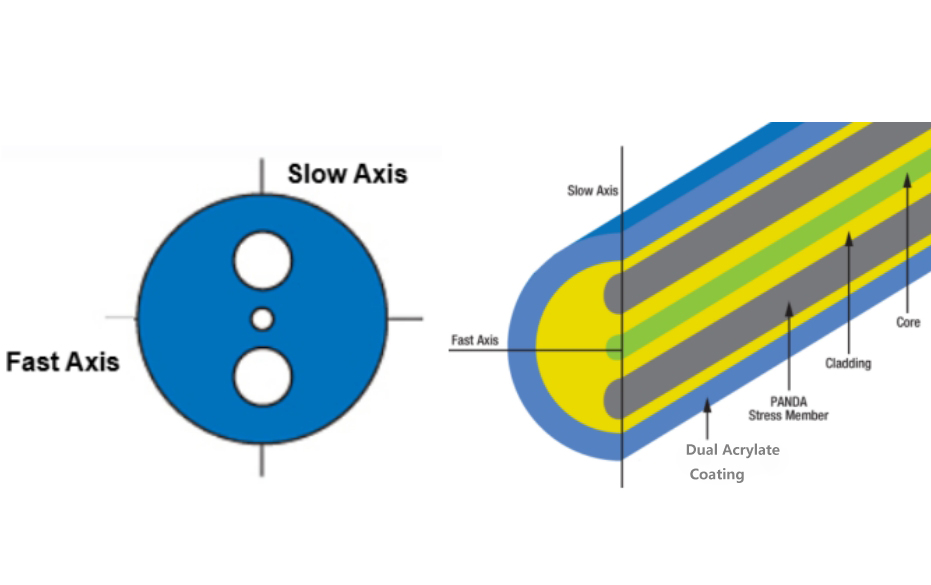
PM fiber generally uses a special structural design to create high birefringence within the fiber.
Common PM fiber designs, such as Panda-type and Bow-Tie-type fibers, use special stress-inducing structures around the fiber core. These structures generate stress in the fiber and create significant birefringence.
The resulting birefringence gives the two orthogonal polarization modes different propagation characteristics.
Simply put:
Standard single-mode fiber:
Polarization is more susceptible to external disturbances → polarization changes can occur.
PM fiber:
High-birefringence structure → reduced polarization-mode coupling → more stable polarization transmission.
This is one of the fundamental differences between PM fiber and standard SM fiber.
3. Why Can’t Standard Fiber Components Fully Replace PM Components?
When selecting optical components, engineers often focus on parameters such as:
- Insertion Loss (IL)
- Return Loss (RL)
- Operating Wavelength
- Optical Power Handling
However, these parameters alone are not sufficient for polarization-sensitive systems.
Two additional parameters are particularly important:
Polarization Extinction Ratio (PER)
and
Polarization Dependent Loss (PDL)
For example, in a system that needs to maintain linearly polarized light, the use of standard SM components after PM fiber may introduce additional polarization changes.
This means:
Using PM fiber alone does not guarantee polarization stability throughout the entire optical path if the other components are not polarization-maintaining.
For systems with strict polarization requirements, the optical path should therefore be designed as a whole, including the light source, fiber, connectors, and passive optical components.
4. Which High-Performance Applications Require PM Components?
4.1 Fiber Lasers
Fiber lasers are an important application for PM components.
In high-power fiber laser systems, polarization can affect:
- Laser output stability
- Beam quality
- Nonlinear effects
- Polarization-dependent gain
- Overall system efficiency
Therefore, PM fiber and PM components such as PM couplers, PM isolators, and PM collimators are used in many high-performance laser systems.
4.2 Fiber Optic Gyroscopes
Fiber optic gyroscopes (FOGs) are highly sensitive to polarization stability.
Because FOG systems detect rotational information through interference signals, changes in polarization can affect the stability of the interference signal and consequently influence measurement performance.
PM fiber and related PM components are therefore widely used in high-performance fiber optic gyroscope systems.
4.3 Coherent Optical Communications
Coherent optical communication systems process optical information including amplitude, phase, and polarization.
Polarization changes can increase the complexity of digital signal processing at the receiver and may affect system performance.
In certain coherent optical modules, test equipment, and laboratory systems, PM components can provide more stable polarization control.
4.4 Fiber Optic Sensing
Polarization can directly affect sensing signals in high-precision fiber optic sensing systems.
Examples include:
- Strain sensing
- Temperature sensing
- Current sensing
- Magnetic field sensing
- Fiber interferometry
For applications requiring high stability and repeatability, PM fiber can help reduce uncertainties caused by polarization changes.
4.5 Precision Optics and Scientific Research
Many laboratory and scientific optical systems require precise control of polarization.
Typical applications include:
- Interferometers
- Polarization measurement
- Laser testing
- Optical coherence experiments
- Quantum optics experiments
In these applications, polarization stability is often more important than in conventional communication systems.
5. Which Parameters Should You Consider When Selecting PM Components?
When choosing PM components, simply looking for a product labeled “PM” is not enough. Several key specifications should be considered.
5.1 Polarization Extinction Ratio (PER)
PER is an important parameter for evaluating polarization-maintaining performance.
In general, a higher PER indicates better preservation of the desired polarization state.
However, actual performance also depends on factors such as the test wavelength, measurement method, connector condition, and operating environment. Therefore, PER values should be compared under equivalent test conditions.
5.2 Polarization Dependent Loss (PDL)
PDL describes the difference in insertion loss between different polarization states.
For polarization-sensitive systems, it is important to ensure that the PDL of the component meets the system requirements.
5.3 Insertion Loss
In addition to maintaining polarization, PM components should provide low insertion loss.
In multi-stage optical systems, the loss of each component accumulates. Low insertion loss is therefore important for maintaining sufficient optical power throughout the system.
5.4 PER Stability
In practical applications, PER is not the only factor that matters.
Polarization performance should also be evaluated under different:
- Temperature conditions
- Optical power levels
- Mechanical stress
- Fiber bending conditions
- Connection configurations
Stable performance under actual operating conditions is important for high-precision applications.
6. Why Is PM Design Needed Throughout the Optical Path?
This is an aspect that is sometimes overlooked.
Consider the following optical path:
PM Laser → PM Fiber → SM Coupler → SM Connector → PM Detector
Although the front and rear sections use PM components, the SM component in the middle may still introduce polarization changes.
For polarization-sensitive applications, a more consistent design could be:
PM Laser → PM Fiber → PM Coupler → PM Switch → PM Collimator → PM Detector
Using PM components throughout the critical optical path can help maintain more consistent polarization characteristics.
This is why PM components are often not simply an “optional upgrade” in high-performance optical systems. They can be an integral part of the overall optical design.
7. What Makes PM Component Manufacturing More Challenging?
Compared with standard SM components, PM components generally require greater precision during manufacturing and assembly.
Important factors include:
- PM fiber axis alignment
- Fiber alignment
- Slow-axis / fast-axis orientation
- Splicing angle
- Connector key orientation
- Fiber stress
- End-face quality
During PM fiber splicing, for example, the polarization axes of the two fibers must be accurately aligned.
Even if the PM fibers themselves have a high PER, inaccurate axis alignment during assembly can significantly reduce the polarization performance of the finished component.
Therefore:
The performance of a PM component depends not only on the PM fiber itself, but also on the complete manufacturing and alignment process.
8. How Should You Select the Right PM Component?
When selecting PM components, the following steps can be useful.
Step 1: Determine the Operating Wavelength
Typical wavelengths include:
780 nm, 850 nm, 980 nm, 1064 nm, 1310 nm, and 1550 nm.
Step 2: Determine the Fiber Type
For example:
- PM-SMF
- PM980
- PM780
- PM1550
- Specialty PM fiber
Step 3: Define the Key Performance Requirements
Important specifications may include:
- PER
- PDL
- IL
- RL
- Optical Power
- Operating Temperature
Step 4: Confirm the Connector Type
Common options include:
- FC/APC
- FC/PC
- LC/UPC
- Bare Fiber
- Custom Connectors
For PM connectors, key orientation should receive particular attention.
An incorrect key orientation may result in an incorrect polarization-axis orientation, even when the optical performance of the component itself meets the required specifications.
9. From PM Fiber to PM Components: Building a Stable Polarization-Controlled Optical Path
The value of polarization-maintaining technology is not simply about “maintaining polarization.”
For high-performance optical systems, it is also about improving the controllability, repeatability, and stability of the entire optical path.
When a system involves high-power lasers, precision measurement, interferometry, or polarization-sensitive signals, any standard component in the critical optical path may become a potential source of polarization variation.
Therefore, from PM fiber and PM couplers to PM collimators, PM switches, and other PM components, the polarization characteristics of the complete optical path should be considered during system design.
Comments are closed