


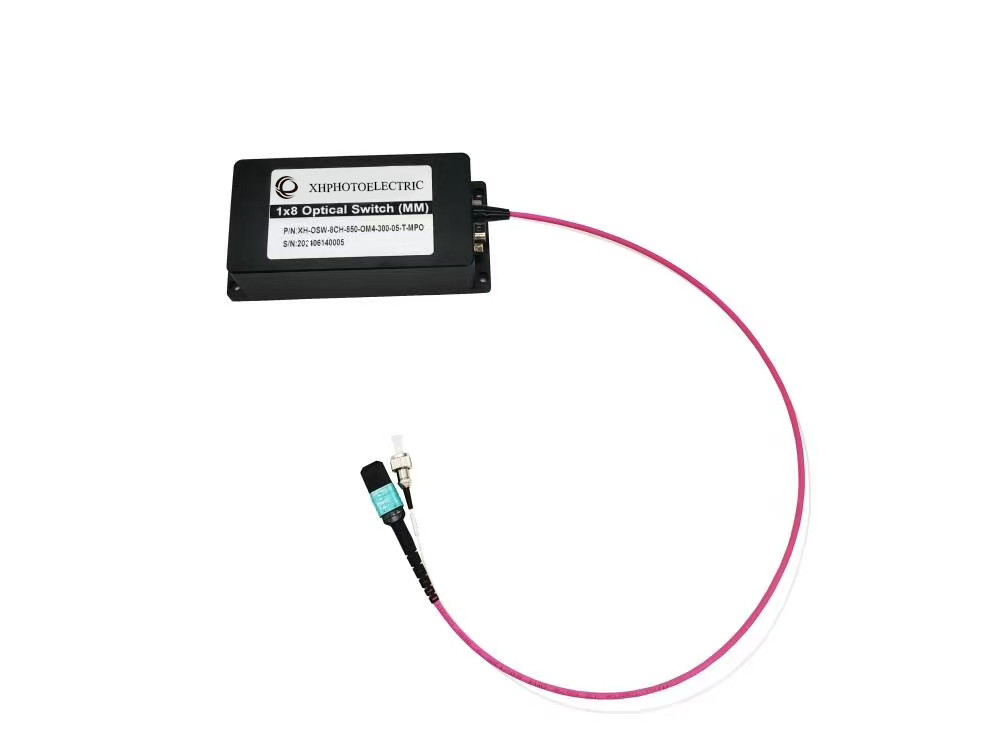
OTDR-Compatible MPO Optical Switch for Automated Testing of All Fibers in MPO Trunk Cables
Introduction
As high-density fiber optic connectivity becomes increasingly common in data centers, cloud computing infrastructure, and high-speed communication networks, MPO trunk cables play an important role in supporting multiple optical channels within a single connector.
However, testing every fiber in an MPO trunk cable individually can be time-consuming and labor-intensive. An OTDR-compatible MPO optical switch provides an efficient solution by automatically switching between optical paths, allowing an OTDR to test multiple fibers without repeatedly connecting and disconnecting cables manually.
For fiber optic manufacturers, data center operators, and optical testing laboratories, this solution helps streamline cable inspection, improve testing efficiency, and simplify quality control.
What Is an OTDR-Compatible MPO Optical Switch?
An OTDR-compatible MPO optical switch is a multi-channel optical switching device designed to work with an Optical Time Domain Reflectometer (OTDR).
The switch connects the OTDR to different fibers within an MPO-terminated cable in sequence. By selecting each optical path automatically, the system enables the OTDR to measure individual fibers and identify potential issues such as excessive insertion loss, connector reflections, fiber breaks, and abnormal attenuation.
Instead of manually moving test connections from one fiber to another, users can integrate the MPO optical switch into an automated testing system.
Depending on the system configuration, the solution can support MPO-8, MPO-12, MPO-16, and MPO-24 cable testing.
Key Benefits of Automated MPO Fiber Testing
1. Automatic Testing of Multiple Fibers
An MPO trunk cable contains multiple optical fibers within a single connector. An MPO optical switch allows the OTDR to access these fibers sequentially through automated optical path selection.
This reduces manual intervention and makes it easier to test all fibers in an MPO trunk cable using a single OTDR, provided the switching configuration matches the cable and test requirements.
2. Improved Testing Efficiency
Manual testing requires operators to repeatedly change fiber connections and initiate measurements. Automated switching simplifies this process by coordinating optical path selection with the testing workflow.
For production lines and quality inspection facilities handling large quantities of MPO cables, this can significantly reduce repetitive operations and improve testing throughput.
3. Simplified Fault Detection
When integrated with an OTDR, the system helps operators identify and locate optical events along each fiber, including:
-
Fiber breaks and abnormal attenuation.
-
Connector and splice losses.
-
Reflective events and connection issues.
-
Fiber length and transmission-path abnormalities.
The OTDR performs the optical measurements, while the switch selects the fiber under test. Together, they support systematic inspection of multi-fiber cable assemblies.
4. Reduced Manual Connection Errors
Repeatedly plugging and unplugging MPO connectors can introduce operational inconsistencies and increase the risk of connector contamination or wear.
Automated optical switching reduces the need for repeated manual reconnection, helping create a more consistent testing process.
5. Suitable for Automated Production Testing
An MPO optical switch can be integrated into a computer-controlled test station, allowing multiple fiber paths to be tested according to a predefined sequence.
This makes it suitable for MPO cable manufacturing, incoming inspection, production quality control, and fiber optic testing laboratories.
How Does an MPO Optical Switch Work with an OTDR?
A typical automated MPO testing system consists of an OTDR, an MPO optical switch, a control computer, and the MPO trunk cable under test.
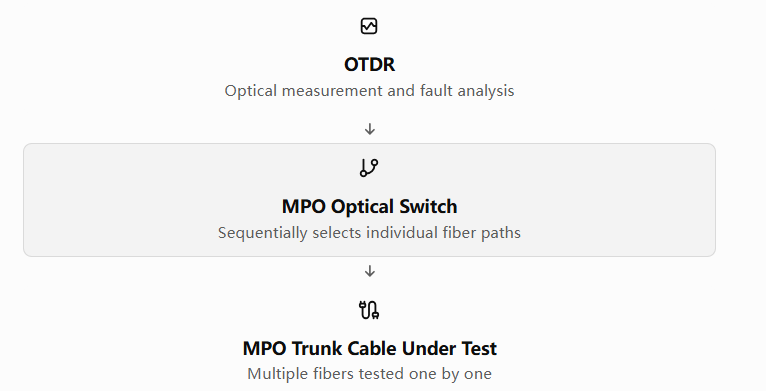
The general testing workflow is as follows:
-
Connect the OTDR: Connect the OTDR to the MPO optical switch using the appropriate optical interface and test configuration.
-
Connect the cable under test: Connect the MPO trunk cable to the designated switch ports or test fixture.
-
Select the first fiber: The control system commands the switch to establish the first optical path.
-
Perform the OTDR measurement: The OTDR measures the selected fiber and records its trace.
-
Switch to the next fiber: The system changes the optical path and repeats the measurement for the remaining fibers.
-
Review the results: The collected measurements are analyzed to assess the condition of each fiber.
The actual level of automation depends on the OTDR interface, switch control method, and test software. Automatic switching alone does not guarantee automatic measurement initiation or report generation; these functions require suitable system integration.
Applications of OTDR-Compatible MPO Optical Switches
Data Center Cabling
Test multi-fiber trunk cables used in high-density data center interconnections, helping verify fiber continuity and identify transmission-path problems before deployment.
Support production testing and quality inspection of multi-fiber cable assemblies while reducing repetitive manual switching operations.
Optical Testing Laboratories
Provide a repeatable method for measuring multiple optical paths during fiber characterization, troubleshooting, and test system development.
Help verify incoming MPO cable assemblies and identify defective fibers before installation or integration into larger optical systems.
How to Choose the Right MPO Optical Switch for OTDR Testing
Before selecting an MPO optical switch, consider the following factors.
MPO fiber count: Select a switching configuration that matches the number of fibers to be tested, such as MPO-8, MPO-12, MPO-16, or MPO-24.
Connector compatibility: Confirm the MPO/MTP connector type, fiber arrangement, polarity, and connector gender required by the test fixture.
Wavelength compatibility: Ensure that the switch’s operating wavelength is compatible with the OTDR and the cable testing requirements.
Control interface: Check whether the switch supports the control interface and communication protocol required by your automated test system.
Testing workflow: Determine whether you need sequential fiber selection only or a fully integrated solution that also triggers OTDR measurements, collects test results, and generates reports.
Optical performance: Evaluate insertion loss, repeatability, return loss, and switching reliability based on the requirements of your test application.
A properly matched solution can help improve testing consistency while reducing unnecessary manual operations.
Conclusion
An OTDR-compatible MPO optical switch is a practical solution for automating multi-fiber testing of MPO trunk cables. By selecting individual fiber paths in sequence, it allows a single OTDR to test multiple fibers with less manual intervention and supports more efficient inspection in data centers, cable manufacturing facilities, and optical laboratories.
For applications requiring automated MPO-8, MPO-12, MPO-16, or MPO-24 cable testing, choosing the appropriate switching configuration and control interface is essential to building a reliable test system.
At Xionghua Photoelectric, we provide optical switching solutions for fiber optic communication and testing applications. If you are developing an automated MPO cable testing system, contact us to discuss your MPO fiber count, OTDR model, connector requirements, and control interface. We can help evaluate a suitable optical switch configuration for your application.
Comments are closed