


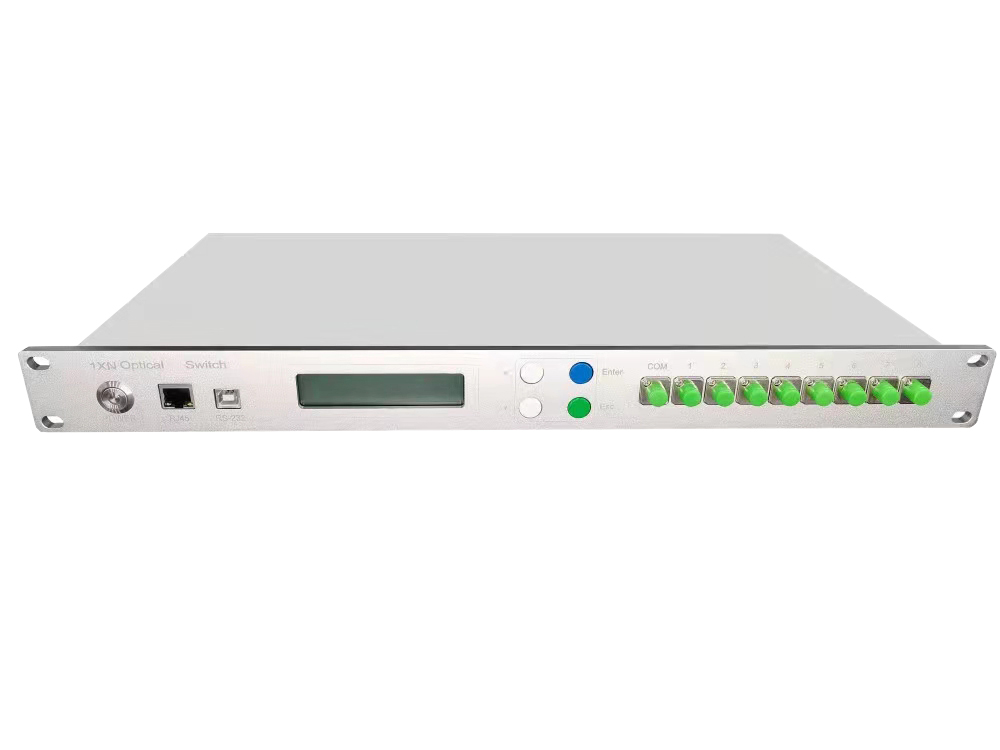
For a dual 1×4 rack-mount optical switch, can the two 1×4 channels be controlled independently?
I. Product Overview
The dual 1×4 rack-mount optical switch is an optical path switching device designed for use in optical communication systems and optical test equipment. It integrates two independent sets of 1×4 optical switch channels, allowing for the selection and switching of multiple optical signals based on system requirements.
Compared to single-channel optical switches, the dual 1×4 rack-mount optical switch integrates two sets of switching functions into a single rack-mounted unit. This helps save installation space, simplifies system cabling, and enhances the convenience of optical path management.
This product is suitable for applications requiring multi-channel optical signal switching, automated testing, and centralized optical path control. Control interfaces, fiber types, connectors, and operating wavelengths can be customized to meet specific project requirements.
II. Key Features of the Dual 1×4 Rack-Mount Optical Switch
1. Dual-Channel Optical Path Switching
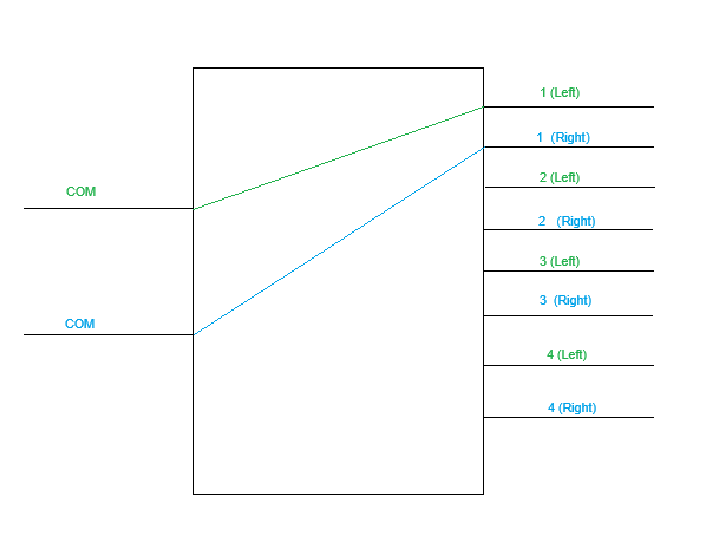
The device integrates two sets of 1×4 optical switch channels, which can be used for separate optical path selection tasks, meeting the switching needs of multi-channel optical testing and optical communication systems.
2. Rack-Mount Integrated Design
Featuring a rack-mount structure, the device is easy to install in standard cabinets or test systems. This design reduces the space occupied by individual units and facilitates future maintenance and system expansion.
3. Support for Remote Control and Automated Testing
Depending on the configuration, the device offers various control interfaces and host-computer software, enabling seamless integration into automated test platforms for remote optical path switching and test process control.
4. Flexible Customization Options
Users can select appropriate operating wavelengths, fiber types (single-mode or multi-mode), optical connectors, and control methods to meet the specific integration requirements of different systems.
III. Performance Specifications
- Operating Wavelength: 1260–1650 nm. Suitable for fields such as fiber-optic communication, optical network monitoring, fiber-optic component testing, and fiber-optic sensing. This range covers wavelengths from the O-band to the L-band, supporting optical path switching, component performance testing, and automated test systems across various wavelengths. Insertion Loss: ≤ 1.2 dB—well below the industry-standard 1.5 dB—minimizing transmission loss for optical signals.
- Repeatability: ≤ 0.02 dB—ensuring minimal drift in optical path loss after repeated switching. With exceptionally high switching precision, it is well-suited for applications such as high-precision testing, measurement, and LiDAR.
- Return Loss: ≥ 50 dB—effectively reducing optical signal reflection and crosstalk, thereby maintaining a high signal-to-noise ratio and improving transmission quality.
- Polarization-Dependent Loss (PDL): ≤ 0.05 dB; Wavelength-Dependent Loss and Temperature-Dependent Loss: ≤ 0.2 dB each. Optical path loss remains highly stable across the entire temperature and wavelength range, with excellent loss consistency across multiple channels, ensuring reliable optical signal transmission.
- Monitoring Ports: Supports RJ45 (Ethernet) and RS-232 (serial) communication interfaces.
IV. Optical Path Schematic:
Beyond its core optical performance, this product features several outstanding technical highlights in terms of environmental adaptability, control methods, and structural design:
1. Wide-Temperature Operation and Robust Environmental Adaptability
The product is designed for stable, long-term operation across a wide temperature range of -20°C to +70°C, with a storage temperature range of -40°C to +85°C. It has also passed rigorous environmental stress testing—including a 48-hour high-temperature soak at +85°C and 48 hours of thermal cycling between -40°C and +85°C—demonstrating exceptional environmental resilience.
Unlike many commercial-grade optical switches, this unit utilizes industrial-grade components and a stable optical packaging process. It effectively withstands external disturbances such as vibration, mechanical shock, and fluctuations in temperature or humidity. This ensures reliable, long-term operation even in demanding environments—such as industrial sites or outdoor base stations—which is the primary reason many industrial-sector clients choose this product.
2. Dual Control Modes for Flexible Deployment
The device supports both RS232 serial and RJ45 network (Ethernet) control interfaces, offering the flexibility to meet diverse on-site control requirements. For direct local control, users can connect via the RS232 port for a simple, convenient interface. For remote, centralized management, the device can be integrated into a local area network (LAN) via the RJ45 port, enabling remote network-based control. This makes it compatible with various control architectures, including centralized management systems for server rooms and industrial automation platforms.
Furthermore, the device employs a standard AT command set with straightforward, intuitive operating logic. Users can quickly integrate the unit into their existing control systems without the need for complex secondary development, significantly reducing both implementation and development costs.
3. Standard Rack-Mount Design, Ideal for Large-Scale Deployment
The 1U rack-mount chassis features a compact design with a height of approximately 44.45 mm, suitable for installation in standard 19-inch racks. It can integrate dual 1×4 optical switch channels, saving rack space while facilitating optical path management, centralized control, and integration into automated test systems. Specific dimensions and interface configurations can be customized to meet client requirements.

1. Data Center Optical Interconnects: Enables flexible switching between different optical links, supporting optical path scheduling and link testing to improve the management efficiency of data center interconnect systems.
2. Fiber Optic Communication Systems: Supports switching between different optical paths for primary/backup link switching tests and redundancy verification, improving system maintenance and troubleshooting efficiency.
3. LiDAR Systems: Switches between different optical paths according to system requirements, supporting optical path selection and testing. The ability to achieve fast scanning depends on the optical switch’s switching speed and the overall system design.
4. Fiber Optic Sensing Systems: Switches between different sensing paths in multi-channel sensing systems, supporting multi-point signal acquisition and monitoring.
5. Optical Test and Measurement Equipment: Automatically switches between different test paths, reducing manual fiber reconnection and repetitive operations while improving testing efficiency and consistency.
V. How to Select the Right Dual 1×4 Rack-Mount Optical Switch?
1. Optical Switch Type: Choose an appropriate technical solution based on switching speed, insertion loss, service life, and budget.
2. Operating Wavelength: Verify that the device is compatible with the operating wavelength of your specific system.
3. Fiber Type: Determine whether single-mode, multi-mode, or polarization-maintaining (PM) fiber is required.
4. Control Interface: Confirm the necessary control interface, such as RS232, USB, Ethernet, or others.
5. Connector Type: Select the appropriate connector type—such as FC, SC, or LC—to match your existing fiber-optic system.
6. Rack-Mounting and System Integration: Check the physical dimensions, power supply requirements, and whether host-side (control) software is needed.
VI. Conclusion
The dual 1×4 rack-mount optical switch is well-suited for optical communication testing, laboratory R&D, and automated test systems that require switching capabilities for two sets of optical paths. Its rack-mount integrated design and flexible configuration options help users simplify optical path management and enhance the integration efficiency of their test systems.
Xionghua photoelectric specializes in the R&D and production of optical switches and related optical communication components. We offer customized solutions tailored to specific customer requirements regarding optical path configurations, control interfaces, and system integration.
Comments are closed