


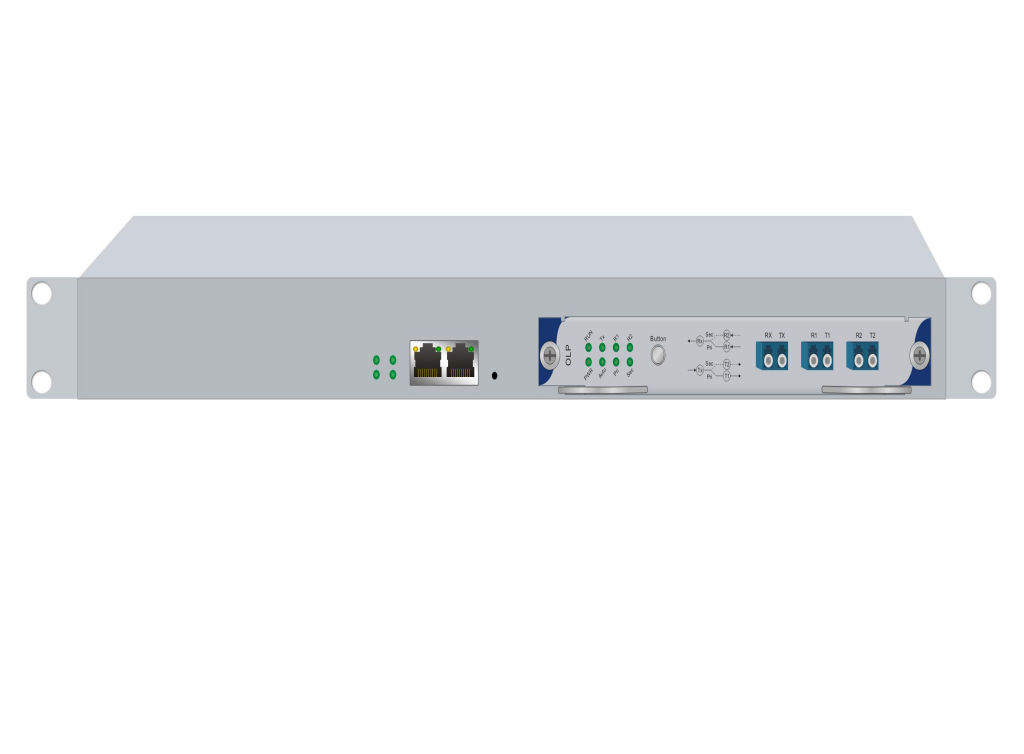
Why Does a 1:1 Rack-Mount Optical Protection System Require Two Devices?
In fiber optic communication networks, maintaining stable and uninterrupted data transmission is essential. Fiber cuts, signal degradation, or unexpected link failures can interrupt communication and affect network performance.
A Rack-Mount Optical Protection System is designed to improve network reliability by automatically switching optical signals from a primary fiber path to a backup path when a fault occurs.
For a 1:1 Rack-Mount Optical Protection System, two devices are typically required to work together. But why are two units necessary? How do they coordinate protection switching?
Let’s explore the working principle and advantages of this configuration.
1. What Is a 1:1 Rack-Mount Optical Protection System?
A 1:1 Rack-Mount Optical Protection System (OLP) uses two optical transmission paths to provide network protection:
- Primary Fiber Path: The main transmission route used during normal operation.
- Backup Fiber Path: A standby route that provides an alternative when the primary path fails.
In a typical dual-ended protection architecture, two Optical Protection System units are installed at opposite ends of the optical link.
One unit is deployed at the local transmission end, while the other is installed at the remote receiving end. Together, they coordinate the protection process to maintain communication when the primary fiber path encounters a fault.
2. Why Are Two Optical Protection System Devices Required?
The main reason is that complete optical link protection involves both ends of the transmission network.
Device A – Local End
The first Rack-Mount Optical Protection System unit manages the optical paths at the local end. It monitors the primary path and provides switching between the main and backup fibers according to the system configuration.
Device B – Remote End
The second unit is installed at the remote end. It manages the optical paths at the receiving side and works with the local unit to establish the backup transmission route when required.
When a fiber failure or abnormal optical condition is detected, the two units coordinate their switching operations to restore communication through the backup path.
A single device may provide switching at one end, but a complete dual-ended protection arrangement generally requires coordinated equipment at both ends.
3. How Do Two Rack-Mount Optical Protection System Units Work Together?
The basic working process can be divided into three stages.
Step 1: Normal Transmission
Under normal operating conditions, optical signals travel through the primary fiber path. The backup fiber remains available as a standby route.
Step 2: Fault Detection
When the primary fiber experiences a cut, excessive attenuation, or another monitored abnormal condition, the protection system detects the fault.
Step 3: Automatic Protection Switching
The two Optical Protection System units coordinate the switching process, transferring communication to the backup fiber path to help restore optical transmission and minimize service interruption.
The actual switching sequence and coordination mechanism depend on the specific system architecture.
4. Key Advantages of a Paired Rack-Mount Optical Protection System
Using two coordinated devices provides several important benefits:
- End-to-End Optical Protection: Provides protection at both ends of the transmission link.
- Automatic Protection Switching: Reduces the need for manual intervention when a fiber fault occurs.
- Improved Network Reliability: Provides an alternative optical route when the primary path becomes unavailable.
- Reduced Service Interruption: Helps maintain communication during unexpected fiber failures.
- Flexible Network Deployment: Suitable for point-to-point optical communication networks and other critical fiber links.
5. Applications of a 1:1 Rack-Mount Optical Protection System
A paired Optical Protection System is suitable for applications where stable optical transmission and network availability are important.
Typical applications include:
- Telecommunication Networks: Protects backbone and access network connections.
- Data Center Interconnections: Improves the reliability of optical links between facilities.
- Enterprise Fiber Networks: Provides backup transmission paths for critical communication links.
- Industrial Communication: Helps maintain stable optical connectivity in industrial environments.
- Critical Transmission Systems: Provides optical path redundancy for important communication services.
6. What Should You Consider When Selecting a Rack-Mount Optical Protection System?
Before choosing a 1:1 Optical Protection System, several technical requirements should be evaluated:
- Operating wavelength, such as 1310 nm or 1550 nm
- Single-mode or multimode fiber compatibility
- Optical power range
- Insertion loss
- Protection switching time
- Optical signal monitoring and alarm functions
- Communication interface and control method
- Compatibility and coordination between the two devices
Selecting two compatible units is essential to ensure that the complete protection system operates correctly.
Conclusion
A 1:1 Rack-Mount Optical Protection System typically uses two paired devices because reliable optical link protection requires coordination between the local and remote ends of the network.
By monitoring the primary fiber path and switching to a backup route when necessary, the system helps reduce service interruptions and improve overall network reliability.
For telecom operators, data centers, and industrial network integrators, a properly configured Rack-Mount Optical Protection System is an effective solution for optical link protection.
Looking for a Rack-Mount Optical Protection System?
Xionghua Photoelectric specializes in optical switches and fiber optic protection products. We provide customized optical protection solutions based on different network configurations and application requirements.
Comments are closed