


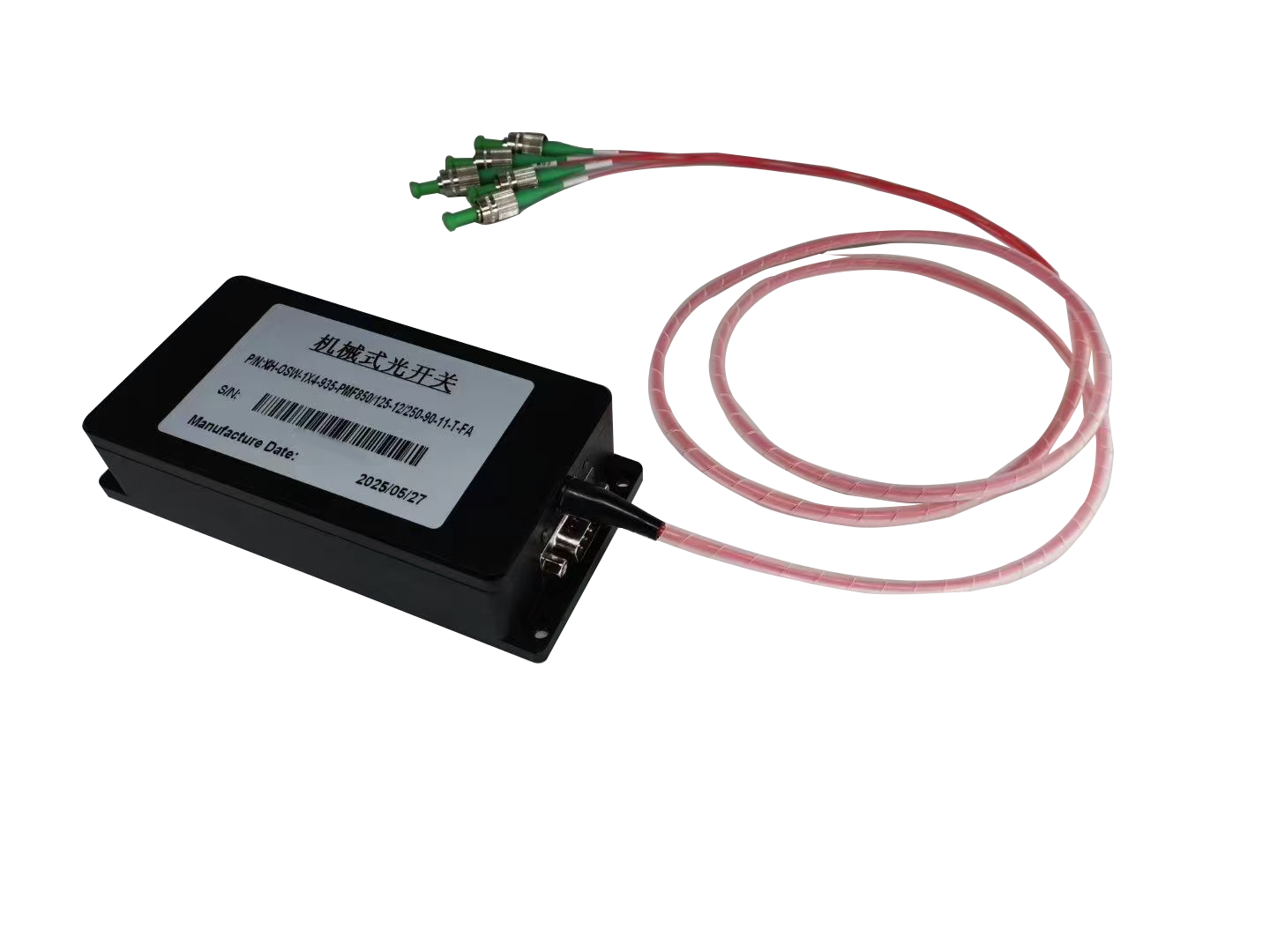
Application of Polarization Maintaining Optical Switch in Fiber Optic Gyroscopes
With the growing demand for high-precision navigation and attitude control, the Fiber Optic Gyroscope (FOG), based on the Sagnac Effect, has been widely used in aerospace, unmanned systems, marine exploration, and inertial navigation. In such systems, the Polarization Maintaining Optical Switch plays a critical role in ensuring stability and measurement accuracy.
1. Basic Principle of Fiber Optic Gyroscopes
Fiber optic gyroscope operates by utilizing the Sagnac Effect. It detects the phase difference between two beams of light traveling in clockwise and counterclockwise directions within a fiber loop. When the system rotates, a slight difference in optical path length occurs, generating an interference signal that can be used to measure angular velocity with high precision.
During this process, the stability of the light’s polarization state directly affects the interference quality. Therefore, Polarization Maintaining Fiber is typically used to suppress polarization-related errors.
2. Functions of Polarization Maintaining Optical Switches
In fiber optic gyroscope systems, polarization maintaining optical switches serve several key functions:
♦Optical Path Switching and Redundancy
High-reliability FOG systems often require redundant optical paths. PM optical switch enable fast switching between multiple fiber channels, allowing seamless transition between primary and backup paths, thus improving system reliability and fault tolerance.
♦ Polarization State Preservation
Conventional optical switches may introduce polarization disturbances during switching. In contrast, PM optical switches maintain a stable polarization state throughout transmission and switching, which is crucial for interference-based measurement systems.
♦ Testing and Calibration
During manufacturing and maintenance, PM optical switches allow switching between different test paths, enabling automated testing and calibration processes, improving efficiency and consistency.
♦ Signal Path Optimization
By dynamically selecting optimal optical paths, PM optical switches help reduce insertion loss and noise, thereby enhancing overall system performance.
3. Key Performance Requirements
For applications in fiber optic gyroscopes, PM optical switches must meet stringent performance criteria:
- Low Insertion Loss: Minimizes signal attenuation and improves signal-to-noise ratio
- High Polarization Extinction Ratio (PER): Ensures effective polarization maintenance
- Low Crosstalk: Prevents interference between channels
- High Repeatability and Stability: Guarantees long-term reliability
- Fast Switching Speed: Meets dynamic system requirements
4. Typical Application Scenarios
Aerospace Inertial Navigation Systems
Used in aircraft attitude control and navigation systems, enabling multi-channel switching and redundancy.
Unmanned Systems (UAVs/UGVs)
Provides stable and accurate angular velocity measurements in complex environments.
Marine and Naval Equipment
FOG systems offer strong resistance to electromagnetic interference, with PM optical switches further enhancing system robustness.
High-End Industrial Measurement
Applied in precision turntables and platform stabilization systems requiring high-accuracy rotation sensing.
5. Development Trends
As fiber optic gyroscopes evolve toward higher precision, smaller size, and lower power consumption, PM optical switches are also advancing in the following directions:
- Miniaturization and integration (e.g., MEMS-based technologies)
- Higher polarization maintaining performance
- Lower power consumption and longer operational lifetime
- Integration with intelligent control systems
Conclusion
As a key optical component in fiber optic gyroscope systems, polarization maintaining optical switches not only perform basic optical path switching but also play an essential role in polarization control, system stability, and reliability. With the continuous growth in high-end inertial navigation applications, their technological advancement will further support the development of precision measurement systems.
Comments are closed