


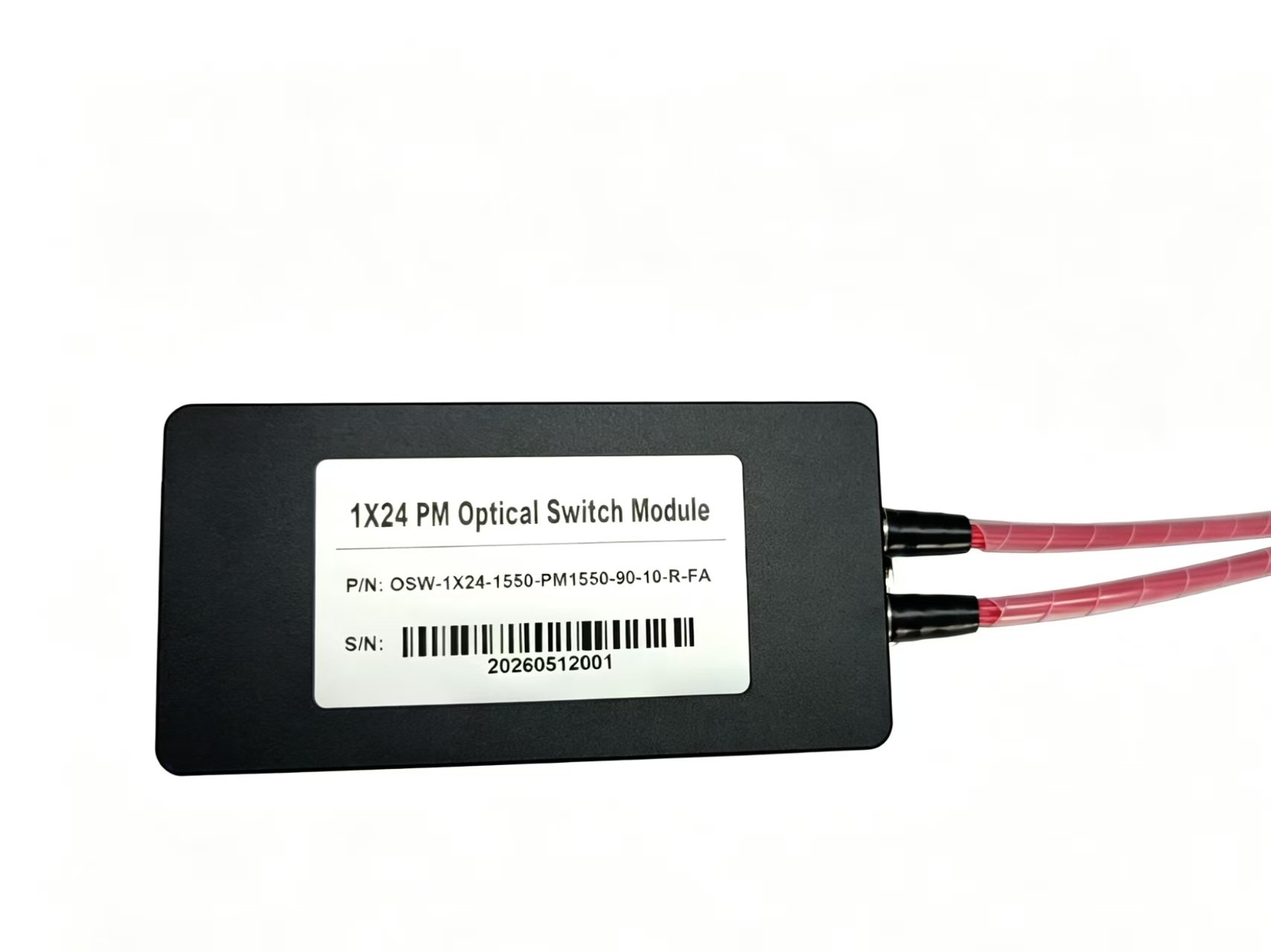
Polarization Maintaining Optical Switch Extinction Ratio: Key Parameter for System Stability
In polarization-maintaining (PM) fiber systems, the stability of the polarization state directly affects overall system performance. As a critical component for optical path switching, Polarization Maintaining optical switch must provide not only low insertion loss and high reliability, but also excellent Extinction Ratio (ER), which is one of the most important parameters for evaluating its performance.
For fiber lasers, fiber sensing, polarization control, and optical test systems, an appropriate extinction ratio helps maintain polarization stability and improves overall system reliability and consistency.
What Is the Extinction Ratio of Polarization Maintaining optical switch ?
The extinction ratio (ER) is defined as the ratio of optical power transmitted along the principal polarization axis to the leakage power in the orthogonal axis, expressed in decibels (dB):
ER (dB) = 10 log (Pprincipal / Porthogonal)
A higher extinction ratio indicates lower polarization crosstalk and better preservation of the polarization state.
Typical performance levels include:
- ≥20 dB: Suitable for most industrial applications
- ≥25 dB: Designed for high-performance systems
- ≥30 dB: Intended for precision scientific research and coherent communication systems
Why Is Extinction Ratio Important?
Maintaining Polarization Stability
Changes in polarization state can affect transmission efficiency and system stability.
A high-quality PM optical switch helps to:
- Minimize polarization crosstalk;
- Maintain a stable polarization state;
- Improve system repeatability;
- Reduce the influence of environmental disturbances.
Enhancing Fiber Laser Reliability
In PM fiber lasers, MOPA systems, and optical test platforms, stable polarization characteristics contribute to:
- Improved laser output stability;
- Better beam quality;
- Reduced power fluctuations;
- Enhanced long-term reliability.
Supporting Fiber Sensing and Measurement Applications
For optical sensing systems, laboratory instruments, and polarization control platforms, an appropriate extinction ratio helps reduce polarization-related errors and improve measurement consistency and stability.
Factors Affecting Extinction Ratio
The extinction ratio of a PM optical switch mainly depends on several key factors:
High-Precision Fiber Axis Alignment
Accurate alignment of the slow axis during fiber splicing is essential for achieving excellent polarization-maintaining performance.
Optimized Optical Design
A well-designed optical structure helps minimize polarization crosstalk and improve overall device performance.
Low-Stress Packaging Technology
Robust packaging reduces the effects of temperature changes and mechanical vibrations on polarization characteristics.
Strict Manufacturing and Testing Processes
Comprehensive aging tests and quality screening ensure stable extinction ratio performance throughout the product lifetime.
Applications Suitable for ≥20 dB Extinction Ratio
PM optical switches with an extinction ratio of ≥20 dB are widely used in:
- Polarization-maintaining fiber laser systems;
- Optical test and measurement equipment;
- Fiber optic sensing systems;
- Polarization control applications;
- Optical communication laboratories;
- Scientific instruments and automated testing platforms.
By balancing performance and cost, an extinction ratio of 20 dB or higher is sufficient for the majority of industrial and laboratory applications.
Conclusion
The extinction ratio is one of the most important parameters for evaluating the performance of a polarization-maintaining optical switch. It directly affects polarization stability and long-term system reliability. Choosing a PM optical switch with low insertion loss, high repeatability, and stable extinction ratio is essential for ensuring dependable operation of fiber-optic systems.
We offer a wide range of polarization-maintaining mechanical optical switches, including 1×2, 2×2, 1×N, and N×N configurations. Available operating wavelengths include 980 nm, 1064 nm, 1310 nm, and 1550 nm, with a typical extinction ratio of ≥20 dB. Featuring low insertion loss, high reliability, and long service life, these switches are widely used in fiber lasers, fiber optic sensing, test and measurement systems, and scientific research applications.
Comments are closed