


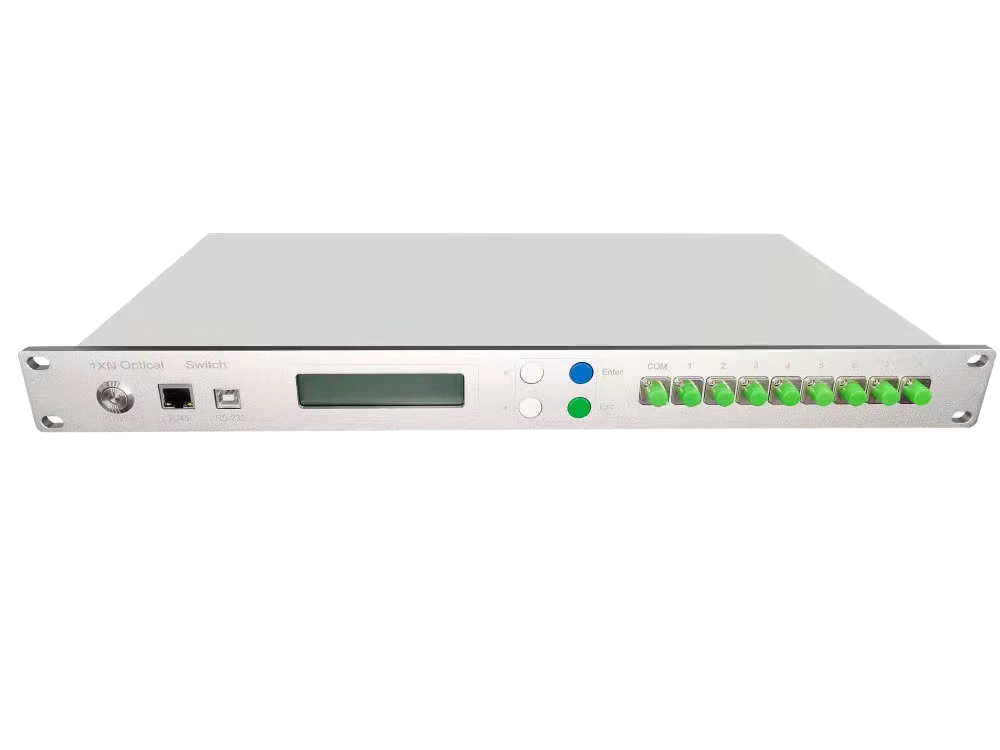
Multi-Channel Optical Switching Systems: Comparison of Four Main Architectures
As fiber optic communications, data centers, fiber sensing, optical testing, and laser systems continue to evolve, the demand for reliable, fast, and scalable optical path management is increasing. Multi-channel optical switching systems enable automatic switching between multiple optical paths, allowing equipment sharing, network redundancy, automated testing, and rapid fault recovery. They have become an essential part of modern optical networks.
Today, four major architectures are commonly used in multi-channel optical switching systems, each offering unique advantages for different applications.
1. Mechanical Optical Switch Architecture
Mechanical optical switches use precision mechanical actuators to align optical fibers or collimators, providing stable and reliable optical path switching. This technology is one of the most mature solutions available.
Advantages
- Low insertion loss
- High return loss
- Low crosstalk
- Excellent bidirectional transmission performance
- High long-term reliability
- Cost-effective
Limitations
- Switching speed is typically in the millisecond range
- Larger physical size for high-port-count systems
Typical Applications
- Fiber optic test systems
- Automated OTDR testing
- Optical network monitoring
- Laboratory and R&D platforms
2. MEMS Optical Switch Matrix Architecture
MEMS (Micro-Electro-Mechanical Systems) optical switches use microscopic movable mirrors to redirect optical beams. They are ideal for high-density, multi-channel optical routing applications.
Advantages
- Supports large-scale switch matrices (8×8, 16×16, 32×32, and beyond)
- Fast switching speed
- Compact size
- Low power consumption
- Easy system integration
Limitations
- Higher cost than conventional mechanical optical switches
- Requires advanced manufacturing and packaging technologies
Typical Applications
- AI computing networks
- Data centers
- Optical Cross-Connect (OXC) systems
- Optical communication networks
- Automated testing equipment
3. Optical Bypass Protection Architecture
Optical Bypass Protection systems automatically reroute optical signals when network equipment fails, loses power, or requires maintenance, ensuring uninterrupted communication services.
Advantages
- Automatic failover
- Improved network reliability
- Reduced system downtime
- Supports online maintenance
- No manual intervention required
Limitations
- Primarily designed for link protection rather than complex optical routing
Typical Applications
- Online OTDR monitoring
- Optical transmission network protection
- Data center link protection
- Telecommunication infrastructure maintenance
4. PLC/WDM Passive Optical Distribution Architecture
PLC splitters and WDM multiplexers distribute or multiplex optical signals using passive optical components without mechanical movement.
Advantages
- No moving parts
- Long operational lifetime
- High reliability
- No power consumption
- Low maintenance costs
Limitations
- Cannot dynamically switch optical paths
- Fixed optical splitting loss
- Limited flexibility
Typical Applications
- FTTH networks
- Passive Optical Networks (PON)
- WDM transmission systems
- Fixed optical distribution networks
Architecture Comparison
| Architecture | Switching Speed | Scalability | Automatic Protection | Cost Efficiency | Recommended Applications |
|---|---|---|---|---|---|
| Mechanical Optical Switch | Millisecond | Medium | Moderate | Excellent | Fiber testing, laboratories, monitoring systems |
| MEMS Optical Switch Matrix | High-speed (Millisecond) | Excellent | Good | Moderate | Data centers, AI networking, OXC systems |
| Optical Bypass Protection | Automatic | Medium | Excellent | Good | Link protection, online OTDR monitoring |
| PLC/WDM Passive Distribution | No switching | Limited | Not applicable | Excellent | FTTH, PON, WDM, fixed optical routing |
How to Choose the Right Optical Switching Architecture
The best optical switching solution depends on your application requirements.
- For maximum network reliability and automatic failover, Optical Bypass Protection is the preferred solution.
- For high-port-count optical routing, a MEMS optical switch matrix provides excellent scalability and performance.
- For low insertion loss and highly stable switching, mechanical optical switches remain a trusted and cost-effective option.
- For fixed optical signal distribution without dynamic switching, PLC splitters and WDM devices offer the most economical passive solution.
In many projects, these technologies can be combined to create a flexible, reliable, and efficient optical network management system.
Xionghua Photonics – Your Trusted Optical Switching Solution Provider
Xionghua Photonics specializes in the design and manufacture of advanced fiber optic components and optical switching solutions. Our product portfolio includes:
- Mechanical Optical Switches (1×2, 1×N, N×N)
- MEMS Optical Switch Matrices
- Optical Bypass Protection (OBP/OLP) Modules
- WDM Multiplexers
- Fiber Optical Circulators
- MEMS Variable Optical Attenuators (VOA)
- Fiber Optic Collimators and Customized Optical Components
Our products are available for single-mode, multimode, polarization-maintaining (PM), and high-power fiber applications. We also provide customized solutions for data centers, optical communication networks, fiber sensing, research laboratories, automated test systems, and industrial laser applications.
Comments are closed