


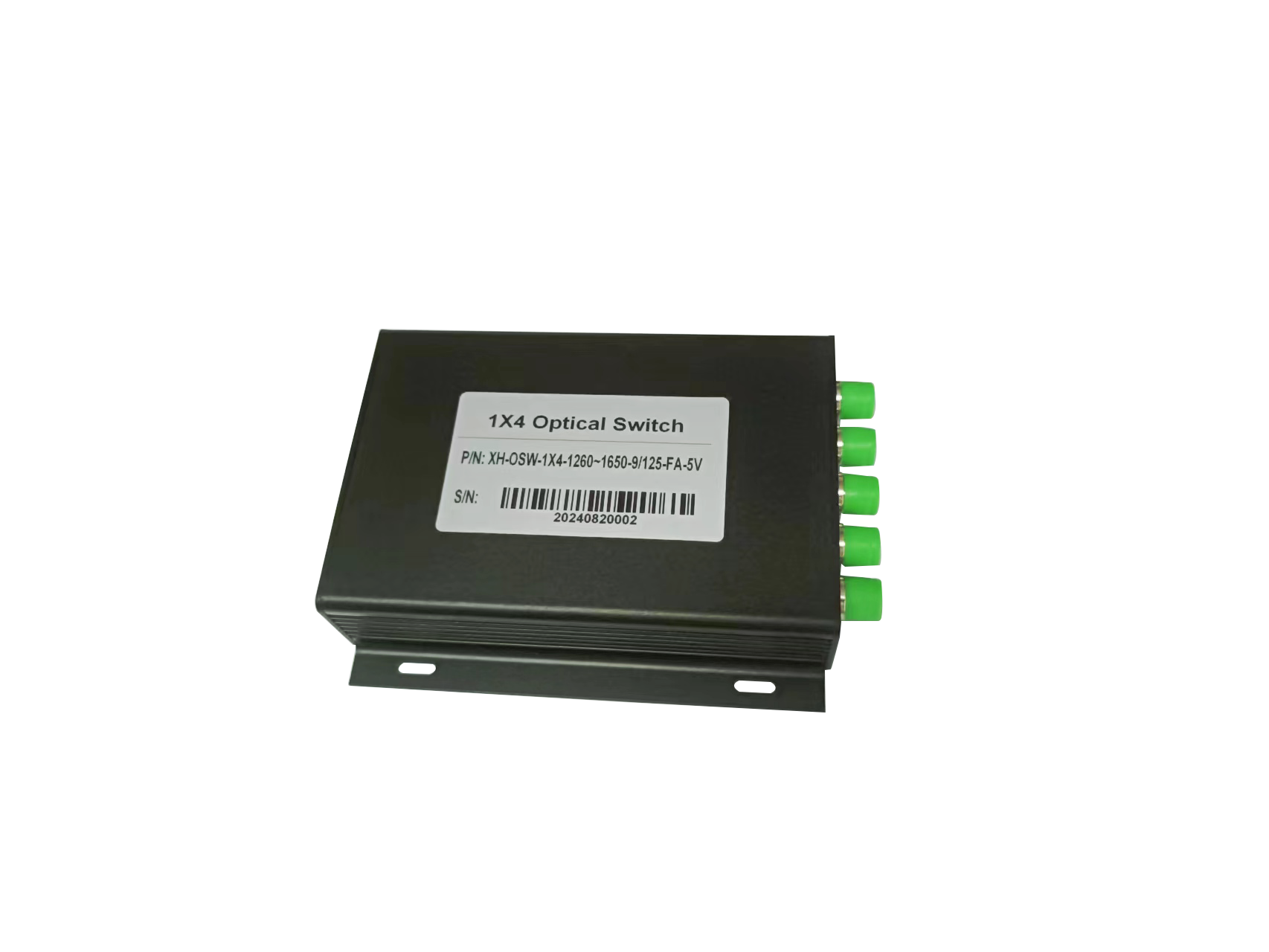
How to Solve Optical Path Drift of Standard Optical Switches in High and Low Temperature Environments
Optical switches are widely used in fiber optic communications, optical sensing, laser testing, and industrial automation. To reduce costs, many projects choose standard optical switches instead of wide-temperature or industrial-grade models. However, when operating in high-temperature, low-temperature, or cyclic temperature environments, standard optical switches may experience optical path drift, leading to increased insertion loss, degraded return loss, and even communication failures. So, how can optical path drift be minimized?
Why Does Optical Path Drift Occur?
Optical path drift is primarily caused by temperature-induced changes in the internal optical structure, including:
- Thermal expansion and contraction of optical fibers
- Micrometer-level displacement of fiber collimators
- Stress caused by optical adhesive expansion or shrinkage
- Different thermal expansion coefficients of metal mounting components
- Mechanical deformation after repeated temperature cycling
Although these displacements are typically only a few micrometers, they can significantly affect fiber-to-fiber coupling efficiency.
Effects of Optical Path Drift
When standard optical switches operate in harsh temperature environments, they may experience:
- Increased insertion loss (IL)
- Reduced return loss (RL)
- Optical power fluctuations
- Unstable system performance
- Higher bit error rates in long-distance optical transmission
These issues can seriously impact applications such as high-speed communication networks, OTDR monitoring systems, fiber optic sensing, and data centers.
How to Reduce Optical Path Drift
1. Use Low Thermal Expansion Materials
Optical components mounted with materials that have low coefficients of thermal expansion help minimize structural deformation and maintain optical alignment during temperature changes.
2. Optimize Optical Packaging
High-stability packaging designs and low-stress bonding processes reduce internal stress caused by adhesive shrinkage or expansion, improving long-term alignment stability.
3. Improve Assembly Accuracy
High-precision active alignment during manufacturing ensures optimal fiber coupling and maintains stable optical performance even under temperature fluctuations.
4. Perform Temperature Cycling Tests
High- and low-temperature cycling tests before shipment help eliminate residual internal stress and verify long-term reliability under varying environmental conditions.
5. Select the Appropriate Optical Switch
If the application operates continuously in harsh environments, such as −40°C to +85°C, a wide-temperature optical switch is recommended. Standard optical switches are better suited for laboratory equipment, indoor communication rooms, and other temperature-controlled environments.
Choosing the Right Optical Switch
When selecting an optical switch, users should consider more than just the purchase price. Important factors include:
- Operating temperature range
- Insertion loss stability
- High- and low-temperature test performance
- Long-term reliability
- Service life and environmental adaptability
For applications in telecommunications, industrial automation, railway systems, aerospace, and outdoor fiber optic networks, choosing a high-reliability optical switch can significantly reduce maintenance costs and improve overall system stability.
Conclusion
Standard optical switches perform well in normal operating environments, but they are more susceptible to optical path drift under extreme temperatures due to thermal expansion, material stress, and mechanical deformation. By using low-expansion materials, optimized packaging techniques, precision assembly, and rigorous environmental testing, manufacturers can significantly improve temperature stability and long-term reliability.
For mission-critical optical communication systems, selecting optical switches that have been validated for high- and low-temperature performance is the most effective way to ensure stable, reliable, and long-lasting network operation.
Comments are closed