


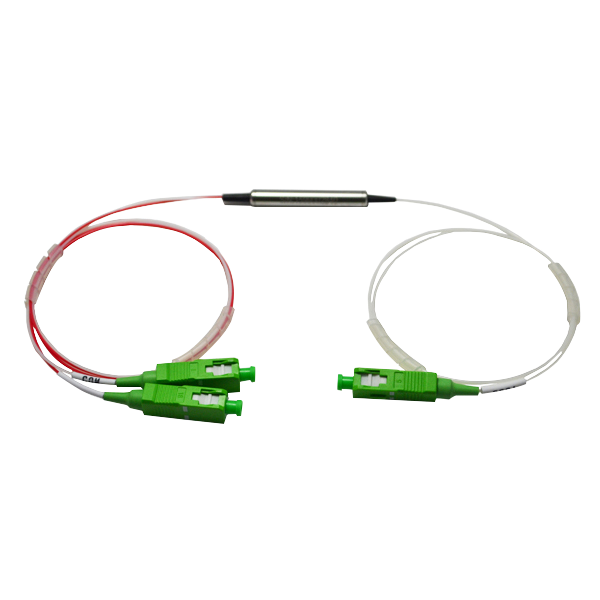
Essential Component for PON Networks: 1310/1490/1550nm Triple-Wavelength FWDM
As Fiber-to-the-Home (FTTH) and Passive Optical Network (PON) technologies continue to expand worldwide, network operators are placing greater emphasis on bandwidth, reliability, and cost-effective deployment. In GPON, EPON, and next-generation PON systems, the 1310/1490/1550nm Filter Wavelength Division Multiplexer (FWDM) is a critical passive optical component that enables bidirectional communication and multi-service transmission over a single optical fiber.
But why is FWDM indispensable in PON networks, and how does it work?
What Is a Triple-Wavelength FWDM?
Filter Wavelength Division Multiplexer (FWDM) is a passive optical device based on Thin Film Filter (TFF) technology. It selectively transmits and reflects different wavelengths, allowing multiple optical signals to travel through a single fiber without interfering with one another.
In a typical PON system, FWDM handles three key wavelengths:
- 1310 nm – Upstream data (ONU → OLT)
- 1490 nm – Downstream data (OLT → ONU)
- 1550 nm – CATV video overlay or value-added optical services
By multiplexing and demultiplexing these wavelengths, FWDM enables simultaneous transmission of data and video over a single optical fiber, maximizing fiber utilization while minimizing infrastructure costs.
How Does a 1310/1490/1550nm FWDM Work?
FWDM employs precision dielectric thin-film filters that exhibit different transmission and reflection characteristics at specific wavelengths.
The operating principle is straightforward:
- The 1490 nm downstream signal passes through the filter.
- The 1310 nm upstream signal is separated into its designated optical path.
- The 1550 nm video signal is independently multiplexed or demultiplexed.
- All three wavelengths are combined onto a single optical fiber for bidirectional transmission.
Because the device is entirely passive and requires no electrical power, FWDM offers exceptional reliability and is ideal for long-term deployment in telecom networks.
Why Is FWDM Essential in PON Networks?
1. Multiple Services over a Single Fiber
FWDM enables one optical fiber to simultaneously carry:
- High-speed Internet
- IPTV
- CATV broadcast services
- Voice communications
This significantly reduces fiber deployment costs while improving network efficiency.
2. Low Optical Loss
Compared with conventional optical couplers, FWDM provides:
- Low insertion loss
- High channel isolation
- Low polarization-dependent loss (PDL)
These characteristics help maintain excellent signal quality over long transmission distances.
3. High Reliability
Since FWDM contains no moving parts, it offers:
- Long service life
- Excellent environmental stability
- Wide operating temperature range
- Maintenance-free operation
This makes it suitable for demanding indoor and outdoor telecom applications.
4. Compatibility with Mainstream PON Standards
Triple-wavelength FWDM is widely used in:
- GPON
- EPON
- XG-PON
- XGS-PON
- CATV Overlay Networks
Its excellent compatibility makes it an ideal solution for both existing and future optical access networks.
Key Specifications to Consider
When selecting a high-quality FWDM, pay attention to the following parameters:
- Operating wavelengths: 1310/1490/1550 nm
- Low insertion loss (IL)
- High isolation
- High return loss (RL)
- Operating temperature: –40°C to +85°C
- Fiber type: SMF-28 or equivalent single-mode fiber
- Package options: Steel tube, ABS module, LGX cassette, rack-mounted module, or customized packaging
A premium FWDM helps minimize optical loss while ensuring long-term network reliability.
Typical Applications
1310/1490/1550nm FWDMs are widely deployed in:
- FTTH (Fiber to the Home)
- GPON and EPON access networks
- CATV fiber-optic transmission systems
- FTTB (Fiber to the Building)
- Optical Line Protection (OLP)
- Online OTDR monitoring systems
- Metropolitan Area Networks (MAN)
- Fiber optic communication and testing equipment
How to Choose the Right FWDM
Before selecting an FWDM, consider the following factors:
- Required operating wavelengths
- Fiber type and connector compatibility
- Insertion loss and isolation performance
- Operating temperature requirements
- Packaging options and customization capabilities
For telecom operators, equipment manufacturers, and system integrators, choosing a reliable FWDM with consistent optical performance can significantly reduce maintenance costs while improving the long-term stability of PON networks.
Conclusion
The 1310/1490/1550nm Triple-Wavelength FWDM is one of the most important passive components in modern PON networks. By enabling bidirectional communication, multi-service integration, and efficient fiber utilization, it plays a crucial role in building high-speed, reliable optical access networks.
As FTTH deployment and next-generation PON technologies continue to evolve, demand for high-performance FWDM solutions will continue to grow. Choosing a high-quality FWDM with low insertion loss, high isolation, and outstanding reliability is essential for ensuring long-term network performance.
Xionghua Photonics provides a wide range of 1310/1490/1550nm FWDM solutions with multiple package options and customization services to meet the diverse requirements of telecom operators, equipment manufacturers, and system integrators worldwide.
No responses yet