


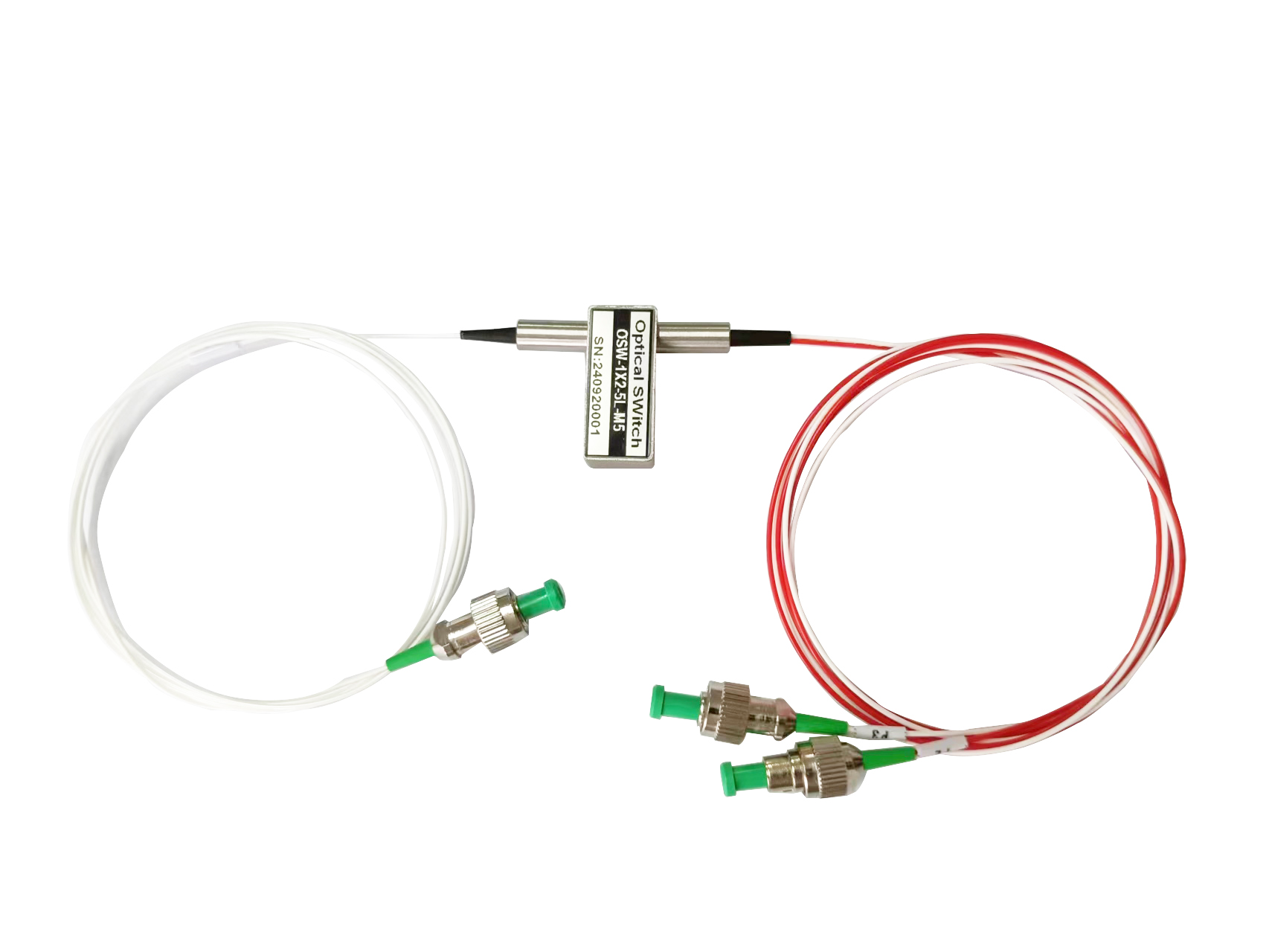
Why Are More and More Devices Adopting Mini Optical Switches?
As fiber optic communications, optical sensing, automated testing, medical equipment, and scientific instrumentation continue to evolve, device manufacturers are demanding optical switching components that are smaller, more energy-efficient, highly reliable, and easier to integrate. Against this backdrop, Mini Optical Switches have become the preferred choice for an increasing number of equipment manufacturers.
So, why are more devices adopting miniature relay optical switches? This article explores the key reasons behind their growing popularity.
1. Compact Size for High-Density Integration
Modern equipment is increasingly designed to be compact, modular, and portable, leaving limited space for internal components.
Compared with conventional optical switches, miniature relay optical switches feature a compact design that can be easily integrated into:
- Optical transceivers
- Fiber optic test equipment
- OTDR systems
- Fiber optic sensing devices
- Medical laser systems
- Industrial inspection instruments
For systems requiring multiple optical paths, their small footprint enables higher channel density and greater system integration without increasing the overall device size.
2. Low Insertion Loss for Better System Performance
Every optical component introduced into a network contributes some degree of signal attenuation. Minimizing this loss is essential for maintaining overall system performance.
High-quality miniature relay optical switches typically provide:
- Low insertion loss
- High return loss
- Low polarization-dependent loss (PDL)
These characteristics help preserve optical signal quality, reduce transmission losses, and improve the performance of high-speed communication networks and precision measurement systems.
3. Low Power Consumption for Continuous Operation
Many applications require equipment to operate continuously for months or even years, including:
- Telecommunication base stations
- Optical network monitoring systems
- Data centers
- Industrial automation equipment
Most miniature relay optical switches utilize a latching mechanism, requiring power only during the switching process. Once switched, the optical path remains in position without continuous power.
This design offers several advantages:
- Lower power consumption
- Reduced heat generation
- Improved energy efficiency
- Extended equipment lifespan
As a result, they are particularly suitable for long-term, unattended operation.
4. High Reliability for Industrial Applications
In telecommunications and industrial systems, reliability often outweighs switching speed.
Mechanical relay optical switches have been proven through years of practical deployment and offer:
- Long operational lifetime
- Excellent environmental stability
- Consistent switching repeatability
- Low failure rates
Even under vibration, temperature fluctuations, or demanding industrial conditions, they maintain stable optical connections, making them ideal for communication systems, industrial control, and precision testing applications.
5. Cost-Effective Solution
Many optical switching applications do not require ultra-fast switching speeds in the microsecond or millisecond range.
Miniature relay optical switches deliver reliable performance while offering:
- Mature manufacturing technology
- Excellent product consistency
- Competitive pricing
For equipment manufacturers, this means achieving high performance while effectively controlling system costs, making them an ideal solution for cost-sensitive applications.
Typical Applications
Today, miniature relay optical switches are widely used in a variety of industries, including:
- Fiber optic communication systems
- Optical test and measurement equipment
- OTDR online monitoring systems
- Optical Line Protection (OLP)
- Data center optical path management
- Fiber optic sensing systems
- Laser equipment
- Medical optical devices
- Scientific research laboratories
- Automated Test Equipment (ATE)
As demand for compact and highly reliable optical systems continues to grow, the application scope of miniature relay optical switches is expanding accordingly.
How to Choose the Right Miniature Relay Optical Switch
When selecting a miniature relay optical switch, consider the following key specifications:
- Fiber type: Single-mode (SM), Multimode (MM), or Polarization Maintaining (PM)
- Operating wavelength: 850 nm, 980 nm, 1064 nm, 1310 nm, 1550 nm, etc.
- Switching configuration: 1×2, 1×4, 2×2, 1X8,4X4,etc.
- Switching mode: Latching or Non-Latching
- Insertion Loss (IL)
- Return Loss (RL)
- Polarization Dependent Loss (PDL)
- Switching time
- Mechanical lifetime
- Operating temperature range
Selecting the appropriate specifications based on your application will help maximize system performance and long-term reliability.
Conclusion
As photonic systems continue to evolve toward miniaturization, intelligence, and higher reliability, miniature relay optical switches are becoming the preferred solution for equipment manufacturers worldwide.
With their compact size, low power consumption, low insertion loss, high reliability, and excellent cost-performance ratio, they provide dependable optical path switching for a wide range of applications—from telecommunications and data centers to industrial automation, fiber optic sensing, medical devices, and scientific research.
Whether designing next-generation communication equipment or high-precision optical instruments, miniature relay optical switches offer a reliable and efficient solution for modern optical networks.
Comments are closed