


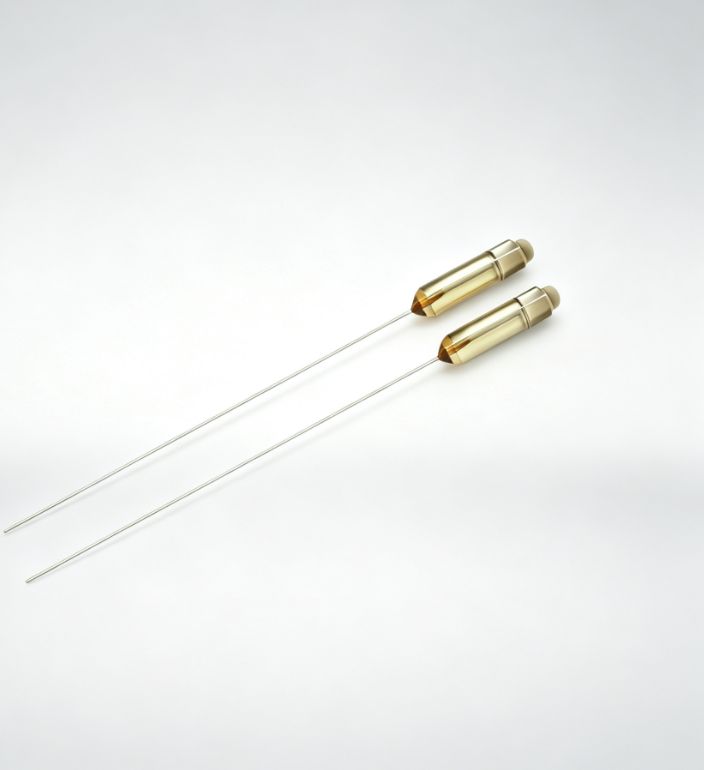
1550nm High-Power Fiber Collimator: A Key Optical Component for High-Power Fiber Systems
The 1550nm wavelength is widely used in optical communication, fiber sensing, LiDAR, and industrial laser systems. When a fiber optic system needs to handle relatively high optical power, standard fiber collimators may not always provide the required long-term stability and power-handling capability.
A 1550nm high-power fiber collimator is an important optical component for coupling light between an optical fiber and a free-space optical path. By converting divergent light from an optical fiber into a nearly collimated beam, it helps achieve stable and efficient optical transmission while supporting different working distances, beam sizes, and power levels.
What Is a 1550nm High-Power Fiber Collimator?
A fiber collimator typically consists of an optical fiber, lens, and mechanical housing. Its main function is to convert the divergent light emitted from an optical fiber into a collimated free-space beam. It can also couple a collimated free-space beam back into an optical fiber.
Compared with standard fiber collimators, high-power fiber collimators need to be specifically designed for higher optical power levels. Optical materials, fiber end-face quality, coatings, adhesives, thermal management, and mechanical structures all need to be considered.
For 1550nm applications, the collimator should provide good optical performance and transmission efficiency at the target near-infrared wavelength. The fiber type and optical structure can also be selected according to the specific application.
Why Choose the 1550nm Wavelength?
1550nm is one of the important operating wavelengths in modern fiber optic systems. It is widely used in telecommunications, sensing, laser systems, and free-space optical applications.
Typical applications include:
- Fiber optic communication systems
- Fiber optic sensing systems
- Laser ranging
- LiDAR systems
- Free-space optical communication
- Industrial laser equipment
- Optical testing and research equipment
A 1550nm-optimized high-power fiber collimator can therefore be integrated with a wide range of 1550nm laser sources and fiber-based optical systems.
Key Performance Parameters of High-Power Fiber Collimators
When selecting a 1550nm high-power fiber collimator, wavelength alone is not enough. Several key parameters should be evaluated.
1. Optical Power
Optical power is one of the most important parameters for a high-power collimator.
As input power increases, the optical components, fiber end face, adhesive materials, and mechanical structure are exposed to greater thermal loads. High-power collimators therefore require suitable optical materials, coatings, and structural designs.
For different power levels, the collimator should be designed according to the actual continuous-wave (CW) power, peak power, and beam characteristics.
2. Working Distance (WD)
Working distance (WD) refers to the designed distance associated with the output collimated beam or focal position.
Different applications may require different working distances, including:
- Short-distance optical coupling
- Long-distance free-space transmission
- Laser scanning systems
- Optical inspection systems
Therefore, the working distance of a 1550nm fiber collimator can be customized according to the requirements of the optical system.
3. Beam Size
The output beam diameter has a direct influence on free-space optical transmission.
In high-power applications, an appropriately increased beam size can help reduce the optical power density, which may reduce the thermal load on optical surfaces.
When designing a high-power 1550nm fiber collimator, the following factors should be considered together:
Input Fiber → Beam Divergence → Lens Parameters → Output Beam Diameter → Working Distance
4. Insertion Loss
Low insertion loss is also important in high-power fiber optic systems.
Lower insertion loss means higher optical transmission efficiency and can also help reduce heat generated by optical absorption within the component.
For high-power applications, particular attention should be paid to fiber end-face quality, optical surface quality, AR coatings, and the coupling efficiency between the fiber and lens.
5. Return Loss
For lasers and high-stability optical systems, reflected light can potentially affect the stability of the light source.
Therefore, depending on the application, a 1550nm fiber collimator with high Return Loss (RL) can be selected. Fiber end-face treatment, optical coatings, and mechanical design can all contribute to reducing unwanted reflections.
High-Power 1550nm Fiber Collimator Design
A reliable high-power collimator is not simply a standard fiber collimator with a higher power rating.
Its design needs to consider both optical and mechanical factors, including:
High-Power Fiber + High-Performance Lens + 1550nm AR Coating + Suitable Housing + Thermal Stability
The fiber type also has a significant influence on the final performance.
Depending on the mode and power requirements, different fiber types may be used, including:
- SM Fiber
- PM Fiber
- Large Mode Area (LMA) Fiber
- Special high-power fibers
For high-power laser applications, large mode area fibers can help reduce the optical power density at the fiber end face and may therefore be suitable for certain high-power fiber laser systems.
Typical Applications of 1550nm High-Power Fiber Collimators
Fiber Lasers
A 1550nm high-power fiber collimator can be used at the free-space output of a fiber laser. It converts the laser output from the fiber into a collimated beam for subsequent optical transmission and processing.
LiDAR and Laser Ranging
The 1550nm wavelength is widely used in certain LiDAR and laser ranging systems. A fiber collimator can help provide a stable output beam and can be integrated with scanning, transmitting, and receiving optical modules.
Fiber Optic Sensing
In fiber sensing systems, 1550nm light sources and fiber collimators can be used in free-space optical paths, detection modules, and laboratory optical platforms.
Optical Communication
1550nm is an important wavelength for optical communication. Fiber collimators can therefore be used for optical coupling, testing, and free-space optical paths in communication equipment.
Research and Laboratory Optical Systems
For research equipment requiring free-space beam transmission at 1550nm, customized fiber collimators can be designed according to working distance, beam diameter, fiber type, connector, and other optical requirements.
How to Select a Suitable 1550nm High-Power Fiber Collimator
When selecting a fiber collimator, it is recommended to first confirm the following parameters:
| Parameter | Requirements to Confirm |
|---|---|
| Operating Wavelength | 1550nm or other specified wavelength |
| Fiber Type | SM / PM / LMA, etc. |
| Input Power | CW power and peak power |
| Working Distance | Required WD |
| Beam Diameter | Required output beam diameter |
| Insertion Loss | IL requirement |
| Return Loss | RL requirement |
| Connector | FC/APC, FC/PC, SMA, etc. |
| Dimensions | Based on available installation space |
| Operating Temperature | According to the application environment |
For high-power applications, it is also important to confirm the laser source type, continuous-wave or pulsed operation, fiber core diameter, and numerical aperture (NA).
Customized 1550nm High-Power Fiber Collimators
Different optical systems can have significantly different requirements. Therefore, customized 1550nm high-power fiber collimators can be developed according to specific application needs.
The following parameters can be customized or optimized:
- Operating wavelength
- Fiber type
- Working distance
- Output beam diameter
- Optical power
- Insertion loss
- Return loss
- Housing dimensions
- Fiber length
- Connector type
- Optical coating
For special high-power applications, the optical and mechanical design can also be optimized according to the specific laser source and system configuration.
Conclusion
The 1550nm high-power fiber collimator is an important component for connecting fiber-based systems with free-space optical paths. Its performance can directly affect the transmission efficiency, stability, and reliability of a high-power fiber optic system.
When selecting a 1550nm high-power fiber collimator, it is important to consider operating wavelength, optical power, fiber type, working distance, beam diameter, insertion loss, and return loss rather than focusing on the wavelength alone.
For applications such as fiber lasers, LiDAR, fiber sensing, optical communication, and scientific research, a customized 1550nm high-power fiber collimator can provide a better match for specific system requirements.
Comments are closed