


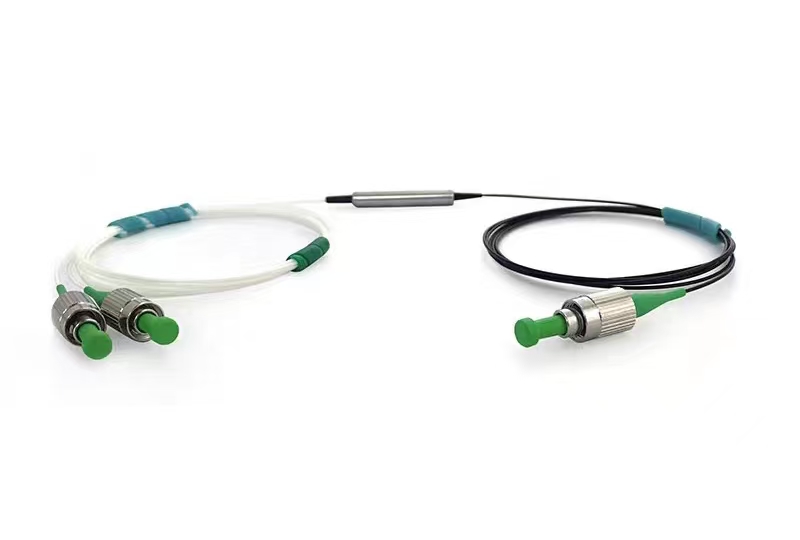
1×2 PM 10:90 FBT Fiber Coupler for Fiber Laser and Optical Monitoring
1×2 Polarization Maintaining (PM) 10:90 FBT Fiber Coupler is a passive fiber optic component designed to split one optical input into two output ports with a nominal 10:90 coupling ratio. It is particularly suitable for applications where a small portion of the optical signal needs to be tapped for monitoring while the majority of the optical power remains in the main optical path.
Based on Fused Biconical Taper (FBT) technology, this type of fiber coupler is widely used in optical monitoring, fiber lasers, optical communication, sensing, and laboratory test systems.
What Is a PM 10:90 FBT Fiber Coupler?
A PM 10:90 FBT fiber coupler is a passive optical component designed to divide an input optical signal into two output signals.
The nominal coupling ratio is:
- 10% optical power to the monitoring port
- 90% optical power to the main output port
For example, if 100 mW of optical power is injected into the input fiber, approximately 10 mW can be directed to the monitoring port while approximately 90 mW continues through the main optical path, subject to the actual coupling ratio and insertion loss.
Unlike standard single-mode fiber couplers, PM fiber couplers are designed to preserve the polarization state of the optical signal, making them suitable for polarization-sensitive applications.
Why Use a 10:90 Coupling Ratio?
The 10:90 ratio is particularly useful when continuous optical monitoring is required without significantly affecting the main signal.
The 90% output can remain connected to the primary optical system, while the 10% output can be connected to a photodetector, optical power meter, spectrum analyzer, or other monitoring equipment.
This configuration allows engineers to monitor parameters such as:
- Optical output power
- Signal stability
- Laser performance
- Power fluctuations
- Optical spectrum
- System operating status
Because only a relatively small portion of the optical power is tapped, the influence on the main optical path can be minimized.
Polarization Maintaining Performance
For polarization-sensitive systems, maintaining the polarization state of the optical signal is critical.
A PM fiber coupler uses polarization-maintaining fiber and a carefully controlled fused taper structure. Proper alignment of the PM fiber and control of the coupling region help maintain polarization characteristics throughout the optical path.
Important parameters for PM applications may include:
- Polarization extinction ratio (PER)
- Insertion loss (IL)
- Excess loss
- Coupling ratio
- Return loss
- Operating wavelength
- Temperature stability
The required performance depends on the application. For high-precision polarization-sensitive systems, the PER and coupling-ratio tolerance should be carefully evaluated during component selection.
FBT Technology for Fiber Couplers
FBT, or Fused Biconical Taper, is a mature technology for manufacturing fiber optic couplers.
During the manufacturing process, two optical fibers are carefully aligned and fused together while being tapered under controlled conditions. A portion of the optical power is transferred from one fiber to the other through the coupling region.
By controlling the tapering process and coupling length, manufacturers can achieve different splitting ratios, including commonly used configurations such as:
- 1:99
- 2:98
- 5:95
- 10:90
- 20:80
- 30:70
- 50:50
For optical monitoring applications, asymmetric ratios such as 10:90 are often useful because they provide sufficient monitoring power while keeping most of the optical power in the primary path.
Applications of PM 10:90 Fiber Couplers
A PM 10:90 FBT fiber coupler can be used in a variety of optical systems.
1. Fiber Laser Monitoring
In fiber laser systems, a small percentage of the output can be tapped and directed to a photodetector or monitoring unit.
This enables real-time monitoring of laser output without interrupting the main optical path.
2. Optical Power Monitoring
The 10% monitoring port can be connected to an optical power detector to continuously measure changes in system output.
This can be useful for detecting:
- Power fluctuations
- Laser degradation
- Unexpected signal loss
- System instability
3. Optical Communication Systems
PM fiber couplers can be used in polarization-sensitive optical communication and testing systems where maintaining the polarization state is important.
The monitoring port can provide a reference signal for system diagnostics and performance evaluation.
4. Fiber Optic Sensing
In fiber sensing applications, polarization characteristics can influence measurement accuracy. PM components can therefore be used where stable polarization behavior is required.
5. Laboratory and Test Equipment
PM 10:90 couplers can also be integrated into optical test setups, allowing engineers to monitor an optical signal while simultaneously sending the majority of the power to the device under test.
Key Parameters to Consider
When selecting a PM 10:90 FBT fiber coupler, several specifications should be considered.
| Parameter | Consideration |
|---|---|
| Coupling Ratio | Typically 10:90, with tolerance depending on requirements |
| Operating Wavelength | Select according to the laser or optical system |
| Fiber Type | PM fiber matched to the application |
| Insertion Loss | Lower loss is preferred for efficient transmission |
| PER | Important for polarization-sensitive applications |
| Return Loss | Important for laser and precision optical systems |
| Optical Power | Must be compatible with the operating power |
| Operating Temperature | Should meet the environmental requirements |
| Connector | FC/APC, FC/PC, LC, or other configurations |
| Package | Select according to installation requirements |
For customized applications, the fiber type, wavelength, coupling ratio, connector configuration, fiber length, and package dimensions can be specified according to the system requirements.
PM 10:90 vs. Standard 10:90 Fiber Couplers
Although both products provide a 10:90 splitting function, their intended applications can be different.
A standard single-mode 10:90 coupler is generally sufficient when polarization preservation is not critical.
A PM 10:90 fiber coupler is more suitable when the system requires stable polarization characteristics, such as:
- Fiber lasers
- Polarization-sensitive measurement systems
- Coherent optical systems
- Precision optical testing
- Fiber optic sensing
Therefore, the choice between standard SM and PM fiber couplers should be based on the polarization requirements of the optical system rather than the coupling ratio alone.
Conclusion
The Polarization Maintaining 10:90 FBT Fiber Coupler combines an asymmetric 10:90 optical splitting ratio with polarization-maintaining fiber technology. It allows approximately 10% of the optical signal to be used for monitoring while approximately 90% remains available for the main optical path.
With its compact passive design and flexible configuration options, the PM 10:90 FBT fiber coupler can be integrated into fiber laser monitoring, optical communication, fiber sensing, optical testing, and other polarization-sensitive systems.
For applications requiring customized wavelengths, coupling ratios, fiber types, connectors, or optical performance, PM FBT fiber couplers can be designed according to the specific requirements of the optical system.
Comments are closed