


How to Choose Fiber Optic Switch for 940nm, 980nm, and 1064nm Fiber Lasers?
Introduction
With the growing adoption of fiber laser technology in industrial processing, fiber optic sensing, medical equipment, LiDAR, and scientific research, the demand for reliable optical switching solutions continues to increase.
Among the commonly used near-infrared wavelengths, 940nm, 980nm, and 1064nm play important roles in different laser applications. However, these wavelengths differ in their typical applications, fiber requirements, optical power levels, and system design considerations.
So, which type of fiber optic switch should you choose for these laser systems? Should you use a MEMS optical switch, a mechanical optical switch, or a specially designed high-power optical switch?
The answer depends on more than just the operating wavelength. Factors such as optical power handling, insertion loss, switching speed, fiber type, polarization requirements, and long-term operating stability must also be considered.
In this article, we will explore the key differences between these laser wavelengths and explain how to select a suitable fiber optic switch for each application.
1. What Are the Differences Between 940nm, 980nm, and 1064nm Fiber Lasers?
Although all three wavelengths belong to the near-infrared region, they are used in different optical systems and have different technical requirements.
940nm Fiber Lasers
940nm fiber-coupled lasers are commonly used in laser pumping, infrared illumination, medical equipment, and industrial applications.
When selecting an optical switch for a 940nm laser system, particular attention should be paid to fiber coupling efficiency, optical power density, and the power-handling capability of the optical interfaces.
980nm Fiber Lasers
980nm is an important wavelength in fiber laser and optical amplification systems. One of its major applications is pumping erbium-doped fiber amplifiers (EDFAs).
In these systems, optical signals may pass through multiple optical components. Therefore, insertion loss and optical power stability are important considerations when selecting a 980nm optical switch.
1064nm Fiber Lasers
1064nm is widely used in ytterbium-doped fiber lasers and industrial laser systems.
Typical applications include:
- Metal cutting and welding
- Laser marking and engraving
- Precision material processing
- Scientific research
- Industrial fiber laser systems
Some 1064nm laser systems operate at relatively high continuous-wave power or high pulsed peak power. As a result, their optical switches may require higher power-handling capabilities and more careful thermal management.
It is important to verify that the selected optical switch supports the required wavelength and optical power under the actual operating conditions.
2. MEMS vs. Mechanical Optical Switches: Which Is More Suitable?
For 940nm, 980nm, and 1064nm fiber laser systems, MEMS and mechanical optical switches are two important technologies to consider.
2.1 MEMS Optical Switches
MEMS (Micro-Electro-Mechanical Systems) optical switches use miniature movable mirrors to redirect light beams and establish different optical paths.
Key advantages include:
- Suitable for multi-channel optical switching.
- Available in different configurations, including 1×N and M×N.
- Flexible channel expansion.
- Suitable for automated optical testing platforms.
- Compact optical switching architecture.
However, the actual insertion loss and optical power-handling capability must be verified at the target wavelength.
Typical applications:
- Multi-channel laser source switching
- Automated optical testing systems
- Fiber optic sensing systems
- Laboratory optical equipment
MEMS optical switches are particularly useful when multiple optical paths need to be controlled within a compact system.
2.2 Mechanical Optical Switches
Mechanical optical switches use motors or other mechanical driving structures to move optical components and switch between different fiber channels.
Key advantages include:
- Mature switching technology.
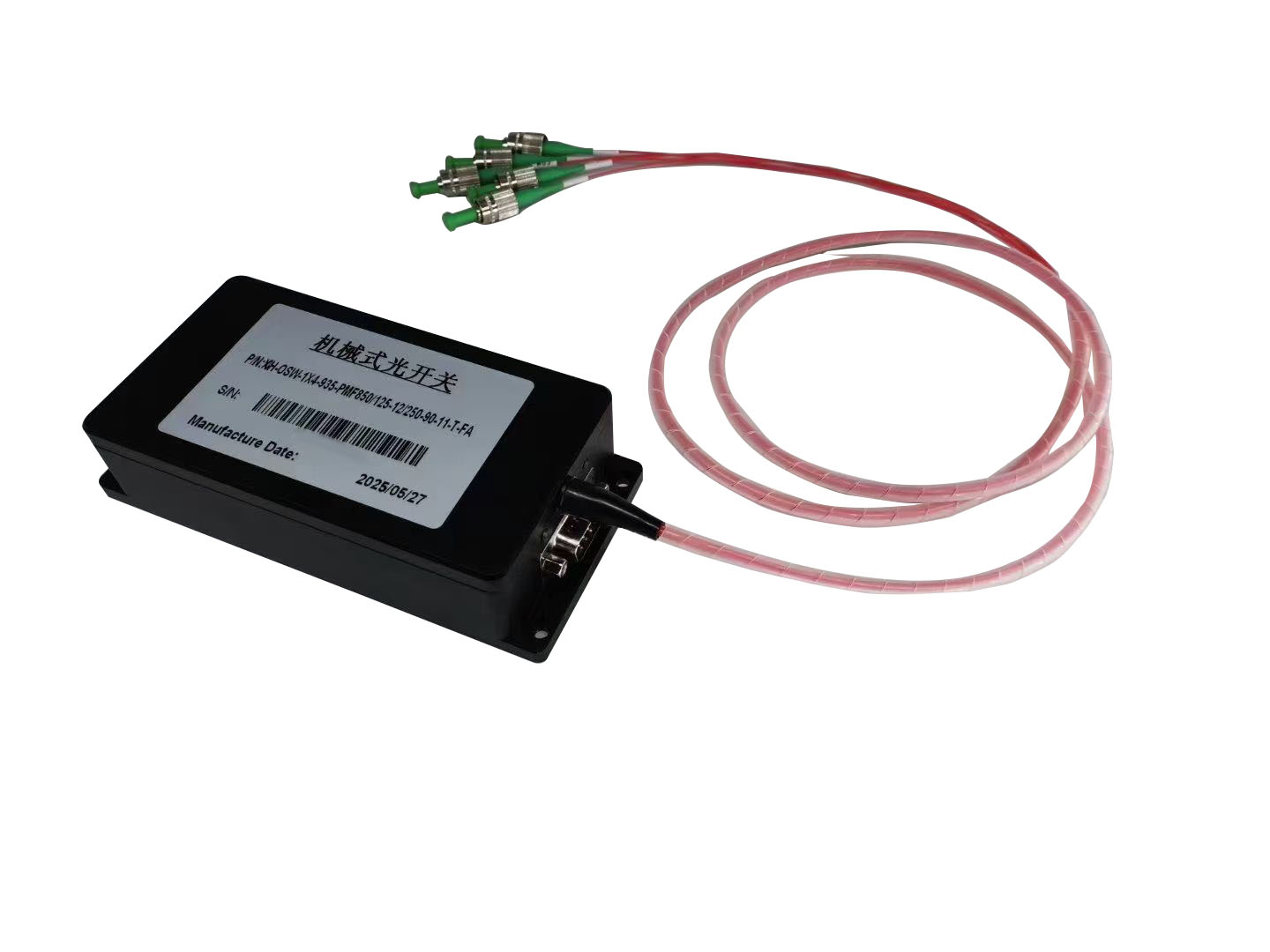
- Available in configurations such as 1×2, 1×4, and 1×8.
- Suitable for single-channel or limited-channel switching.
- Flexible customization of fiber types and connectors.
- Suitable for various optical equipment and experimental systems.
When selecting a mechanical optical switch, switching time, mechanical lifetime, and repeatability should be carefully evaluated.
Typical applications:
- Laser equipment optical path selection
- Optical source switching
- Laboratory optical systems
- Industrial optical path control
How Should You Choose?
If your system requires multi-channel switching, automated control, and flexible port expansion, a MEMS optical switch is worth considering.
If your application only requires switching between two or several optical paths, a mechanical optical switch may be a suitable solution.
It is important to note that MEMS technology is not automatically better than mechanical technology for high-power laser applications. Both types must be evaluated according to actual optical power, beam characteristics, and internal optical design.
3. How to Select Optical Switches for Different Laser Wavelengths?
The most important part of optical switch selection is understanding the specific requirements of each wavelength.
3.1 Optical Switch Selection for 940nm Fiber Lasers
940nm laser systems require particular attention to short-wavelength near-infrared compatibility.
Important selection factors include:
- Confirming that the operating wavelength range covers 940nm.
- Matching the fiber core diameter and mode field diameter to the laser source.
- Evaluating insertion loss at 940nm.
- Selecting the appropriate single-mode (SM), multimode (MM), or polarization-maintaining (PM) fiber.
- Confirming that the laser output power is within the switch’s rated power capacity.
Recommended solutions:
For low-power, multi-channel optical switching, a MEMS optical switch specifically designed to support 940nm can be considered.
For simpler 1×2 or 1×4 optical switching applications, a customized mechanical optical switch may also be suitable.
3.2 Optical Switch Selection for 980nm Fiber Lasers
980nm is widely used in optical amplification and fiber laser systems, particularly in EDFA pumping applications.
Since pump light may pass through multiple optical components, additional insertion loss from an optical switch can affect the overall optical power budget.
Important considerations include:
- Actual insertion loss at 980nm.
- Maximum optical power handling.
- Switching repeatability.
- Fiber type and connector compatibility.
- Long-term operating stability.
Recommended solutions:
For low-power 980nm optical switching, a dedicated 980nm MEMS optical switch can be considered.
If the system has strict polarization requirements, a polarization-maintaining (PM) optical switch designed for 980nm may be more appropriate.
Depending on the product design, 980nm PM MEMS optical switches are available in configurations such as 1×2, 1×4, and 1×8. Actual performance should always be verified using the corresponding product datasheet.
3.3 Optical Switch Selection for 1064nm Fiber Lasers
1064nm is one of the most important wavelengths in industrial fiber laser applications, particularly in ytterbium-doped fiber laser systems.
Unlike low-power optical communication systems, some 1064nm laser systems operate at relatively high continuous-wave power or high pulsed peak power.
Therefore, wavelength compatibility alone does not guarantee that an optical switch can safely operate in a high-power laser system.
Important selection factors include:
- Maximum continuous-wave (CW) optical power.
- Pulsed laser peak power and pulse energy.
- Optical damage threshold of fiber end faces and internal optical components.
- Insertion loss and localized optical absorption.
- Fiber core diameter and mode field diameter.
- Thermal stability during long-term operation.
Recommended solutions:
- Low-power 1064nm applications: Evaluate dedicated MEMS or mechanical optical switches.
- Medium-power applications: Consider customized mechanical optical switches that have undergone actual power testing.
- High-power applications: Use specially designed high-power optical switches with verified optical power handling and thermal performance.
For high-power applications, standard communication-grade MEMS optical switches should not be assumed to support industrial laser power levels.
The optical coupling structure, component absorption, and thermal management must all be considered during the design process.
4. Recommended Optical Switch Types for 940nm, 980nm, and 1064nm Fiber Lasers
Different laser wavelengths and application requirements call for different optical switching solutions. The following table provides practical recommendations based on wavelength compatibility, channel configuration, and optical power requirements.
| Laser Wavelength | Recommended Switch Type | Main Selection Considerations |
|---|---|---|
| 940nm | MEMS or Mechanical Optical Switch | Wavelength compatibility, fiber matching, and insertion loss |
| 980nm | MEMS or PM MEMS Optical Switch | Low insertion loss, power stability, and polarization requirements |
| 1064nm | Mechanical or High-Power Optical Switch | Optical power handling, damage threshold, and thermal stability |
940nm: MEMS or Mechanical Optical Switch
For low-power 940nm laser applications, MEMS optical switches are suitable for multi-channel switching and automated optical systems. Mechanical optical switches are a practical choice for simpler 1×2 or 1×4 configurations.
980nm: MEMS or PM MEMS Optical Switch
For 980nm laser pumping and optical amplification systems, MEMS optical switches are suitable for multi-channel applications where low insertion loss is important. If polarization stability is required, a PM MEMS optical switch should be selected.
1064nm: Mechanical or High-Power Optical Switch
For low-power 1064nm applications, both MEMS and mechanical optical switches can be used, provided their wavelength and power ratings meet system requirements.
For higher-power 1064nm fiber laser systems, a specially designed high-power optical switch is recommended. Its optical damage threshold, thermal performance, and power-handling capability must be verified before use.
5. Five Key Parameters to Consider When Selecting a Fiber Optic Switch
In addition to operating wavelength, the following five parameters are essential for determining whether an optical switch is suitable for a specific laser system.
5.1 Insertion Loss (IL)
Insertion loss determines how much optical power is lost when light passes through the optical switch.
Lower insertion loss generally means less impact on the system’s optical power budget.
For laser systems that are sensitive to output power variations, select an optical switch with low insertion loss and request test data at the target wavelength.
5.2 Maximum Optical Power
Maximum optical power is one of the most important parameters for high-power laser applications.
It is necessary to distinguish between:
- Continuous-wave (CW) power
- Average pulsed power
- Peak pulse power
The rated maximum power alone is not sufficient. Testing conditions, fiber end-face characteristics, beam parameters, and optical damage thresholds must also be considered.
5.3 Fiber Type
Common fiber options include:
- SM: Single-Mode Fiber
- MM: Multimode Fiber
- PM: Polarization-Maintaining Fiber
- Large-Core Fiber: Fiber with a larger core diameter for specific optical power and coupling requirements
For 940nm and 1064nm applications in particular, fiber compatibility should be evaluated according to the actual operating wavelength, core diameter, and mode field diameter.
5.4 Switching Time
For applications involving fast optical path switching or automated testing, switching time should be selected according to the system’s control cycle.
It is also important to consider settling time after switching, rather than evaluating only the initial switching response.
5.5 Polarization Extinction Ratio (PER)
For polarization-maintaining laser sources, polarization-sensitive measurements, and fiber optic sensing systems, the polarization extinction ratio (PER) is an important performance parameter.
If the application has strict polarization requirements, a dedicated PM optical switch should be considered.
Its actual extinction ratio should be verified at the target operating wavelength.
6. What Information Is Needed to Select the Right Optical Switch?
Before selecting an optical switch for a fiber laser system, it is recommended to confirm the following technical requirements.
| Selection Item | Required Information |
|---|---|
| Operating Wavelength | 940nm / 980nm / 1064nm |
| Switch Type | MEMS / Mechanical |
| Channel Configuration | 1×2 / 1×4 / 1×8 / M×N |
| Laser Power | mW / W |
| Fiber Type | SM / MM / PM |
| Fiber Core Diameter | According to the actual fiber |
| Control Interface | TTL / RS232 / USB / Ethernet |
| Switching Speed | According to application requirements |
For high-power 1064nm laser applications, additional information should be provided, including continuous-wave output power, pulse energy, pulse duration, and repetition rate.
These details help determine whether a standard optical switch or a customized high-power switching solution is more appropriate.
Conclusion: Which Optical Switch Should You Choose for 940nm, 980nm, and 1064nm Fiber Lasers?
Both MEMS and mechanical optical switches can be considered for 940nm, 980nm, and 1064nm fiber laser systems. However, the final selection depends on the specific application and technical requirements.
- 940nm: Prioritize wavelength compatibility, fiber matching, and coupling efficiency.
- 980nm: Focus on low insertion loss, optical power stability, and polarization requirements.
- 1064nm: Pay particular attention to optical power handling, optical damage thresholds, and thermal stability.
For low-power, multi-channel applications, MEMS optical switches offer advantages in integration and channel expansion.
For simple optical path switching or specially engineered high-power applications, mechanical optical switches may also be worth considering.
The most important point is that wavelength compatibility does not automatically guarantee sufficient optical power handling capability. Proper optical switch selection must consider wavelength, power, fiber type, and optical performance together.
Comments are closed