


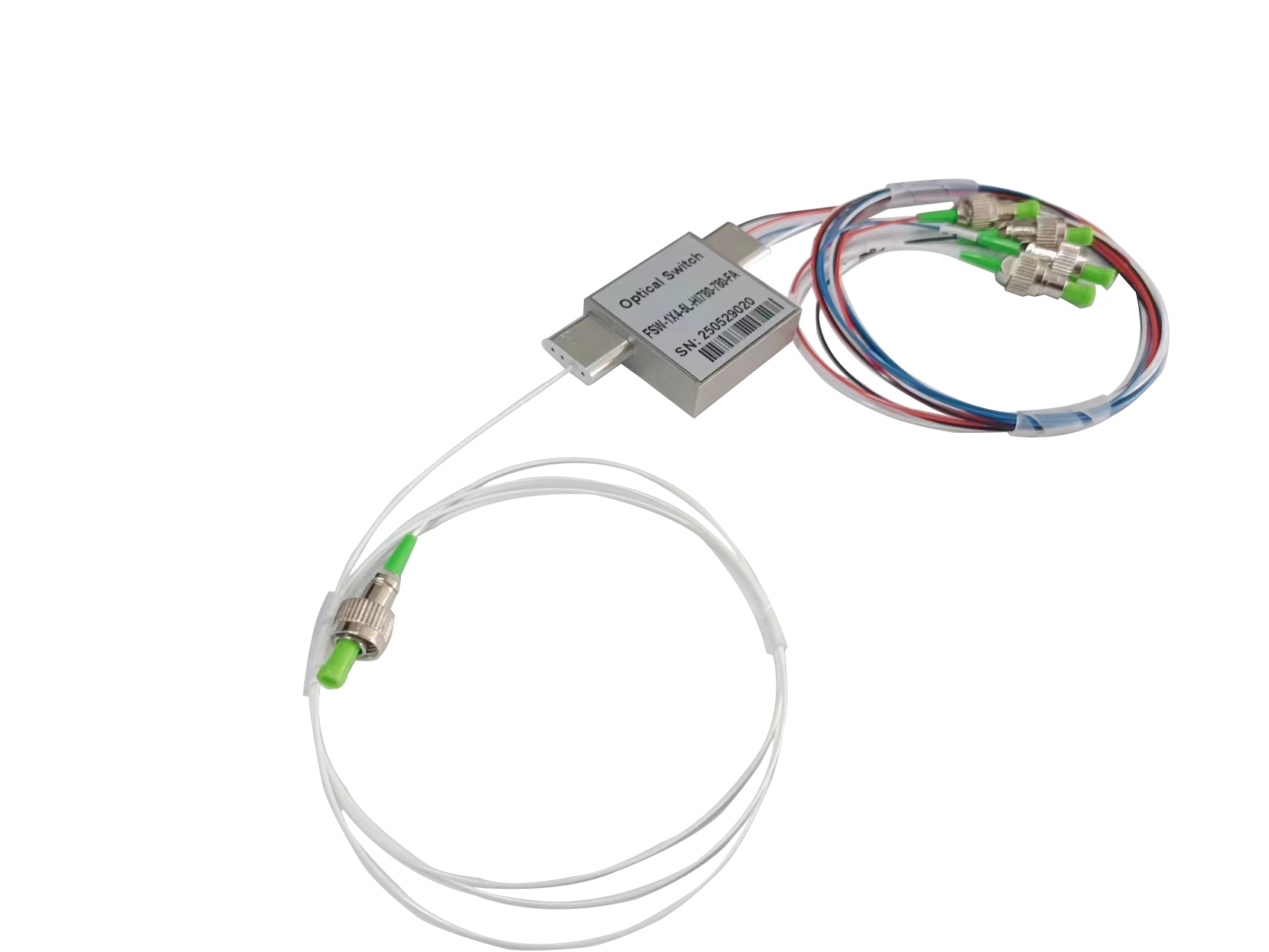
Optical Switches in LiDAR Systems: Key Components for Autonomous Driving Perception
With the rapid development of autonomous driving, intelligent transportation, and industrial robotics, LiDAR (Light Detection and Ranging) has become an important technology for environmental perception. By transmitting laser pulses and receiving reflected signals, LiDAR systems can accurately measure the distance, position, and movement of surrounding objects, providing essential 3D environmental data for autonomous vehicles.
In addition to laser sources, photodetectors, scanning modules, and signal processing units, optical switches can also play an important role in certain LiDAR-related optical systems. Particularly in multi-channel optical routing, optical signal switching, fiber laser systems, and LiDAR testing platforms, optical switches provide flexible optical path management and help improve system integration and testing efficiency.
This article explores the applications of optical switches in LiDAR systems, their operating principles, technical advantages, and future development trends.
1. What Is LiDAR (Light Detection and Ranging)?
LiDAR is a distance-measurement and environmental perception technology that uses laser light. It works by transmitting laser pulses toward a target and measuring the time difference between transmission and reception, commonly known as Time of Flight (ToF).
The basic working process includes:
- Laser Emission: A laser source generates laser pulses at a specific wavelength.
- Laser Scanning: A scanning system directs the laser beam across different directions and areas.
- Signal Reception: A photodetector receives laser signals reflected from surrounding objects.
- Distance Measurement: The system calculates the distance to an object based on the laser signal’s travel time.
- Data Processing: The collected information is processed to generate 3D point clouds and identify vehicles, pedestrians, roads, and other obstacles.
LiDAR technology is widely used in autonomous vehicles, intelligent transportation, robotic navigation, drones, and industrial automation.
2. The Role of Optical Switches in LiDAR Systems
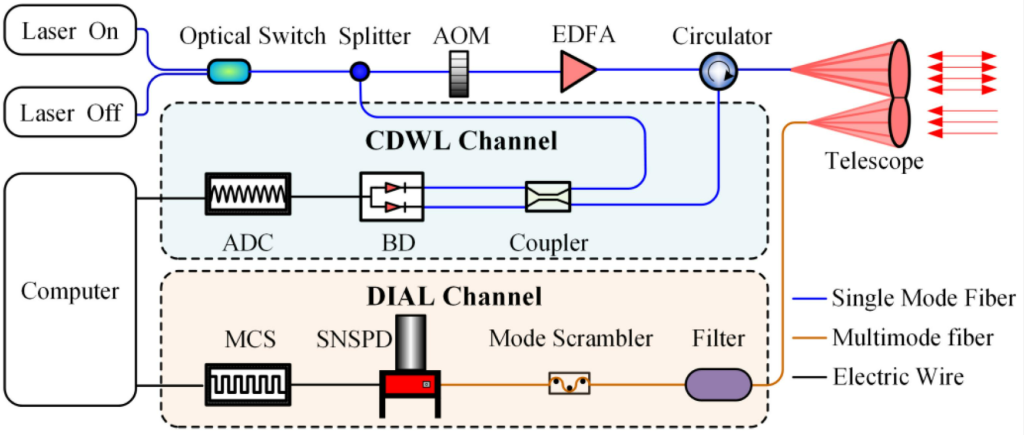
An optical switch is a device that controls the transmission path of optical signals. By changing its internal optical path configuration, it directs an input optical signal to a selected output port according to system commands.
In LiDAR systems that use fiber-optic transmission and multi-channel optical architectures, optical switches can support several important functions.
2.1 Multi-Channel Optical Path Switching
Some LiDAR systems use multi-channel optical architectures that require different optical paths to be selected and switched.
For example, in multi-channel laser transmission or fiber-optic systems, a 1×N optical switch can route one input optical signal to different output channels.
This approach can help achieve:
- Selective transmission of multi-channel laser signals.
- Switching between different optical channels.
- Flexible distribution of multiple optical signals.
- Simplified optical connection design in certain system architectures.
For systems that require multiple optical channels to work together, optical switches provide a more flexible approach to optical path management.
2.2 Laser Signal Testing and Switching
During LiDAR development and manufacturing, different optical channels need to undergo performance testing.
Typical testing requirements include:
- Laser output power measurement.
- Optical insertion loss measurement.
- Optical signal stability testing.
- Multi-channel optical performance comparison.
- Optical component reliability testing.
By using mechanical optical switches or MEMS optical switches, testing equipment can automatically switch between different optical channels, reducing manual fiber reconnection.
For multi-channel LiDAR testing equipment, automated optical path switching can improve testing efficiency while reducing potential connection losses and human errors caused by repeated manual operations.
2.3 Optical Path Control in Fiber Lasers
Some LiDAR systems use fiber lasers as their light sources.
In these systems, optical signals may pass through different optical components during transmission and processing. Depending on the system architecture, optical switches can be used to select and switch between different optical paths.
For example, in optical research and development platforms, optical switches can route laser outputs through different paths, allowing engineers to test and compare multiple optical components.
Optical switches also offer practical value in equipment involving fiber-optic sensing, laser measurement, and fiber laser technologies.
2.4 Automation in LiDAR Development and Manufacturing
As LiDAR technology evolves toward higher channel counts, smaller form factors, and greater integration, optical testing during development and manufacturing is becoming increasingly complex.
Traditional manual optical path switching can involve longer operating times, inconsistent repeatability, and lower testing efficiency.
By integrating optical switches, equipment can automatically select different optical testing paths and work with control software to execute predefined testing procedures.
This approach is particularly useful for LiDAR production lines, optical component inspection platforms, and research laboratories.
3. Which Types of Optical Switches Are Suitable for LiDAR-Related Systems?
Different LiDAR architectures have different optical switching requirements. Selecting an appropriate optical switch requires consideration of the optical path configuration, operating wavelength, channel count, switching speed, and optical power requirements.
3.1 MEMS Optical Switches
MEMS optical switches use micro-electromechanical systems to control miniature mirrors, redirecting optical signals between different ports.
Key features include:
- Compact design.
- Relatively low insertion loss.
- Support for multi-channel optical switching.
- Suitability for automated optical testing equipment and multi-channel fiber-optic systems.
3.2 Mechanical Optical Switches
Mechanical optical switches use mechanical movement to change the transmission path of optical signals.
Key features include:
- Mature optical switching technology.
- Multiple port configurations.
- Customizable designs according to application requirements.
- Suitability for laboratory equipment and optical testing systems.
3.3 M×N Matrix Optical Switches
M×N matrix optical switches provide flexible connections between multiple input and output ports.
Key features include:
- Support for complex optical path configurations.
- Suitability for multi-channel testing platforms.
- Centralized optical path management.
- Applications in automated optical testing systems.
It is important to note that these optical switches are primarily intended for fiber-optic routing, testing, and development applications related to LiDAR systems. They do not directly replace the scanning mirrors or MEMS scanning mirrors used in conventional LiDAR architectures.
4. Key Parameters to Consider When Selecting Optical Switches for LiDAR Systems
When selecting optical switches for LiDAR-related systems or optical testing equipment, several technical specifications should be carefully evaluated.
| Technical Parameter | Selection Considerations |
|---|---|
| Operating Wavelength | Must cover the actual wavelength used in the system |
| Insertion Loss (IL) | Should be minimized to reduce optical signal loss |
| Return Loss (RL) | Helps reduce the impact of optical reflections |
| Switching Time | Must meet the system’s switching requirements |
| Channel Count | Select 1×N or M×N configurations according to the optical architecture |
| Repeatability | Ensures stable optical performance after repeated switching |
| Optical Power | Must support the actual input optical power |
| Control Interface | RS232, USB, Ethernet, etc. |
| Operating Temperature | Must meet the actual operating environment |
Among these parameters, operating wavelength, insertion loss, and switching time are particularly important.
For pulsed laser systems, it is also essential to verify the optical switch response time, optical path stability, and compatibility with the actual pulse operating conditions. Port count alone is not sufficient for selecting an appropriate optical switch.
5. Future Trends of Optical Switches in LiDAR Applications
As autonomous driving technology continues to advance, LiDAR systems are evolving toward higher resolution, smaller form factors, lower costs, and greater reliability.
In the future, optical switches may play increasingly important roles in several related areas.
1. Multi-Channel Optical Systems
As LiDAR optical architectures become more sophisticated, the demand for multi-channel optical signal management and testing is expected to increase. Optical switches can provide flexible routing solutions for complex optical paths.
2. Automated Testing Equipment
LiDAR development and manufacturing require extensive optical performance testing. Integrating MEMS and mechanical optical switches can help build automated optical path testing platforms.
3. Highly Integrated Optical Equipment
As fiber lasers and optical modules become more compact, optical switches will face higher requirements for size, power consumption, reliability, and integration capabilities.
4. Intelligent Optical Path Control
By integrating computer control software and automated testing systems, optical switches can automatically change optical paths according to different testing tasks, improving equipment operating efficiency.
6. Conclusion
LiDAR is an essential technology for autonomous driving perception systems, while optical switches serve as important auxiliary components in certain fiber-optic routing, optical testing, and automation applications related to LiDAR.
By selecting suitable MEMS optical switches, mechanical optical switches, and matrix optical switches, engineers can implement multi-channel optical path switching, automated testing, and flexible optical signal management.
As LiDAR technology continues to evolve, optical switches are expected to find further applications in optical research and development, testing equipment, and fiber laser systems.
7. Looking for Reliable Optical Switch Solutions?
Xionghua Photoelectric specializes in the development and manufacturing of fiber optic switching products and optical components.
Our product portfolio includes:
- MEMS Optical Switches
- Mechanical Optical Switches
- 1×N and M×N Optical Switches
- Rack-Mount Optical Switch Systems
- Customized Fiber Optic Switching Solutions
We support customized configurations based on different wavelengths, port counts, fiber types, and control interfaces.
Whether you are developing optical testing equipment, fiber laser systems, or multi-channel optical devices, our team can help evaluate a suitable optical switching solution.
Comments are closed