


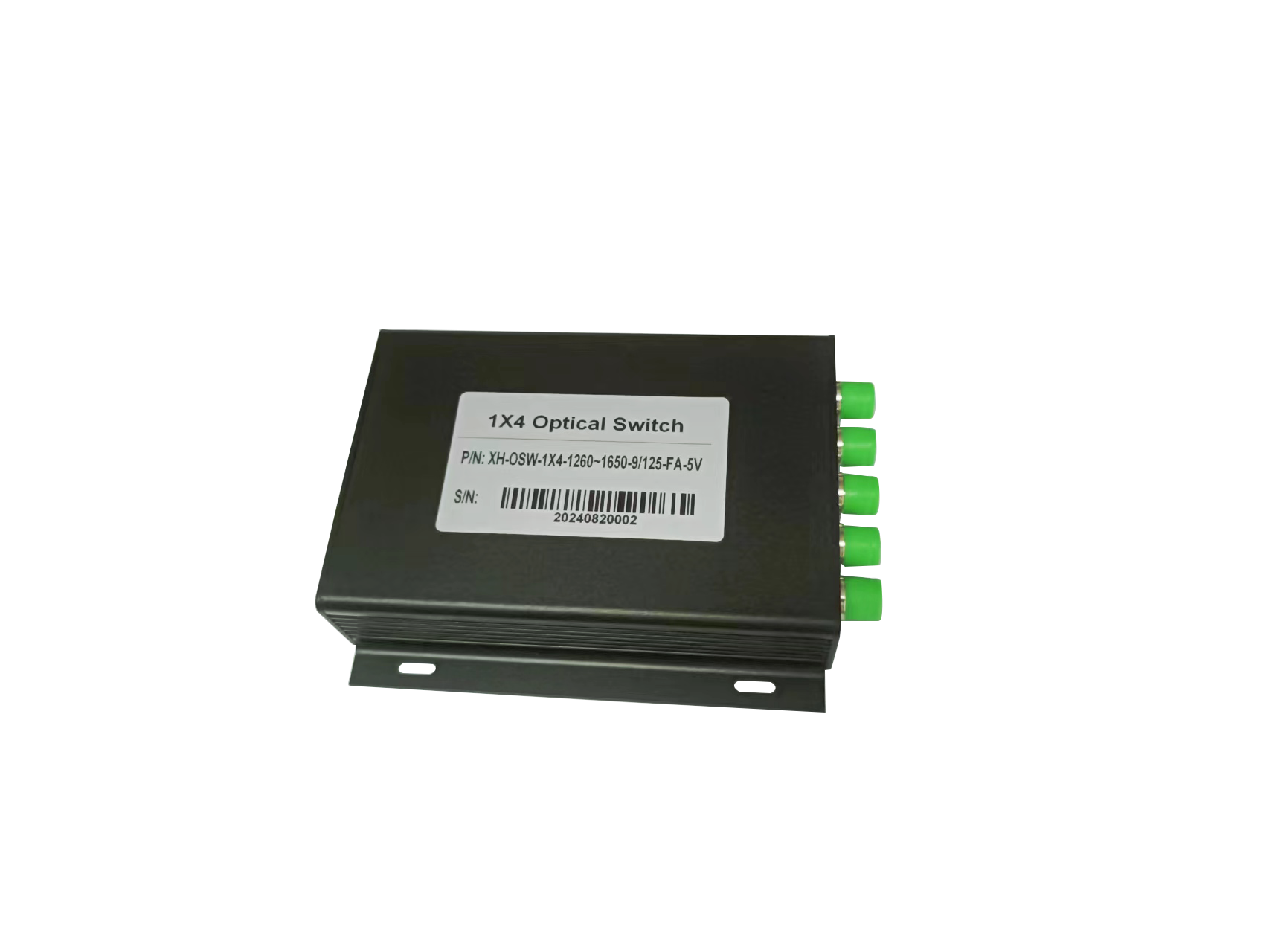
Optical Switches in Quantum Communication: Precision Optical Path Control for the Quantum Era
Introduction
Quantum communication is emerging as an important technology for secure information transmission. By using quantum mechanical principles such as quantum superposition and quantum entanglement, quantum communication systems offer new approaches to information security, particularly in quantum key distribution (QKD).
As quantum communication networks continue to develop, the demand for precise, stable, and flexible optical path management is increasing.
Optical switches play an important role in these systems by enabling controlled switching between different optical paths, supporting channel selection, optical network configuration, and automated testing.
But why are optical switches important in quantum communication, and what should engineers consider when selecting them?
1. Why Does Quantum Communication Require Precise Optical Path Control?
Unlike conventional optical communication, quantum communication systems often work with extremely weak optical signals, including single-photon-level signals.
This creates several challenges for optical system design:
- Low optical signal levels: Optical components must minimize unnecessary insertion loss to help preserve the available signal.
- High stability requirements: Optical path fluctuations and unwanted disturbances can affect system performance.
- Accurate channel selection: Different optical paths may need to be selected according to communication or experimental requirements.
- Flexible network configuration: Multi-channel quantum communication systems require adaptable optical connections.
- Reliable testing and monitoring: Optical paths need to be switched and evaluated during system development and maintenance.
In this environment, optical switches provide a practical way to manage optical connections while supporting flexible system configurations.
2. Key Applications of Optical Switches in Quantum Communication
2.1 Quantum Key Distribution (QKD) Systems
Quantum Key Distribution is one of the most important applications of quantum communication.
In QKD systems, quantum states are transmitted through optical fiber or free-space optical links to establish secure encryption keys.
Optical switches can be used to select different optical channels, connect testing paths, and configure optical transmission routes.
For example, in a multi-channel QKD test platform, an optical switch can help engineers select different fiber channels for system testing and performance evaluation.
This makes optical switching particularly useful in laboratory environments and QKD equipment development.
2.2 Quantum Communication Network Switching
As quantum communication networks expand, managing multiple optical links becomes increasingly important.
A network may include multiple communication nodes, optical fiber connections, and quantum transmission channels.
Optical switches can support:
- Selection between different optical fiber paths.
- Flexible configuration of multi-channel optical connections.
- Optical path switching between different test or communication nodes.
- Automated optical network testing.
MEMS and matrix optical switches can provide flexible multi-channel switching solutions for these applications.
However, the actual switching architecture depends on the network design and whether the system requires switching quantum signals directly or configuring classical control and test paths.
2.3 Quantum Optical Experiments and Laboratory Testing
Quantum optics laboratories frequently use complex optical setups involving lasers, photon sources, detectors, interferometers, and optical fiber connections.
During experiments, researchers may need to change optical paths or connect different measurement channels.
Optical switches can help automate these processes.
Typical applications include:
- Switching between different optical measurement paths.
- Selecting optical fiber channels for experimental comparison.
- Connecting different optical devices during testing.
- Automating repeated optical measurements.
By reducing manual fiber reconnection, optical switches can improve experimental efficiency and make laboratory configurations more flexible.
2.4 Quantum Network Testing and Development
Before quantum communication equipment is deployed, extensive testing is required.
Engineers need to evaluate optical link performance, transmission stability, channel characteristics, and system compatibility.
Multi-channel optical switches can be integrated into automated test systems to select different optical paths and support sequential testing.
For equipment manufacturers and research institutions, this provides a more efficient approach to optical system validation.
3. Which Types of Optical Switches Are Suitable for Quantum Communication?
Different optical switching technologies offer different advantages. The appropriate choice depends on the optical signal characteristics, switching architecture, and system requirements.
Mechanical Optical Switches
Mechanical optical switches use physical movement to change the optical path.
They are commonly used in optical testing equipment, laboratory platforms, and fiber optic measurement systems.
Key advantages include:
- Mature switching technology.
- Flexible channel configurations.
- Support for different fiber types.
- Suitable for automated optical testing.
Mechanical optical switches are particularly useful when switching speed is not the primary requirement and stable optical connections are important.
MEMS Optical Switches
MEMS (Micro-Electro-Mechanical Systems) optical switches use miniature mechanical structures to control optical beam paths.
Compared with conventional mechanical switching solutions, MEMS technology enables compact designs and high-density multi-channel configurations.
Key advantages include:
- Compact optical switching architecture.
- Multi-channel switching capability.
- Flexible 1×N and M×N configurations.
- Suitable for integration into advanced optical test platforms.
MEMS optical switches can be considered for quantum communication research platforms and multi-channel optical testing systems, provided their insertion loss, return loss, crosstalk, and optical power characteristics meet the system requirements.
Matrix Optical Switches
For systems requiring connections between multiple input and output channels, matrix optical switches offer a more flexible switching architecture.
They allow different input channels to be connected to designated output channels according to the system configuration.
Potential applications include:
- Multi-channel optical testing platforms.
- Quantum communication equipment development.
- Laboratory optical network configuration.
- Automated fiber connection testing.
The choice between mechanical and MEMS matrix switching depends on channel count, optical performance, control requirements, and system architecture.
4. Important Parameters When Selecting Optical Switches for Quantum Communication
Not all optical switches are suitable for quantum optical applications. Engineers should pay particular attention to the following characteristics.
1. Low Insertion Loss
Insertion loss directly affects the optical power available at the output.
For systems handling weak optical signals, minimizing the loss introduced by switching components is particularly important.
2. High Channel Isolation
Good channel isolation helps reduce unwanted optical leakage between different paths.
This is important when multiple optical channels operate within the same experimental or communication system.
3. Low Optical Crosstalk
Crosstalk can introduce unwanted optical signals into the selected channel. Engineers should evaluate the isolation performance of the complete optical path, not just the switch itself.
4. Switching Repeatability
Consistent switching performance is important for automated measurements and repeated experimental procedures.
5. Control Interface and Automation
RS232, USB, and Ethernet interfaces can simplify integration with laboratory control systems and automated test equipment.
6. Fiber Type and Wavelength Compatibility
Quantum communication systems may operate at different wavelengths and use different fiber configurations.
The optical switch must match the system’s wavelength range, single-mode or polarization-maintaining fiber requirements, and connector configuration.
Importantly, low insertion loss alone does not guarantee suitability for single-photon applications. System-level evaluation should also consider polarization-dependent loss, phase stability, back-reflection, spectral characteristics, and the effect of switching transients on quantum states.
5. How Optical Switch Manufacturers Support Quantum Communication Development
As quantum communication technology advances, optical component manufacturers are increasingly involved in supporting research and equipment development.
Optical switch manufacturers can provide customized switching solutions based on different system requirements, including:
- 1×N mechanical optical switches.
- 1×N MEMS optical switches.
- M×N matrix optical switches.
- Rack-mount optical switching systems.
- Customized fiber and connector configurations.
- RS232, USB, and Ethernet control options.
For research laboratories and equipment manufacturers, customized optical switching solutions can help simplify optical path management and improve the flexibility of testing platforms.
However, quantum applications require careful component-level verification. Standard telecom optical switch specifications should not automatically be assumed to satisfy single-photon or phase-sensitive quantum experiments.
Conclusion
Quantum communication is creating new opportunities for advanced optical technologies.
As quantum networks, QKD systems, and quantum optics laboratories continue to develop, precise optical path control will remain an important part of system design.
Optical switches provide flexible channel selection, automated optical path configuration, and efficient testing capabilities. Mechanical, MEMS, and matrix optical switches each offer different advantages for specific applications.
Selecting the right optical switch requires more than considering channel count and switching speed. Optical loss, isolation, polarization performance, phase stability, and system compatibility must also be evaluated.
Comments are closed