


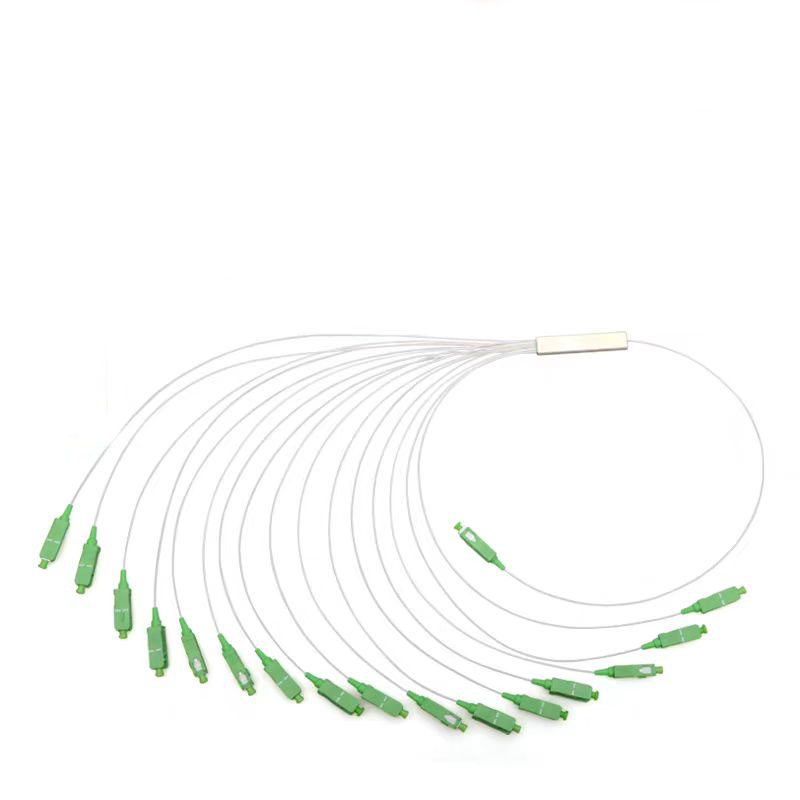
The “Universal Optical Splitter” in Fiber Optics: Understanding Optical Fiber Couplers
In modern fiber optic communication systems, a single optical signal often needs to be distributed to multiple devices or combined from multiple optical paths. The key passive component that makes this possible is the Optical Fiber Coupler.
Despite its compact size, the optical fiber coupler plays a vital role in optical communications, fiber sensing, fiber lasers, CATV, FTTx networks, and optical testing. For this reason, it is often regarded as the “universal splitter” of fiber optic systems.
What Is an Optical Fiber Coupler?
An Optical Fiber Coupler is a passive optical device that splits an incoming optical signal into two or more output ports according to a predefined coupling ratio, or combines multiple optical signals into a single output.
Because it requires no electrical power, an optical fiber coupler offers several key advantages:
- Low insertion loss
- High reliability
- Maintenance-free operation
- Long service life
- Immunity to electromagnetic interference (EMI)
These characteristics make it an indispensable component in long-term, high-reliability optical networks.
How Does an Optical Fiber Coupler Work?
Optical fiber couplers are typically manufactured using one of two technologies:
- FBT (Fused Biconical Taper) Technology
- PLC (Planar Lightwave Circuit) Technology
For example, a 1×2 optical coupler has:
- One input port
- Two output ports
The input optical power can be divided according to various coupling ratios, including:
- 50:50
- 60:40
- 70:30
- 80:20
- 90:10
- 95:5
- 99:1
Different coupling ratios are optimized for different applications.
50:50
Ideal for optical interferometers, laboratory experiments, and fiber optic sensing systems.
90:10
90% of the optical power continues through the main transmission path, while 10% is used for online monitoring.
99:1
Only 1% of the optical power is tapped for monitoring, minimizing the impact on the primary communication link.
Common Types of Optical Fiber Couplers
1×2 Optical Fiber Coupler
The most widely used configuration.
Typical applications include:
- Optical power splitting
- Network monitoring
- Fiber optic sensing
- Optical laboratory testing
2×2 Optical Fiber Coupler
A 2×2 coupler can function as both a splitter and a combiner.
It is widely used in:
- Fiber optic interferometers
- Fiber optic gyroscopes
- Coherent optical communication
- Optical measurement systems
1×N Optical Fiber Coupler
Common configurations include:
- 1×4
- 1×8
- 1×16
- 1×32
- 1×64
These devices are widely deployed in:
- PON (Passive Optical Networks)
- FTTH (Fiber to the Home)
- Fiber monitoring systems
- CATV signal distribution
FBT vs. PLC Splitters: What’s the Difference?
| Feature | FBT Coupler | PLC Splitter |
|---|---|---|
| Manufacturing Technology | Fused Biconical Taper | Planar Lightwave Circuit |
| Splitting Ratio | Flexible and customizable | Typically equal splitting |
| Operating Wavelength | Optimized for specific wavelengths | Wide operating wavelength range |
| Insertion Loss | Lower in many customized designs | Slightly higher but highly consistent |
| Output Uniformity | Good | Excellent |
| Cost | Lower | Slightly higher |
| Typical Applications | Fiber lasers, sensing, laboratory systems | FTTH, PON, telecom networks |
If your application requires uneven splitting ratios such as 95:5 or 99:1, FBT couplers are generally the preferred choice. For large-scale, equal-ratio optical distribution, PLC splitters offer superior uniformity and scalability.
How to Choose the Right Optical Fiber Coupler
When selecting an optical fiber coupler, consider the following specifications:
- Operating wavelength: 850 nm, 980 nm, 1064 nm, 1310 nm, 1550 nm, etc.
- Fiber type: Single-mode (SM), Multimode (MM), or Polarization Maintaining (PM)
- Coupling ratio: 50:50, 90:10, 99:1, and more
- Insertion Loss (IL): Lower values improve system performance.
- Polarization Dependent Loss (PDL): Critical for precision optical systems.
- Return Loss (RL): Higher return loss enhances signal quality and system stability.
- Package type: Bare fiber, stainless steel tube, ABS module, rack-mount, etc.
- Operating temperature: Choose industrial-grade or telecom-grade specifications based on your environment.
Typical Applications of Optical Fiber Couplers
With the rapid development of fiber optic technologies, optical fiber couplers are widely used in a variety of industries:
- FTTH and PON networks for distributing one optical signal to multiple subscribers.
- Fiber optic sensing systems for signal distribution and acquisition.
- Fiber lasers for power monitoring, beam splitting, and feedback control.
- CATV networks for optical signal distribution.
- Online OTDR monitoring by tapping a small portion of the optical signal without interrupting live traffic.
- Research laboratories for interferometry, optical experiments, and precision measurement.
Why Choose a High-Quality Optical Fiber Coupler?
A premium optical fiber coupler not only minimizes signal loss but also improves the overall stability and reliability of optical systems. In high-speed communications, precision sensing, and industrial applications, component quality directly impacts network performance.
A professional manufacturer can typically provide:
- Custom coupling ratios
- Single-mode, multimode, and PM fiber options
- Narrowband and broadband wavelength solutions
- Low insertion loss, low PDL, and high stability
- Multiple package styles and connector options for customized applications
Conclusion
Although an optical fiber coupler is a relatively small passive component, it performs the essential tasks of optical signal splitting, combining, and monitoring. From telecommunications and fiber lasers to scientific research and industrial automation, it remains a fundamental building block of modern fiber optic systems.
As data centers, AI computing, fiber sensing, and next-generation optical networks continue to evolve, the demand for low-loss, highly stable, and precision-engineered optical fiber couplers will continue to grow. Choosing a reliable, high-performance optical fiber coupler is an investment in the long-term efficiency, stability, and scalability of your optical network.
Comments are closed